
Overview
Methodology
At Ateneo de Manila University, sustainability is strengthened through a culture of accountability, collaboration, and continuous innovation. The University integrates sustainability into its institutional structures, decision-making processes, and strategic priorities, ensuring that environmental and social responsibility remain central to its mission and operations.
Guided by principles of transparency and good governance, Ateneo fosters engagement among students, faculty, staff, and partners in advancing sustainability goals across the institution. The University also embraces digital transformation to improve efficiency, accessibility, and data-driven decision-making, enabling more effective implementation and monitoring of sustainability initiatives.
Through open communication, responsible stewardship, and a commitment to institutional excellence, Ateneo continues to build a resilient and future-ready community that contributes meaningfully to sustainable development locally and globally.
| Highlights: |
|---|
| 1.) Sustainability Report View more ▼ |
|
Sustainability Reporting and Stakeholder Engagement for Integral Ecology (Coalescence Feature)
Grounded in Ignatian spirituality and inspired by Pope Francis' Laudato Si', Ateneo continues its journey toward becoming a Laudato Si' University, recognizing that care for the environment is inseparable from care for people and communities. This vision of integral ecology guides the Ateneo De Manila University’s Impact On Sustainable Development Goals  The University promotes a whole-of-society approach to sustainability guided by the theme “Multifaceted and multistakeholder for multiplier effect,” emphasizing collaboration, dialogue, and community engagement in advancing integral ecology. These efforts are featured in Coalescence, the AIS School Year-End Magazine, which highlights sustainability-related initiatives and community involvement across the academic year. Environmental, social, and economic impacts are formally documented through the Ateneo Sustainability Reports (ASR), aligned with Global Reporting Initiative (GRI) Standards. Published every three academic years, the ASR has been released in 2014, 2017, 2020, and 2025, with each cycle building on previous data and insights. The reports are developed through coordinated data collection across various administrative offices involved in implementing campus sustainability programs. 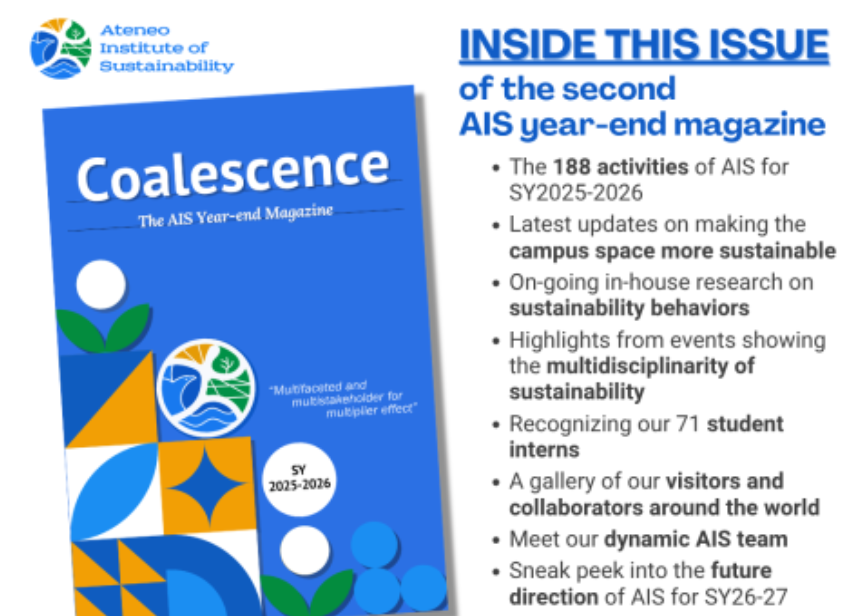 ↑ Return to Top |
| 2.) Unit(s) or Office(s) that Coordinate Sustainability on Campus View more ▼ |
|
Institutional Structure for Sustainability Governance at the University (Collective Reimagination Model)
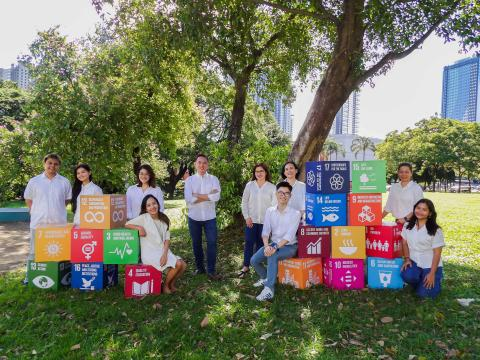 The primary hub for sustainability at the University is the Ateneo Institute of Sustainability (AIS), established in 2013, which serves as the central coordinating body for the institution’s environment-development agenda. Operating under a “collective reimagination” model, sustainability is integrated across multiple administrative, academic, and grassroots units rather than being centralized in a single office. AIS leads the Sustainable University Master Plan (up to 2050) through key programs on organizational sustainability, climate and disaster resilience, and the Sustainable Development Goals (SDGs), under the leadership of the Director reporting to the Vice President for Mission Integration. Operational implementation is supported by units such as the Central Facilities Management Office (CFMO), Campus Safety and Mobility Office (CSMO), Office of the Vice President for Administration, and the Strategy and Quality Management Office, which oversee infrastructure efficiency, mobility, resource management, and institutional quality systems. Research and academic support is provided by units including the Ateneo Biodiversity Research Laboratory, Department of Environmental Science, and Ateneo Center for Social Entrepreneurship (ACSEnt), which contribute technical expertise and applied sustainability frameworks. Sustainability is further integrated through mission-oriented offices such as the Office of the Vice President for Mission Integration and student-led initiatives like the Sanggunian Environmental Analysis Team, ensuring that sustainability is embedded in both institutional strategy and grassroots engagement guided by integral ecology and the principles of Laudato Si’. ↑ Return to Top |
