13.3.2 Climate Action Plan, Shared
21 Jan 2025


Institutional Climate Action and Local Government-Community Outreach of Ateneo
Ateneo de Manila University actively collaborates with local government units, non-governmental organizations, national agencies, and local community stakeholders to advance local and regional climate action, disaster resilience, and environmental health governance. Institutional efforts focus on capacity building for local government administration, community-focused climate risk education, public health integration, and simulation-driven policy training.
Through specialized administrative programs, the university delivers technical training to assist local government units in implementing climate resilience plans funded by national mechanisms such as the People’s Survival Fund. University research and academic centers actively engage public health officials, community leaders, and local organizations to address climate-induced health vulnerabilities, extreme weather impacts, and environmental health policy integration. Furthermore, interactive climate negotiation workshops bring together university members and external partners to model global and local emission reduction strategies aligned with the Paris Agreement targets. These multi-sectoral initiatives document a structured body of activity dedicated to developing, sharing, and operationalizing climate action frameworks with local communities and local government partners.
Race to Zero: Bending the Curve Climate Negotiation Workshop
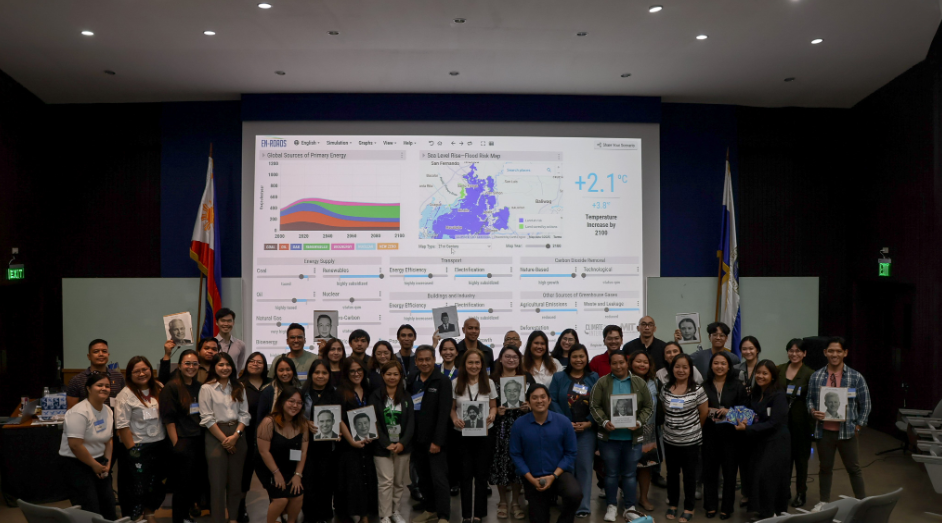
On 8 April 2025, the Ateneo Institute of Sustainability (AIS), in collaboration with Make a Difference (MAD) Travel, conducted the second iteration of the "Race to Zero: Bending the Curve" climate negotiation workshop. The interactive session utilized the En-ROADS Climate Change simulator, developed by Climate Interactive and the MIT Sloan Sustainability Initiative, alongside specialized "action cards" created by the My Climate Risk – Ateneo de Manila University (MCR-Ateneo) Regional Hub to simulate real-world climate negotiation disruptions.
Participants included members of the Ateneo community and external partner organizations. The workshop structured participants into nine negotiation blocs reflecting stakeholders in the United Nations Climate Change Conference of the Parties (COP) framework. Key presentations included a global climate context and Intergovernmental Panel on Climate Change (IPCC) AR6 warming scenario briefing by Mr. Daniel C. Ratilla, Program Head for Climate and Disaster Resilience at AIS, and a localized analysis of climate impacts in the Philippines presented by Mr. Rafael Dionisio, co-founder of MAD Travel. Participants engaged in three rounds of policy negotiations aimed at formulating action strategies to limit global warming to well below 2°C relative to pre-industrial levels.
The collaborative delivery of this simulation workshop establishes institutional engagement in capacity building and policy contextualization alongside external partners. By combining global emission modeling with localized climate risk assessments, the initiative provides a structured platform for university and community stakeholders to examine policy leverage points, simulate multi-sectoral negotiations, and evaluate local action strategies necessary to meet Paris Agreement climate objectives.
World Environmental Health Day Climate and Health Webinar
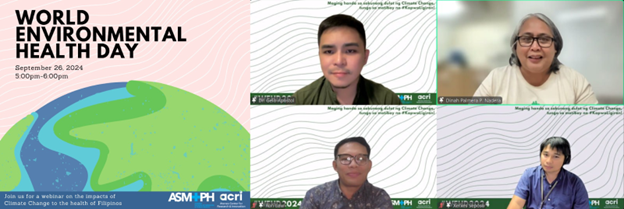
In Feb 2025, the Environmental Health and Global Health Security Flagship Program of the Ateneo School of Medicine and Public Health Center for Research and Innovation (ACRI) hosted a public educational webinar focusing on climate change and public health. The event convened experts, government representatives, and community members to discuss strategies for building resilient communities against extreme weather events.
Academic research presented by Dr. Xerxes Seposo highlighted the correlation between rising temperatures driven by climate change and increased dengue incidence nationwide. Dr. Dinah Palmera P. Nadera shared research findings regarding the psychological impacts of climate-induced events, such as drought in Mindanao introducing concepts of ecological grief and community stress. Dr. Ronald Law from the Department of Health (DOH) presented national policies aimed at creating sustainable, climate-resilient health facilities.
Additionally, ACRI’s broader environmental health program led the formulation of the National Environmental Health Action Plan 2030 (NEHAP) in partnership with the World Health Organization and the Philippine Inter-Agency Committee on Environmental Health (IACEH), and facilitated community chemical safety seminars with organizations across Cavite, Tondo, Malabon, and Caloocan.
The research dissemination and public programming led by ACRI document active alignment between university health researchers, national health agencies, and local community groups. Translating empirical climate data into policy-relevant recommendations and community awareness activities directly supports local health governance, disaster preparedness, and institutional adaptation planning.
Borongan City LGU Project Management Training for Climate Resilience
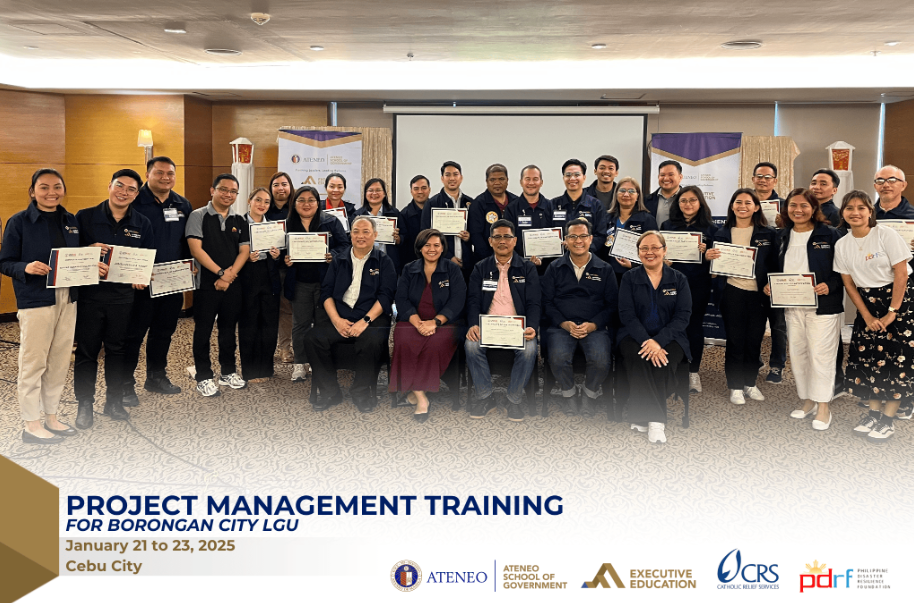
From 21 to 23 January 2025, the Ateneo School of Government (ASoG) Executive Education Program, in partnership with the Philippine Disaster Resilience Foundation (PDRF) and Catholic Relief Services (CRS), conducted a customized Project Management Training course for the local government unit (LGU) of Borongan City.
The program was specifically designed to build the administrative and technical capacity of Borongan City officials including Mayor Jose Ivan Dayan C. Agda, department heads, and municipal staff to manage local projects funded through the national People's Survival Fund (PSF). Facilitated by ASoG Executive Education Program Head Sharon Grace S. Yabut and certified PRINCE2 trainer Noel M. Macalalad trained LGU officials on structured project management, resource allocation, risk mitigation, and stakeholder engagement targeted at long-term climate adaptation and community resilience.
The direct delivery of technical training to local government leadership establishes operational collaboration between the university and local government units. By equipping municipal officers with standardized project execution frameworks for People's Survival Fund projects, the university directly contributes to the implementation, monitoring, and governance of local climate resilience plans.
Sources:
1. AIS and MAD Travel host second iteration of immersive climate negotiation workshop
2. Climate Change and Filipino Health: ASMPH explores insights on World Environmental Health Day
3. Executive Education Program delivers customized project management course for Borongan City LGU - Philippine Disaster Resilience Foundation
Recent News
You may also like these articles

Growing with purpose: How Mekeni Food Corporation turns adversity into shared value
From a small backyard operation in Porac, Pampanga, to an internationally recognized food brand exporting to 25 countries, Mekeni Food Corporation's journey demonstrates how businesses

Three Ateneo-incubated startups secure DOST-PCIEERD’s startup grant fund
Last 9 November, during the opening day of Philippine Startup Week 2026, Soolok Properties Inc, Pili AdheSeal Inc, and Saltric Power (PDG Engineering Services), three
Ateneo de Manila Grade 2 students are the little Earth helpers
It was a great day for saving the world when Ateneo Institute of Sustainability (AIS) came to Ateneo Grade School to give a session on
JGSOM representatives complete green finance training in Poland, sets sights on 2027 micro-credential launch
Representatives of Ateneo de Manila University's John Gokongwei School of Management (JGSOM) completed the second phase of their Erasmus+ Green Finance international mobility activities at
JGSOM Representatives Participate in Green Finance Training at the University of Twente
Enschede, Netherlands | October 15–16, 2026 Representatives of Ateneo de Manila University's John Gokongwei School of Management (JGSOM) participated in a specialized Green Finance training

Professor Emeritus Dr Emma Porio highlights climate resilience and biodiversity at international conferences
Emma E Porio, PhD, Professor Emeritus of Ateneo de Manila University and Principal Investigator of Ateneo's Manila Observatory Center for Climate Resilience and Public Health