Growing with purpose: How Mekeni Food Corporation turns adversity into shared value
20 Nov 2026





From a small backyard operation in Porac, Pampanga, to an internationally recognized food brand exporting to 25 countries, Mekeni Food Corporation's journey demonstrates how businesses can grow while remaining deeply rooted in their communities.
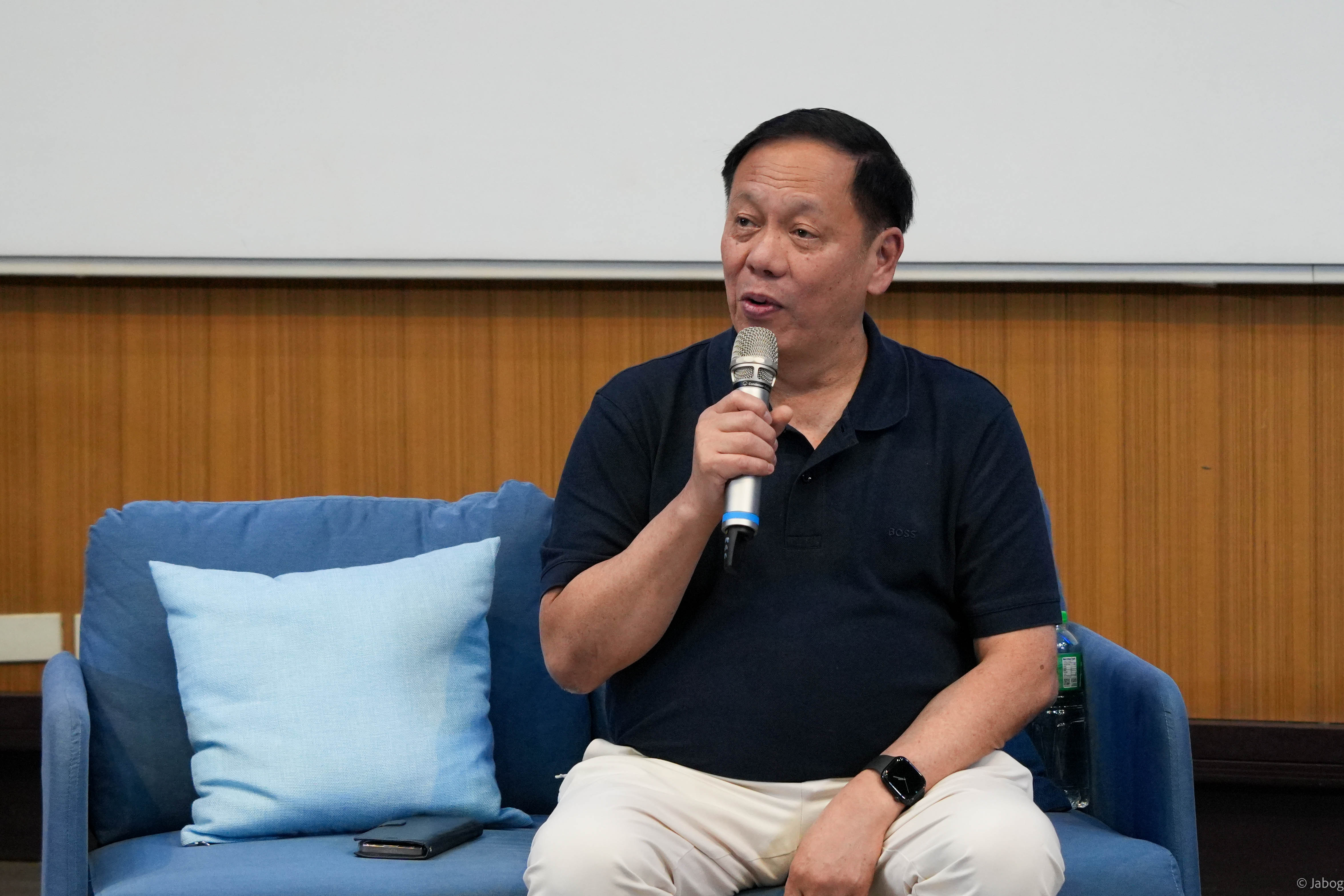
What does it take for a business to remain resilient through decades of crises while staying true to its purpose? For Prudencio "Pruds" Garcia, President of Mekeni Food Corporation, the answer lies in remembering why the business began and recognizing the people who make its success possible.
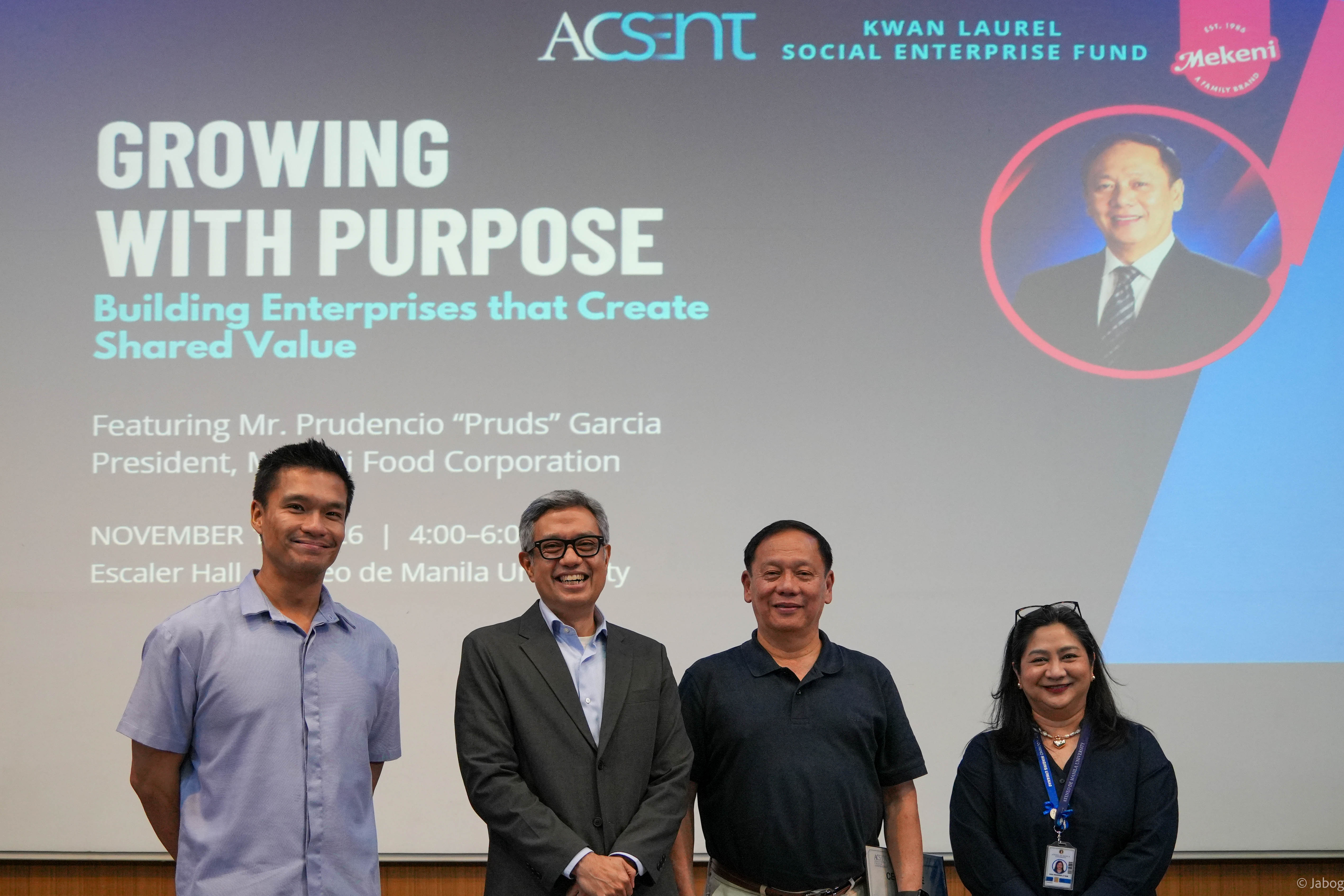
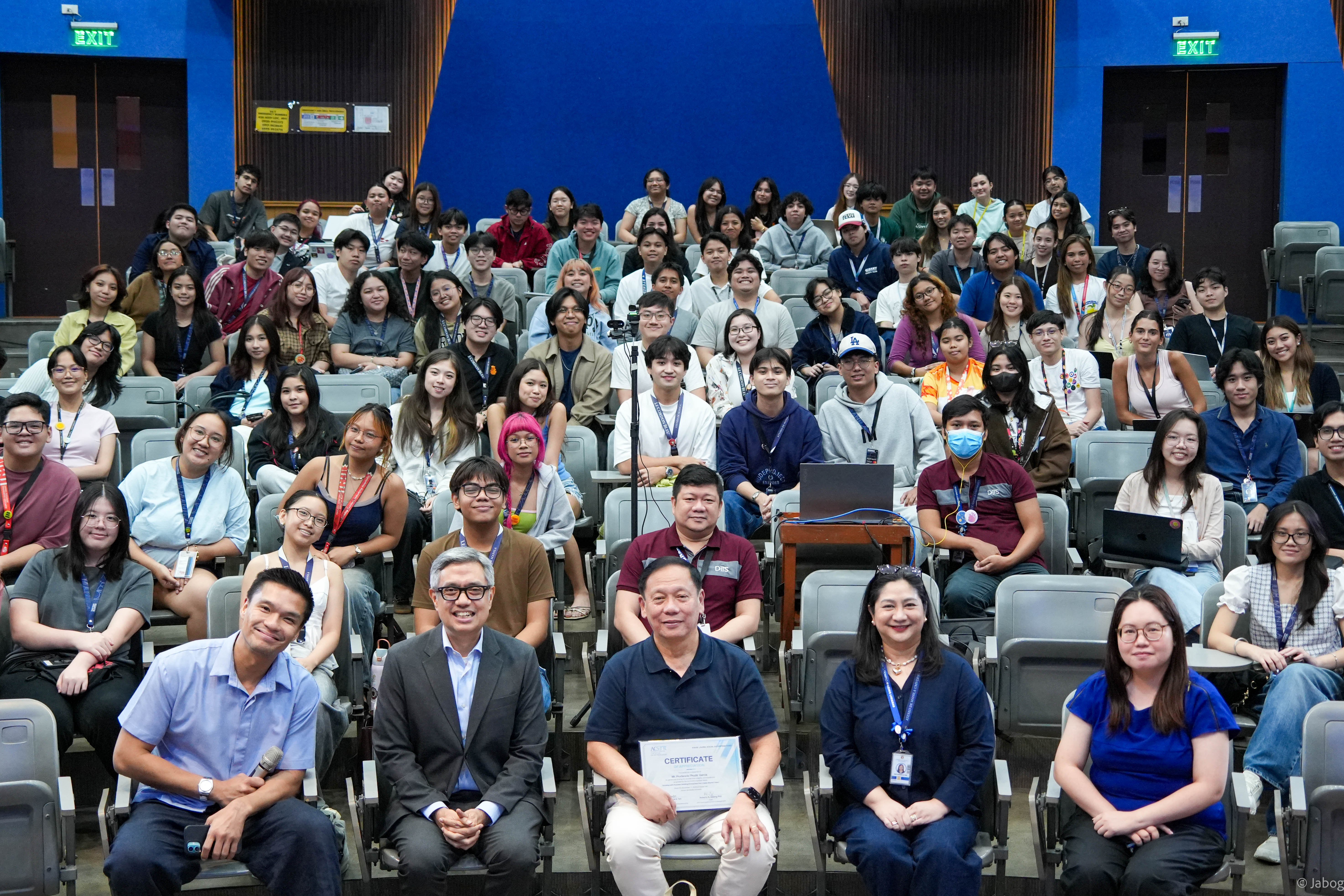
Garcia shared this perspective during the 3rd Ateneo Center for Social Entrepreneurship (ACSEnt) Speaker Series, held on 11 November 2026, at Escaler Hall, Ateneo de Manila University. Supported by the Kwan Laurel Social Enterprise Fund, the event carried the theme "Growing with Purpose: Building Enterprises that Create Shared Value." The fireside chat was moderated by ACSEnt Director Ana Marina Tan and Assistant Director Arkel Mendoza.
Through stories spanning four decades, Garcia reflected on how resilience, malasakit (compassionate care), and bayanihan (collective action) have shaped Mekeni's growth and its commitment to creating opportunities for the communities it serves.

Rooted in Malasakit: Returning to Rebuild
Founded in 1986 by public school teachers Felix and Medicia Garcia as a retirement livelihood, Mekeni began as a modest family operation in Porac, Pampanga. Starting with the production of tocino and chicharon, the business initially sold its products to neighbors and members of the local community.
Everything changed when Mount Pinatubo erupted in 1991, devastating parts of Pampanga with lahar and displacing thousands of residents. At the time, Pruds Garcia and his brothers were building their careers abroad. However, a letter from their father, Tatang Felix, would eventually bring them home.
He reminded his sons that their education and opportunities had been made possible, in part, by the very community members who had supported their family's small business as its first customers.
In 1993, the brothers returned to the Philippines to help rebuild Mekeni. Their decision went beyond continuing a family enterprise. They saw the business as an opportunity to provide employment and help their hometown recover. Many of the people they employed had not even completed high school.
Their father's guiding principle was simple: "Help ordinary people perform extraordinarily." This became central to Mekeni's approach to business and its commitment to creating opportunities for others.
Resilience Through Adversity
Mekeni's four-decade journey has not been without challenges. The company weathered the 1995 Foot-and-Mouth Disease outbreak, the 1997 Asian Financial Crisis, the 2019 African Swine Fever (ASF) scare, and the COVID-19 pandemic.
For Garcia, navigating these difficult periods required leaders to remain anchored in their purpose. He shared one of his guiding reminders: "Remember your 'why,' and forget your 'ex' your excuses."
One defining test came in 2019, when rumors incorrectly linked Mekeni's products to the African Swine Fever outbreak. Despite laboratory tests that subsequently cleared the company, Garcia made the difficult decision to voluntarily recall and destroy more than PHP 100 million worth of finished products.
He described the decision as "the price of integrity." It was a costly move, but one that reflected the company's commitment to protecting consumer trust. Mekeni eventually regained consumer confidence within two weeks.
The COVID-19 pandemic brought another deeply personal and operational challenge. After losing two family members, Garcia admitted that he came close to selling the company. But with more than 1,600 employees depending on Mekeni for their livelihoods, he chose to continue. He committed another decade of service to the enterprise, recognizing that its future was tied to the lives and well-being of the people who depended on it.
Bayanihan: Rising by Lifting Others
Perhaps one of the most compelling aspects of Mekeni's story is how its employees and communities have become partners in overcoming adversity.
During the 1997 Asian Financial Crisis, Garcia initially considered downsizing to reduce operating costs. His employees, however, refused to let anyone lose their jobs. Instead, they voluntarily agreed to a three-day workweek so that everyone could retain a source of income.
This spirit of bayanihan gave rise to the company's enduring battle cry: "Walang iwanan" (No one gets left behind).
The same commitment to shared survival and opportunity was evident during the pandemic. When lockdowns disrupted livelihoods, Mekeni pivoted to producing familiar Filipino street food staples such as fishballs and kikiam. This enabled displaced workers and neighborhood resellers to earn income within their own communities.
What began as an adaptive response to the crisis eventually opened new opportunities, including international markets for these products and the eventual manufacturing of Mekeni's flagship meat products in the United States.
Mekeni's commitment to community also extends beyond its business operations. During severe flooding in Pampanga, the company mobilized overnight to prepare 20,000 ready-to-eat meals, working with local businessmen and volunteers to bring food directly to families stranded by the floods.
These experiences illustrate how businesses can contribute to community resilience not only by providing jobs and livelihoods, but also by mobilizing resources and working with others when communities need support most.
A Legacy Defined by Purpose
In his closing message to the Ateneo students, Garcia challenged aspiring entrepreneurs and future business leaders to look beyond profit margins and personal comfort. He emphasized that building a successful enterprise also means being accountable for the lives it touches and the opportunities it creates.
Drawing inspiration from his own name, he shared five principles that have guided his leadership: Purpose, Resilience, Uplifting
Others, Discipline, and Servant Leadership.
In his closing remarks, John Gokongwei School of Management Dean Roberto Martin Galang highlighted how Mekeni's experience demonstrates the value of placing communities at the heart of business.
Mekeni's story offers an important lesson for aspiring entrepreneurs and established businesses alike: growth and social impact need not be competing priorities. When enterprises recognize their responsibility to employees, customers, and communities, they can create value that extends well beyond the products they sell and the profits they earn.
Ultimately, growing with purpose means building an enterprise that succeeds not only because of the people behind it, but also because of the people it serves.
About the ACSEnt Speaker Series
The ACSEnt Speaker Series brings together business leaders and practitioners who share their experiences and insights on building enterprises that create meaningful social impact. Through these conversations, the Ateneo Center for Social Entrepreneurship hopes to inspire students, aspiring entrepreneurs, and the wider business community to pursue more inclusive and purpose-driven approaches to enterprise development.
To learn more about ACSEnt's programs and initiatives, visit ACSEnt's website or email acsent.jgsom@ateneo.edu.
Recent News
You may also like these articles

Three Ateneo-incubated startups secure DOST-PCIEERD’s startup grant fund
Last 9 November, during the opening day of Philippine Startup Week 2026, Soolok Properties Inc, Pili AdheSeal Inc, and Saltric Power (PDG Engineering Services), three

Ateneo de Manila Grade 2 students are the little Earth helpers
It was a great day for saving the world when Ateneo Institute of Sustainability (AIS) came to Ateneo Grade School to give a session on
JGSOM representatives complete green finance training in Poland, sets sights on 2027 micro-credential launch
Representatives of Ateneo de Manila University's John Gokongwei School of Management (JGSOM) completed the second phase of their Erasmus+ Green Finance international mobility activities at
JGSOM Representatives Participate in Green Finance Training at the University of Twente
Enschede, Netherlands | October 15–16, 2026 Representatives of Ateneo de Manila University's John Gokongwei School of Management (JGSOM) participated in a specialized Green Finance training
Professor Emeritus Dr Emma Porio highlights climate resilience and biodiversity at international conferences
Emma E Porio, PhD, Professor Emeritus of Ateneo de Manila University and Principal Investigator of Ateneo's Manila Observatory Center for Climate Resilience and Public Health
Professor Emeritus Dr Emma Porio highlights intersectional resilience pathways for climate-ready coastal cities at Iloilo scientific forum
As climate change continues to intensify the risks faced by coastal communities, scientists, policymakers, local government leaders, and resilience practitioners gathered in Iloilo City to