Advancing Gender Equity in Admissions and Enrollment
01 May 2025


Advancing Gender Equity in Admissions and Enrollment
Ateneo de Manila University systematically measures and tracks women’s application, admission, and enrollment rates to monitor access, diversity, and equity across school years. According to institutional data, female application rates have shown significant involvement, comprising 40.83% of total applicants in SY 2021–22, 60.35% in SY 2022–23, 40.79% in SY 2023–24, and rising to 58.68% in SY 2024–25. In terms of actual student intake, female enrollment has consistently represented over half of the total incoming population across recent years. Specifically, female students accounted for 60.48% of enrolled students in SY 2021–22, 61.41% in SY 2022–23, 52.49% in SY 2023–24, and 51.69% in SY 2024–25. This ongoing tracking demonstrates a sustained institutional commitment to evaluating gender parity and ensuring equitable higher education opportunities for women.
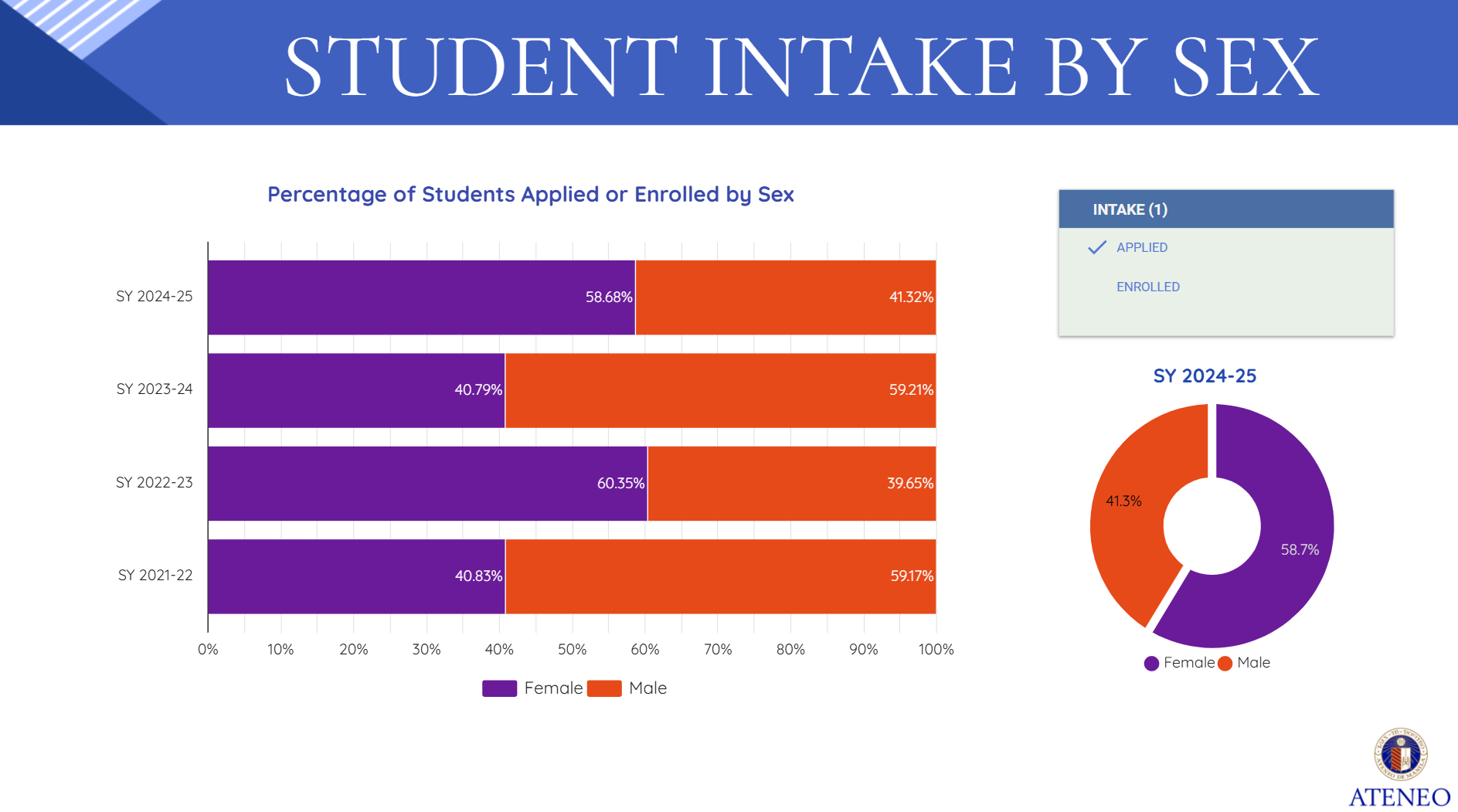
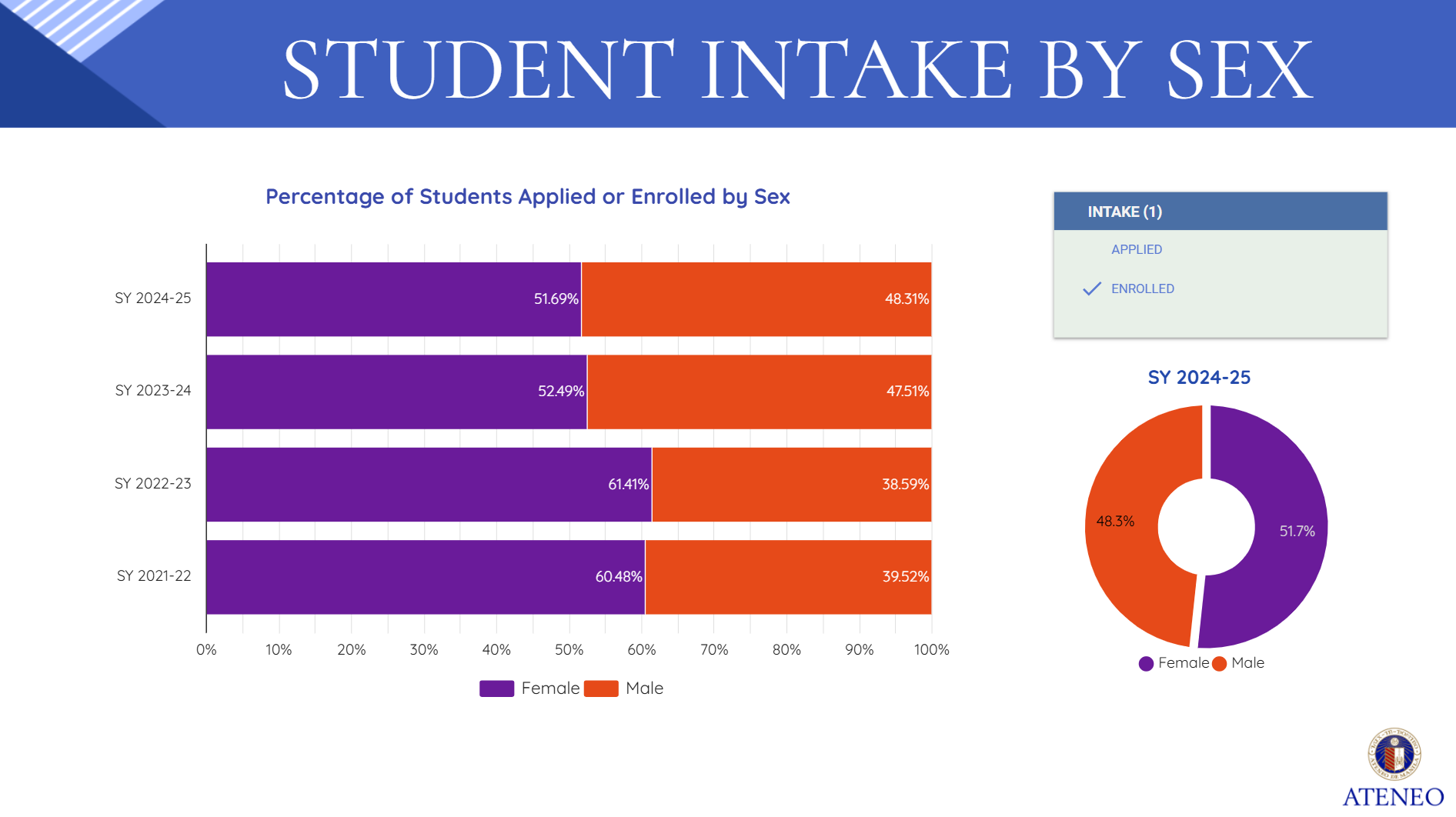
Ateneo de Manila University systematically monitors women's access to and acceptance into the University through enrollment data. These data are disaggregated by year of entry and by the school to which applicants applied and were ultimately admitted, allowing the University to examine patterns of access and representation across its academic units over time.
As reflected in the graphs above, women have consistently comprised a proportion of the student population that is comparable to or higher than that of men across the University's various schools in recent years. This indicates that women continue to have substantial representation among those who enter and enroll at Ateneo, with their participation remaining consistently strong across different academic units.
Notably, beginning SY 2024-2025 up to the present, the School of Humanities, John Gokongwei School of Management, and the Dr. Rosita G. Leong School of Social Sciences have increased percentages both in women’s application and enrollment. Meanwhile, there had been more women applicants to the School of Science and Engineering for SY 2024-2025 up to SY 2025-2026.
Monitoring enrollment data in this manner enables the University to track trends in gender representation and assess whether women and men have equitable access to its educational opportunities. The disaggregation of data by year of entry and school also allows for a more nuanced understanding of how representation may vary across programs and over time.
Recent News
You may also like these articles

Growing with purpose: How Mekeni Food Corporation turns adversity into shared value
From a small backyard operation in Porac, Pampanga, to an internationally recognized food brand exporting to 25 countries, Mekeni Food Corporation's journey demonstrates how businesses

Three Ateneo-incubated startups secure DOST-PCIEERD’s startup grant fund
Last 9 November, during the opening day of Philippine Startup Week 2026, Soolok Properties Inc, Pili AdheSeal Inc, and Saltric Power (PDG Engineering Services), three

Ateneo de Manila Grade 2 students are the little Earth helpers
It was a great day for saving the world when Ateneo Institute of Sustainability (AIS) came to Ateneo Grade School to give a session on
JGSOM representatives complete green finance training in Poland, sets sights on 2027 micro-credential launch
Representatives of Ateneo de Manila University's John Gokongwei School of Management (JGSOM) completed the second phase of their Erasmus+ Green Finance international mobility activities at

JGSOM Representatives Participate in Green Finance Training at the University of Twente
Enschede, Netherlands | October 15–16, 2026 Representatives of Ateneo de Manila University's John Gokongwei School of Management (JGSOM) participated in a specialized Green Finance training

Professor Emeritus Dr Emma Porio highlights climate resilience and biodiversity at international conferences
Emma E Porio, PhD, Professor Emeritus of Ateneo de Manila University and Principal Investigator of Ateneo's Manila Observatory Center for Climate Resilience and Public Health