10.6.7 Accessible facilities
01 May 2025


Ateneo’s Institutional Commitment to Disability Access and Infrastructure: Enhancing Accessibility and Student Support Services at
Ateneo de Manila University maintains a multi-faceted institutional commitment to ensuring universal physical access, reasonable accommodation, and inclusive academic facilities for persons with disabilities (PWDs). Grounded in Republic Act No. 10754 (Magna Carta for Disabled Persons), the UN Convention on the Rights of Persons with Disabilities, and the university’s internal Sustainability Policies and Specific Guidelines, Ateneo implements an end-to-end framework spanning physical campus retrofitting, operational mobility support, and specialized academic accommodations. Guided by the Ignatian principle of cura personalis (care for the whole person), the university integrates infrastructure investments with administrative support mechanisms to eliminate physical and social barriers across all learning environments.
Infrastructure Accessibility and Physical Barrier Elimination (Scope & Reach Dimension)
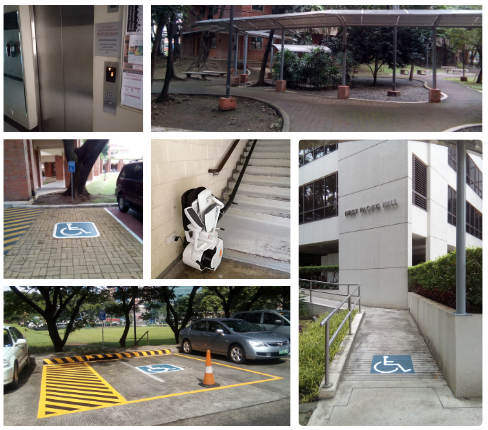
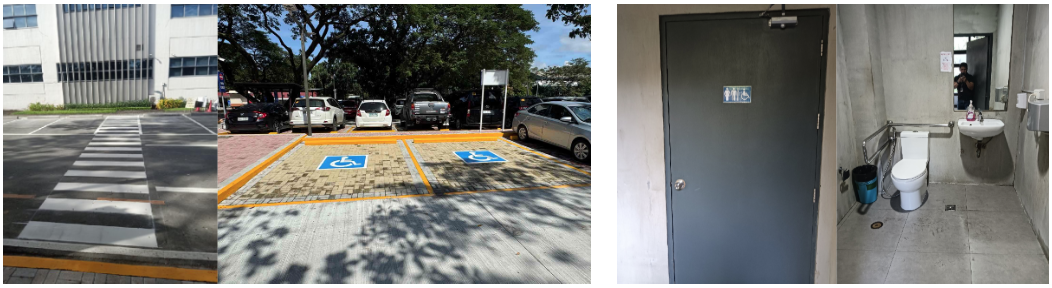
To ensure barrier-free mobility throughout its main campus and satellite units, Ateneo de Manila University continuously expands its physical infrastructure to support wheelchair users, individuals with visual impairments, and persons with mobility constraints. Built environment initiatives include the continuous installation and routine maintenance of ramps with protective handrails across high-density facilities, including the Science Education Complex (SEC), the Blue Eagle Gym, Bellarmine Hall, Social Sciences Building (Leong Hall), Faura Hall, John Gokongwei Student Enterprise Center (JSEC), Mateo Ricci Hall, CTC Building, and Gonzaga–Schmitt Hall. Universal physical access is further reinforced by designated covered walkways connecting academic blocks, specialized tactile guide strips along key pedestrian pathways, dedicated PWD parking slots situated at the North Carpark, Xavier Hall, Gonzaga, and Bellarmine Hall, as well as level-entry floor layouts. For vertical mobility, multi-story structures such as the Senior High School (SHS), International Residence Hall (IRH), Ateneo Professional Schools (APS) Rockwell campus, and the First Pacific Hall at Rizal Library are equipped with elevators containing Braille buttons and hands-free control systems. In historic or architectural structures where elevator installation is structurally unfeasible, mechanical stairlifts (e.g., within the Social Sciences Building and Bellarmine Hall) are systematically operated and maintained to ensure total vertical accessibility. All facilities-based physical accommodations are fully funded through internal capital budget allocations and accessible to all campus constituents and guests free of charge.
Operational Student Accommodation and Specialized Administrative Support (Policy Cycle & Execution Dimension)
Under the leadership of the Office of the Associate Dean for Student Affairs (OADSA) specifically through its Student Concerns and Compliance section the university executes formal accommodation protocols to address the individualized needs of students with physical disabilities, chronic medical conditions, and neuro-developmental conditions. Operating under established policy guidelines updated as of April 8, 2024, the OADSA manages key operational services, including the relocation of scheduled lectures to ground-floor classrooms for mobility-impaired students, the issuance of special campus PWD vehicle parking passes, and authorization for personal companion/chaperone access. Furthermore, the Campus Facilities and Management Office (CFMO), in coordination with the Office of Health Services (OHS) and the Office of Guidance and Counseling (OGC), performs continuous oversight and preventive maintenance of specialized accessibility hardware, including motorized stairlifts and dedicated PWD rest facilities equipped with grab bars and emergency assistance mechanisms. These administrative processes guarantee prompt, non-discriminatory service delivery without imposing additional administrative or financial burdens on students.
Academic Equity, Admission Testing Accommodations, and Financial Accessibility (Cost & Inclusion Dimension)
Ateneo de Manila University enforces non-discriminatory admission standards while providing tailored financial and institutional support mechanisms for disabled applicants and enrolled scholars. In alignment with national legal frameworks and official university testing guidelines, the university offers individualized testing accommodations during entrance examinations, such as extra test duration, accessible exam venues, and modified test formats for applicants with special needs. Post-admission, the university extends financial accessibility measures, including a dedicated Tuition (20%) Scholarship for Persons with Disabilities, supported by quota allocations across various academic schools, alongside external partner initiatives such as the AUN-DPPnet Postgraduate Scholarship for regional policy studies. Additionally, students benefit from specialized mental health, counseling, and psychological intervention services provided by the OGC and the Ateneo Bulatao Center for Psychology Services. All structural, administrative, and testing accessibility measures are integrated into the university's open-access institutional policy, ensuring that physical facilities and learning environments remain fully inclusive and universally accessible.
Source:
Recent News
You may also like these articles

Growing with purpose: How Mekeni Food Corporation turns adversity into shared value
From a small backyard operation in Porac, Pampanga, to an internationally recognized food brand exporting to 25 countries, Mekeni Food Corporation's journey demonstrates how businesses

Three Ateneo-incubated startups secure DOST-PCIEERD’s startup grant fund
Last 9 November, during the opening day of Philippine Startup Week 2026, Soolok Properties Inc, Pili AdheSeal Inc, and Saltric Power (PDG Engineering Services), three
Ateneo de Manila Grade 2 students are the little Earth helpers
It was a great day for saving the world when Ateneo Institute of Sustainability (AIS) came to Ateneo Grade School to give a session on
JGSOM representatives complete green finance training in Poland, sets sights on 2027 micro-credential launch
Representatives of Ateneo de Manila University's John Gokongwei School of Management (JGSOM) completed the second phase of their Erasmus+ Green Finance international mobility activities at
JGSOM Representatives Participate in Green Finance Training at the University of Twente
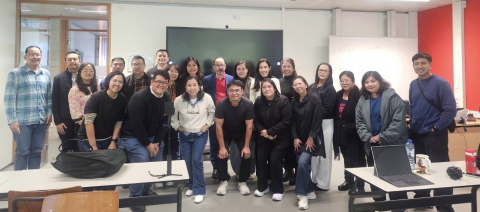
Enschede, Netherlands | October 15–16, 2026 Representatives of Ateneo de Manila University's John Gokongwei School of Management (JGSOM) participated in a specialized Green Finance training

Professor Emeritus Dr Emma Porio highlights climate resilience and biodiversity at international conferences
Emma E Porio, PhD, Professor Emeritus of Ateneo de Manila University and Principal Investigator of Ateneo's Manila Observatory Center for Climate Resilience and Public Health