10.6.10 Disability Accommodation Policy
01 May 2025


Institutional Framework and Funded Strategy for Comprehensive Reasonable Disability Accommodations
Ateneo de Manila University maintains a fully institutionalized, adequately funded reasonable accommodation strategy and policy framework that supports persons with disabilities (PWDs) across the full educational lifecycle. Aligned with international frameworks, national mandates such as Republic Act 10754, and the university’s internal Sustainability Policies and Specific Guidelines, the strategy ensures equitable access to higher education through a human rights-based, non-discriminatory approach. The institutional policy encompasses non-discriminatory admissions, individualized academic testing adjustments, non-academic support services, post-admission wellness tracking, physical and sensory campus infrastructure upgrades, and targeted financial aid mechanisms. By combining clear policy definitions, dedicated administrative channels, physical and digital accessibility measures, and allocated scholarship funding, Ateneo guarantees an inclusive, safe, and barrier-free environment for students, faculty, staff, and visitors with diverse physical, neuro-developmental, sensory, and psycho-emotional conditions.
Policy Framework, Inclusive Admissions, and Post-Admission Accommodation Mechanics
Ateneo de Manila University explicitly operationalizes its commitment to persons with disabilities through its formal Policy On Addressing Students With Special Needs. Executed across all academic units at the main Loyola Heights campus in Quezon City, the policy provides clear, standardized definitions for disabilities and special needs, including physical conditions, chronic medical illnesses, neuro-developmental conditions, and psycho-emotional or psychiatric conditions. Under this framework, admissions remain strictly non-discriminatory: applicants with disabilities are evaluated on identical academic standards without prior inquiry into their special needs during the initial selection phase.
Once admitted, the university activates a specialized, post-admission reasonable accommodation workflow that respects student privacy and operates on a confidential, need-to-know basis. Institutionalized non-academic and academic accommodations are provided open-access and free-of-charge to qualified students. These services include authorization for mobility chaperones, issuance of special PWD campus parking passes, priority room assignment/classroom relocation to ground levels, dedicated enrollment lanes, and individualized academic testing modifications (such as extended exam duration, accessible venues, and adjusted test administration) as detailed in the Admission Testing Guidelines for Accommodation of Applicants with Special Needs.
Physical Infrastructure, Spatial Accessibility, and Universal Design Operations
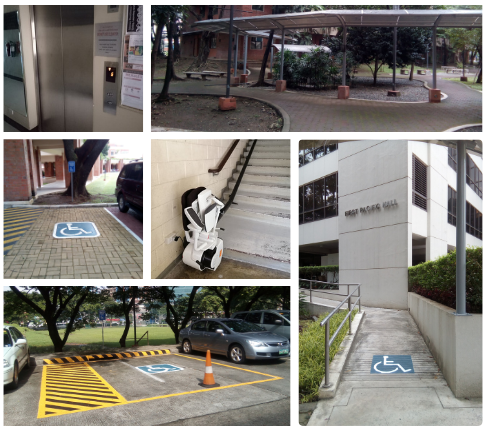
Complementing its policy-level provisions, the university continually executes campus-wide structural accessibility enhancements governed by its updated Sustainability Policies and Specific Guidelines. Implemented by the Campus Facilities and Management Office (CFMO) across major university sites including the Loyola Heights campus in Quezon City and the Ateneo Professional Schools (APS) campus in Rockwell, Makati the program integrates structural universal design features to facilitate autonomous mobility.
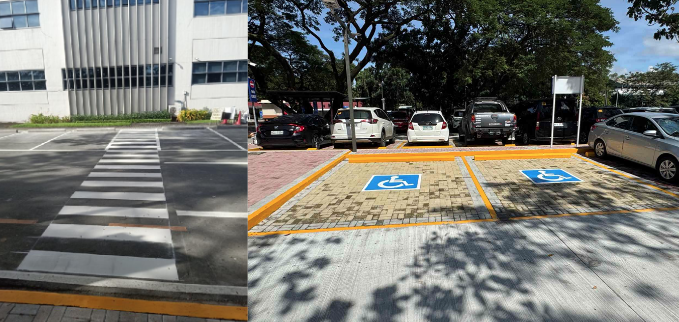
Infrastructure investments include designated PWD parking slots near building entrances (e.g., Xavier Hall, North Carpark, Bellarmine Hall, Gonzaga, SEC, and University Dormitory), covered walkways, high-visibility hazard identification markings, and seamless ramps with handrails across major academic buildings such as Leong Hall, Faura Hall, Mateo Ricci Hall, CTC Building, SOM Building, and the Science Education Complex. For vertical mobility, facilities are equipped with elevators featuring Braille button interfaces and hands-free control systems, alongside specialized mechanical stair lifts in heritage locations like the Social Sciences Building and Bellarmine Hall. Sensory accommodations include tactile guide strips and mats at building entrances, as well as fully equipped, accessible PWD restrooms with specialized assistive railings across facilities such as Areté, APS Rockwell, and the International Residence Hall (IRH).
Allocated Funding Mechanisms and Global Scholarship Networks
To eliminate financial barriers to higher education for persons with disabilities, Ateneo de Manila University operates direct, institutionalized funding streams alongside international grant partnerships. The university maintains an internal budget allocation that funds a dedicated Tuition (20%) Scholarship for PWDs, which guarantees designated financial support slots per academic school and unit.
Furthermore, the university collaborates with international partner organizations and funding networks to scale its financial assistance capacity. Key external partnerships include the ASEAN University Network - Disability and Public Policy Network (AUN-DPPnet) scholarship program, supported by The Nippon Foundation. This grant-funded international partnership provides full scholarship support for post-graduate students with disabilities across the region. Together, these internal allocations and external grant mechanisms ensure that Ateneo's reasonable accommodation policies are backed by sustainable, adequately funded financial frameworks.
Source
Recent News
You may also like these articles

Growing with purpose: How Mekeni Food Corporation turns adversity into shared value
From a small backyard operation in Porac, Pampanga, to an internationally recognized food brand exporting to 25 countries, Mekeni Food Corporation's journey demonstrates how businesses

Three Ateneo-incubated startups secure DOST-PCIEERD’s startup grant fund
Last 9 November, during the opening day of Philippine Startup Week 2026, Soolok Properties Inc, Pili AdheSeal Inc, and Saltric Power (PDG Engineering Services), three
Ateneo de Manila Grade 2 students are the little Earth helpers
It was a great day for saving the world when Ateneo Institute of Sustainability (AIS) came to Ateneo Grade School to give a session on
JGSOM representatives complete green finance training in Poland, sets sights on 2027 micro-credential launch
Representatives of Ateneo de Manila University's John Gokongwei School of Management (JGSOM) completed the second phase of their Erasmus+ Green Finance international mobility activities at
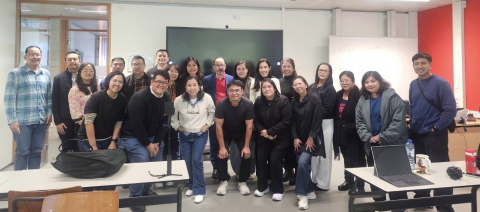
JGSOM Representatives Participate in Green Finance Training at the University of Twente
Enschede, Netherlands | October 15–16, 2026 Representatives of Ateneo de Manila University's John Gokongwei School of Management (JGSOM) participated in a specialized Green Finance training
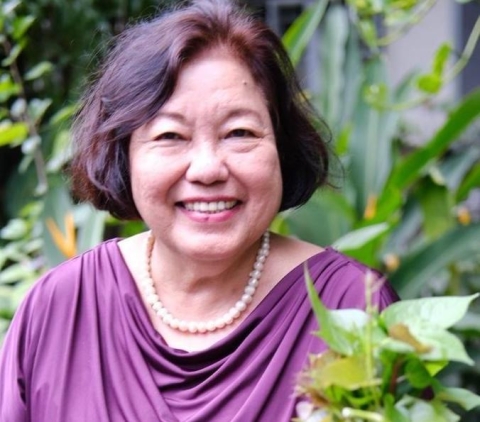
Professor Emeritus Dr Emma Porio highlights climate resilience and biodiversity at international conferences
Emma E Porio, PhD, Professor Emeritus of Ateneo de Manila University and Principal Investigator of Ateneo's Manila Observatory Center for Climate Resilience and Public Health