16.2.2 Students' Union
14 Oct 2024


Student Governance
The Council of Organizations of Ateneo–Manila (COA) coordinates accredited student organizations, while the Sanggunian ng Mag-aaral ng mga Paaralang Loyola serves as the independent student government of Ateneo’s Loyola Schools. Both provide avenues for student representation, organization, and participation in university affairs. Their involvement in TALAB 2024 reflects the University’s recognition of independent student leadership and student organizations as partners in advancing sustainability and community engagement.
Ateneo Advances Integral Ecology Through TALAB 2024
From October 14 to 31, 2024, Ateneo de Manila University held Talakayang Alay sa Bayan (TALAB) 2024 under the theme “Integral Ecology: Caring for Our Common Home.” The program provided members of the Ateneo community with opportunities to explore environmental sustainability, social responsibility, and the University's commitment to integral ecology.
TALAB 2024 was organized as Ateneo prepared for the 10th anniversary of Pope Francis' Laudato Si’ encyclical in 2025. It also supported the University's commitment to becoming a Laudato Si’ University by 2030, creating spaces for students and members of the University community to reflect on how this commitment can be translated into learning, engagement, and action.
The main day of TALAB activities was held on October 15, 2024, when regular undergraduate classes were replaced by TALAB activities. Undergraduate students were expected to participate in at least four hours of activities, with additional opportunities available throughout the October 14–31, 2024 program period. Graduate classes continued as scheduled.
Student participation and engagement were supported by the Sanggunian ng Mag-aaral ng mga Paaralang Loyola, Ateneo's student government for the Loyola Schools, which represents and advocates for students while facilitating student participation in University life. The Council of Organizations of Ateneo–Manila (COA), the coordinating body for accredited student organizations, likewise helped connect the program with the University's student-organization community. Their involvement enabled student groups to contribute activities and provided additional avenues for students to participate in discussions and initiatives related to integral ecology.
The program was led by the Office of the Assistant Vice President for Social and Environmental Engagement for Development and Sustainability (OAVP-SEEDS) under the Mission Integration cluster, in partnership with the Sanggunian and COA. The collaboration brought together University offices, academic and support units, student government, and student organizations in creating a shared platform for sustainability learning and engagement.
Sources:
Recent News
You may also like these articles

Growing with purpose: How Mekeni Food Corporation turns adversity into shared value
From a small backyard operation in Porac, Pampanga, to an internationally recognized food brand exporting to 25 countries, Mekeni Food Corporation's journey demonstrates how businesses

Three Ateneo-incubated startups secure DOST-PCIEERD’s startup grant fund
Last 9 November, during the opening day of Philippine Startup Week 2026, Soolok Properties Inc, Pili AdheSeal Inc, and Saltric Power (PDG Engineering Services), three
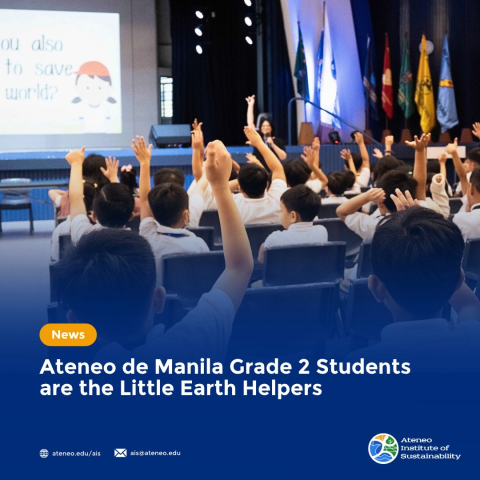
Ateneo de Manila Grade 2 students are the little Earth helpers
It was a great day for saving the world when Ateneo Institute of Sustainability (AIS) came to Ateneo Grade School to give a session on
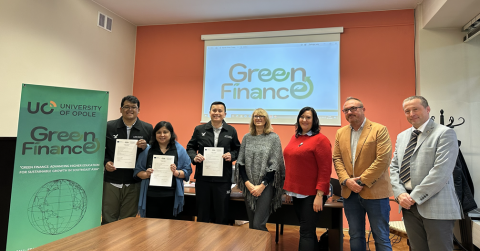
JGSOM representatives complete green finance training in Poland, sets sights on 2027 micro-credential launch
Representatives of Ateneo de Manila University's John Gokongwei School of Management (JGSOM) completed the second phase of their Erasmus+ Green Finance international mobility activities at
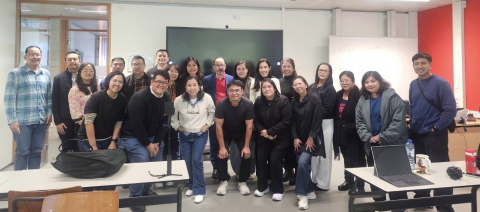
JGSOM Representatives Participate in Green Finance Training at the University of Twente
Enschede, Netherlands | October 15–16, 2026 Representatives of Ateneo de Manila University's John Gokongwei School of Management (JGSOM) participated in a specialized Green Finance training

Professor Emeritus Dr Emma Porio highlights climate resilience and biodiversity at international conferences
Emma E Porio, PhD, Professor Emeritus of Ateneo de Manila University and Principal Investigator of Ateneo's Manila Observatory Center for Climate Resilience and Public Health