13.3.4 Inform and Support Government
05 Sep 2024


Ateneo de Manila Climate Disaster Risk and Early Warning Support
Ateneo de Manila University actively engages with national, regional, and local government bodies, international development agencies, and civil society partners to provide data-driven science, technical support, and evidence-based frameworks for local climate change disaster monitoring, risk assessment, and early warning systems. Through institutional entities such as the Coastal Cities at Risk in the Philippines (CCARPH) project, housed under the President's Office, and collaborative facilities like the Manila Observatory, the university translates interdisciplinary research into operational local government policy and disaster risk management practice. Institutional expertise extends across multiple highly vulnerable urban and regional landscapes including Pasig City, Naga City, Iloilo City, and the Municipality of Angono where the university implements risk assessments, socioeconomic mapping, heat monitoring, and capacity-building frameworks aligned with the National Local Climate Change Action Plan (LCCAP). Beyond local technical partnerships, university leadership contributes directly to international and multilateral policy dialogues, including the Japan International Cooperation Agency (JICA) Chair Lecture Series and the Intergovernmental Panel on Climate Change (IPCC), ensuring local disaster risk, early warning capabilities, and climate science inform global and national policy agendas.
Dr. Emma Porio Participates as Discussant in the 5th JICA Chair Lecture Series
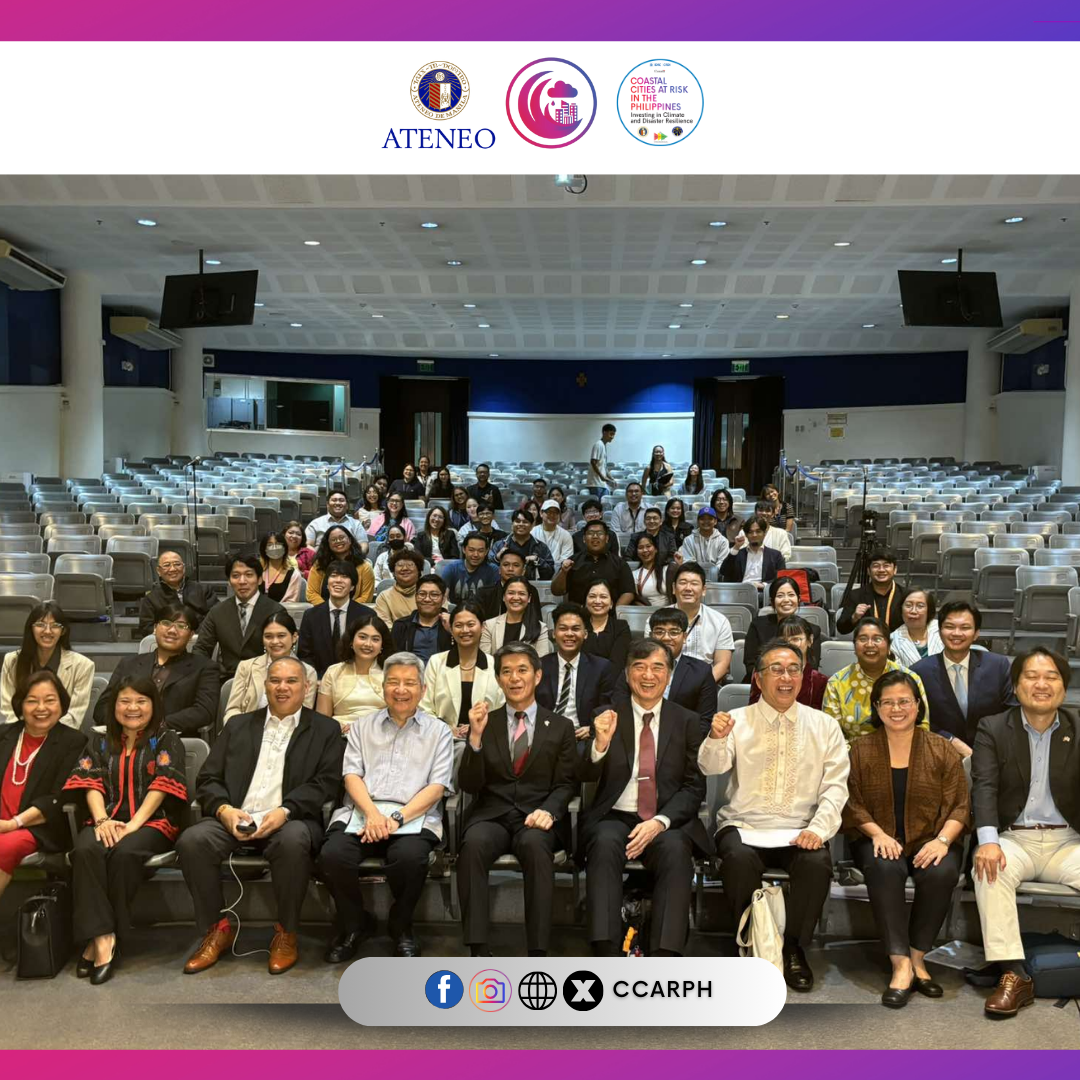
On 5 September 2024, CCARPH–Dr. Emma E. Porio, Professor Emerita of Ateneo de Manila University and Project Principal of Coastal Cities at Risk in the Philippines (CCARPH), participated as a discussant in the successful 5th JICA Chair Lecture Series held on September 5, 2024, at the Leong Hall Auditorium, ADMU.
The event, focused on “Japan’s Experiences and Strategies for Disaster Risk Reduction and Resilience,” featured keynote speaker Dr. Nishikawa Satoru, JICA Senior Advisor, and Asec. Bernardo Rafaelito R. Alejandro IV from the Office of Civil Defense. The distinguished panel shared valuable insights from Japan’s disaster preparedness and resilience approaches, emphasizing how these strategies can benefit global and local disaster management efforts.
Dr. Porio, a recognized expert in climate change adaptation and disaster risk reduction, provided her expertise, contributing to a deeper understanding of the role of science and policy integration in strengthening disaster resilience. The event was well-received and highlighted the importance of collaborative efforts in disaster risk reduction.
Automated Weather Station Systems for Local Climate Monitoring and Disaster Risk Management
The Manila Observatory, located on the Ateneo de Manila University campus, deployed and operated Automated Weather Station (AWS) networks as documented in the 2024–2025 Extreme Weather and Climate (ECW) Report. The AWS infrastructure incorporates sensor arrays engineered to capture real-time meteorological indicators, including atmospheric pressure, ambient temperature, relative humidity, wind speed, direction, and rainfall intensity.
The technical data captured by the AWS network directly supports local government units, agricultural sectors, and regional disaster risk reduction management offices. By transmitting localized meteorological data, the system feeds into regional disaster risk management frameworks, enhancing early warning notifications, emergency preparedness protocols, and ongoing local climate monitoring across surrounding urban and rural ecosystems.
Building Climate-Resilient Cities: Urban Adaptation and Local Government image Collaborations
 Through the Coastal Cities at Risk in the Philippines (CCARPH) since 2018, Ateneo de Manila University provides direct technical and analytical support to local government units (LGUs) to strengthen climate disaster risk assessment, early warning systems, and urban resilience policies. Housed at the Manila Observatory and supported by interdisciplinary university partnerships, CCARPH implements structured resilience frameworks across key target regions, including Metro Manila, Iloilo City, Naga City, and Angono, Rizal.
In Pasig City, the university collaborated with the Pasig City Disaster Risk Reduction and Management Office (DRRMO) to introduce infrared heat mapping via drone technology, socioeconomic vulnerability surveys, and green technology solutions targeting urban heat island impacts. This data directly informed LGU policy adjustments and updated local emergency preparedness protocols. In Naga City, CCARPH partnered with local authorities to address landslide exposure by integrating a three-pronged resilience framework focused on risk assessment enhancement, exposure reduction, and policy reform. In Iloilo City, the university worked alongside the Iloilo City Government, the Manila Observatory, the National Resilience Council, and the University of the Philippines-Visayas to execute a comprehensive Climate and Disaster Risk Assessment (CDRA). Utilizing Integrated Risk Analysis (IRA) and hazard-exposure-vulnerability mapping, this initiative supplied data-driven strategies to mitigate flood risks, storm surges, and El Niño-induced water shortages, establishing alignment with the National Local Climate Change Action Plan (LCCAP). Additionally, local community initiatives executed with Buklod Tao established solar-powered water infrastructure and disaster-resilient livelihood models in flood-prone districts.
Sources:
1. Dr. Emma Porio Participates as Discussant in the 5th JICA Chair Lecture Series
2. ECW Report
3. Building climate-resilient cities: Dr Emma Porio and Ateneo’s leadership in urban adaptation | Features
Recent News
You may also like these articles

Growing with purpose: How Mekeni Food Corporation turns adversity into shared value
From a small backyard operation in Porac, Pampanga, to an internationally recognized food brand exporting to 25 countries, Mekeni Food Corporation's journey demonstrates how businesses

Three Ateneo-incubated startups secure DOST-PCIEERD’s startup grant fund
Last 9 November, during the opening day of Philippine Startup Week 2026, Soolok Properties Inc, Pili AdheSeal Inc, and Saltric Power (PDG Engineering Services), three

Ateneo de Manila Grade 2 students are the little Earth helpers
It was a great day for saving the world when Ateneo Institute of Sustainability (AIS) came to Ateneo Grade School to give a session on

JGSOM representatives complete green finance training in Poland, sets sights on 2027 micro-credential launch
Representatives of Ateneo de Manila University's John Gokongwei School of Management (JGSOM) completed the second phase of their Erasmus+ Green Finance international mobility activities at

JGSOM Representatives Participate in Green Finance Training at the University of Twente
Enschede, Netherlands | October 15–16, 2026 Representatives of Ateneo de Manila University's John Gokongwei School of Management (JGSOM) participated in a specialized Green Finance training

Professor Emeritus Dr Emma Porio highlights climate resilience and biodiversity at international conferences
Emma E Porio, PhD, Professor Emeritus of Ateneo de Manila University and Principal Investigator of Ateneo's Manila Observatory Center for Climate Resilience and Public Health