Ateneo grade schoolers experience joy of problem solving in summer math program
01 Nov 2026 | Arabella Isles (M AMDSc)



Ateneo Grade School (AGS) students from Grades 2 to 5 strengthened their problem-solving and analytical thinking skills during the 2026 Ateneo Summer Math Problem-Solving Program held from 8 to 11 June 2026.
Over the course of four days, participants tackled challenging mathematical problems and explored concepts in Algebra, Geometry, Analysis, and Recreational Mathematics through activities designed to encourage logical reasoning, creativity, and intellectual curiosity.
The program distinguishes itself from regular mathematics classes by placing greater emphasis on problem-solving than on memorizing formulas and procedures. Instead, students are encouraged to investigate patterns, test different strategies, and work collaboratively to solve non-routine problems.
According to 2026 Program Coordinator Dr Eden Delight Miro, the goal is to help students become comfortable with uncertainty and learn from the process of solving problems.
“We give them non-routine problems and challenging puzzles where the path to the answer is not obvious, forcing them to think creatively instead of just copying steps,” she said.
Miro added that the program also teaches students “how to face a tough problem without panicking,” with the hope of developing resilience, grit, and a growth mindset alongside their mathematical skills.
The program was facilitated by faculty members from the Ateneo Department of Mathematics in collaboration with AGS teachers Grace Yn, Girlie Salvador, Rachelle Suba, and Rosalyn De Jesus, who assisted across sessions and grade levels throughout the program.
For Grade 2, participants tackled a variety of number and logic puzzles throughout the program. Through activities such as Addition Fubuki and Hidato, students arranged numbers according to specific conditions, completed numerical sequences, and identified patterns. They also explored Connect the Numbers, Grid Pattern Search, and Addition and Subtraction with Geometry, which challenged them to apply both arithmetic and visual reasoning to solve problems.
Grade 3 participants built on these foundational skills by exploring different approaches to mathematical problem-solving. Through Number Crunching and Techniques in Problem Solving activities, including the Jack and the Beanstalk challenge, students practiced breaking down complex problems into manageable steps and evaluating multiple solution strategies.
They also strengthened their spatial reasoning through geometry-based activities such as tangrams, paper folding, and origami, which encouraged them to visualize shapes, recognize geometric relationships, and apply mathematical concepts in creative and hands-on ways.
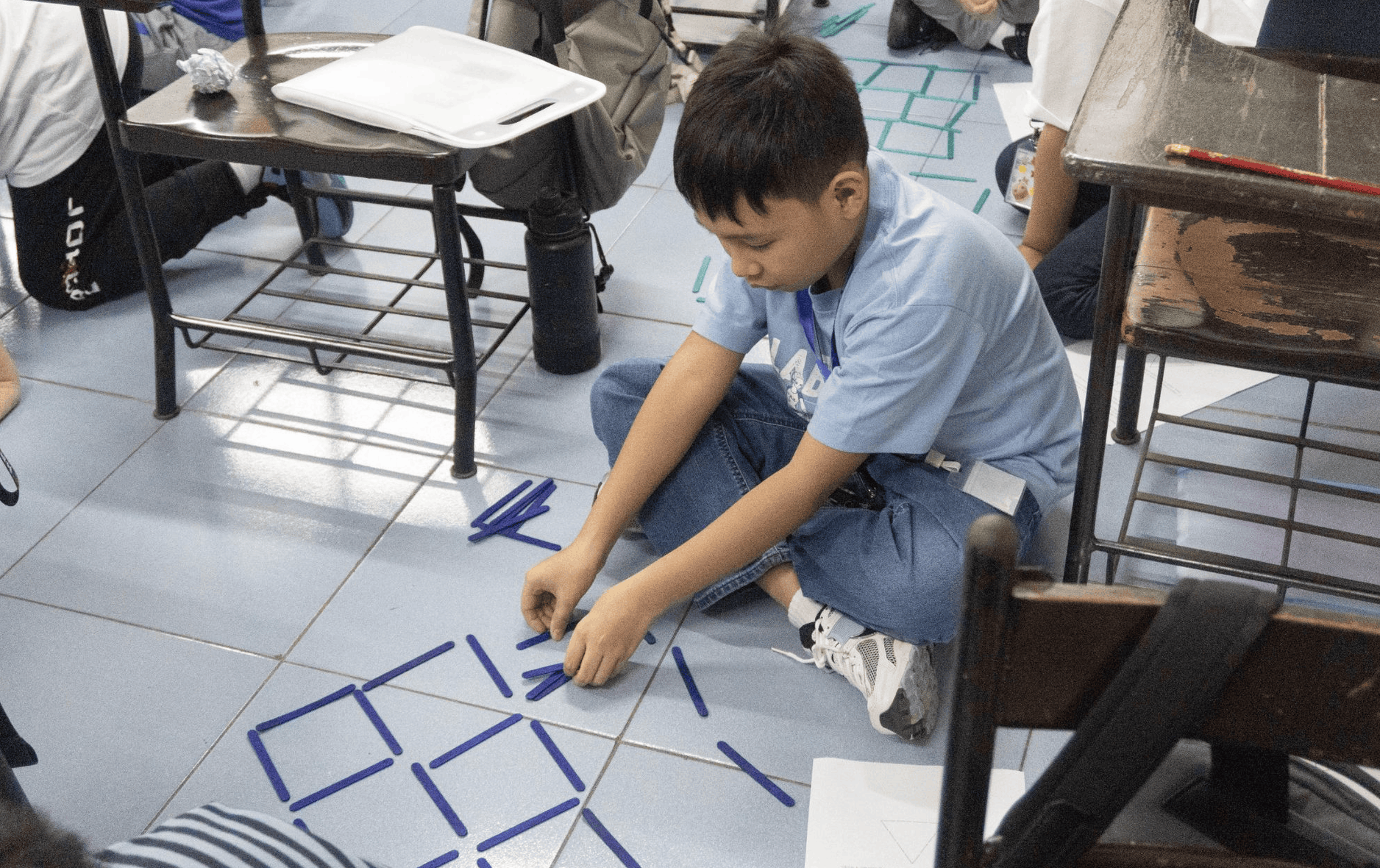
Meanwhile, Grades 4 and 5 students developed their logical and analytical thinking through activities such as The Eliminators, Tricky Sticks, Shape Finder, and Word Problems. These challenges required participants to identify patterns, eliminate possibilities, visualize geometric transformations, and apply mathematical concepts to real-world situations. While both grade levels worked on similar types of problems, Grade 5 students encountered more advanced variations that demanded deeper reasoning and more strategic approaches.
Beyond the lessons and activities, the program fostered an environment where students were encouraged to explore, collaborate, and discover the joy of mathematical thinking.
For the facilitators, some of the most memorable moments came from seeing students react with excitement as they uncovered new ways of solving problems.
Grade 3 facilitator Lizzie Montemayor shared that watching students become genuinely fascinated by the solutions they discovered was especially rewarding. "May kid na sinabi niya literally 'mind blown' siya," she recalled. "Nakakawarm ng heart na math fascinates them at fun ito para sa kanila."
Grade 2 facilitator Nichole Co likewise observed students' enthusiasm throughout the program, particularly during interactive activities that encouraged participation and experimentation. While some students initially felt overwhelmed by the pace of the sessions, they gradually gained confidence as they worked through the challenges.
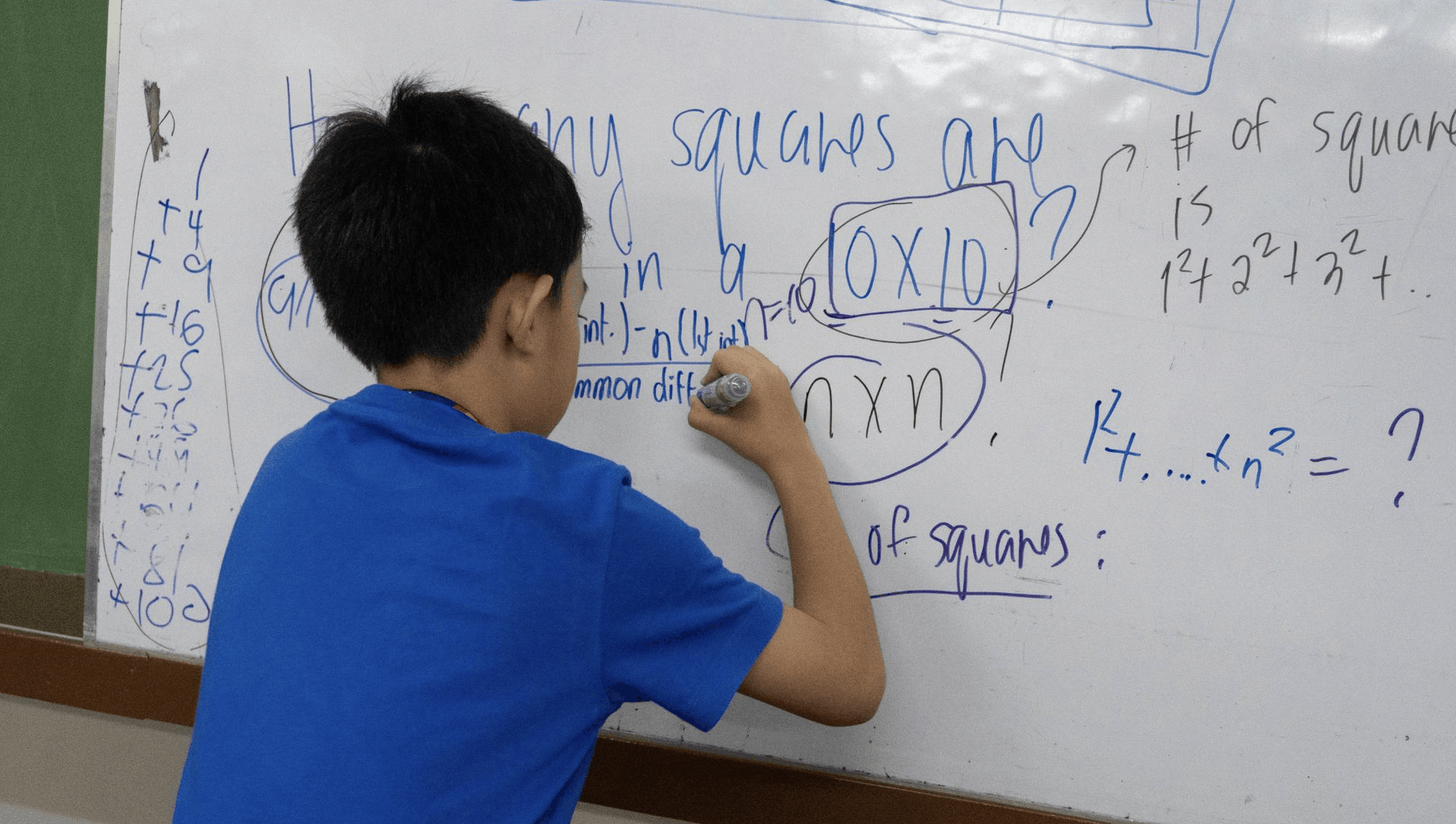
Co noted that storytelling and figure-guessing activities sparked friendly competition among participants, while opportunities to write on the board and test different solutions through trial and error kept students actively engaged in the learning process.
The Summer Math Problem-Solving Program forms part of the Department of Mathematics' long-standing commitment to strengthening STEM education in the Philippines through the development of young problem solvers. Launched in the early 2000s through the initiative of Fr. Bienvenido "Ben" Nebres, SJ, and Dr. Queena N. Lee-Chua, the program was created to nurture mathematically inclined grade school students by exposing them to challenging problems beyond the regular curriculum. More than two decades later, it continues to inspire young learners to develop the critical thinking, creativity, and perseverance needed to become future innovators and contributors to society.
The 2026 Summer Math Problem-Solving Program was made possible through the collaborative efforts of its facilitators, the Ateneo Grade School mathematics teachers, and the Department of Mathematics faculty. Leading the sessions were Program Coordinator Dr Eden Delight Miro, together with Eurlyne J Domingo, Mida R Guillermo, Kurt Anthony C de los Santos, and Grace U Yn, Mathematics Subject Area Coordinator of AGS and the 2026 Summer Math Problem-Solving Program Grade School Coordinator, who guided and supported participants throughout the four-day enrichment program.
Recent News
You may also like these articles

Ateneo hosts 30th Asian Technology Conference in Mathematics
The Ateneo Department of Mathematics, in partnership with the School of Science and Engineering and the Ateneo Office of the Assistant Vice President for University

A math major’s training: How the Freshman Enhancement Program (FrEP) solidified my math journey
Under the bright fluorescent lights of the SEC A classrooms, math majors were being prepared for their college life. You could see papers filled with

Ateneo Math showcases diverse research at 2026 MSP Annual Convention in Pangasinan
Faculty members, collaborators, alumni, and both graduate and undergraduate students from Ateneo de Manila University presented their latest research at the 2026 Mathematical Society of

ASOG promotes cybersecurity awareness in the public sector
As government services increasingly rely on digital systems, cybersecurity plays a vital role in protecting sensitive information, strengthening public institutions, and safeguarding the people they

PSA to run Ateneo-built National ID verification for local governments and NGOs
Built for areas with limited or no connectivity, including geographically isolated and disadvantaged areas. The same software is available to banks and other institutions.

Dr Maria Mercedes T Rodrigo is elected President of the International Artificial Intelligence in Education Society
Ateneo de Manila University congratulates Dr Maria Mercedes T Rodrigo on being named President-elect of the International Artificial Intelligence in Education Society (AIED Society).