Klim@Matcha
13 May 2026 | Patrick Jordan Santos, Lyzter John Deuda & Alexandra Marie Lumbis



From the performative male epidemic to viral banana pudding fusions, matcha continues to solidify itself as the pop culture beverage. Starting as a niche cultural element in Japanese ceremonies, the green drink is now nothing short of a global sensation, finding itself among other menu staples like lattes and americanos. The international demand for matcha has ballooned so much, in fact, that the world is now facing a global matcha shortage, and the hype around it shows no signs of slowing down (Zhuang, 2025). Alongside ever rising global temperatures, social media trends, and limited growing areas around the world, what options do we have to make drinking matcha more sustainable?

What’s the tea?
Contrary to its contemporary image, the art of matcha, and thus tea making, originated in China during the Tang Dynasty (618–907 CE) before reaching Japan. At the time, green tea leaves were first steamed and layered into bricks, and then roasted until they were ready to be pulverized. Nonetheless, the tea making process largely associated with today’s matcha cultivation methods did only flourish later in Japan, when Japanese tea farmers developed shade grown cultivation and stone-milling techniques. This distinguished the matcha-specific cultivation of the tea plant (Camellia sinensis) from earlier tea making processes.
Still in early Japan, matcha became an essential part of meditation and formal tea ceremonies. Due to it containing a special combination of caffeine and L-theanine, it provided ceremonial tea drinkers a delicate balance between alertness and calmness. Matcha then began penetrating foreign markets through international expos and the media, where it started being advertised as a superfood and was bunched together with kombucha, acai berries, chia seeds, and other trendy ingredients. Cafés then explored the potential of matcha even further, incorporating it into lattes, ice creams, and even in cakes and brownies, until it came to be one of the most popular café staples today. Over time, these changes shifted the identity of matcha from a cultural cornerstone into a global commodity.
To meet growing demands, the global matcha industry expanded significantly by the 2010s, but not without challenges. Matcha production relies on labor-intensive shading, a process wherein tea leaves are covered with reed screens or similar materials to block the majority of incoming light. This agricultural process is what helps promote L-theanine and chlorophyll production in the tea leaves, and is what ultimately gives matcha its signature look and taste (Song, 2012). Furthermore, stone mills are required in order to grind the produced tencha (i.e., the shade grown tea leaves) into matcha, which similarly requires a lot of manual labor. A study by Huang et al. (2021) found that different milling methods are capable of altering matcha quality, suggesting that traditional, slow milled tencha yields a much finer and smoother matcha powder than fast and mechanically milled tencha, posing a concern for mass production.
Over time, these changes shifted the identity of matcha from a cultural cornerstone into a global commodity.
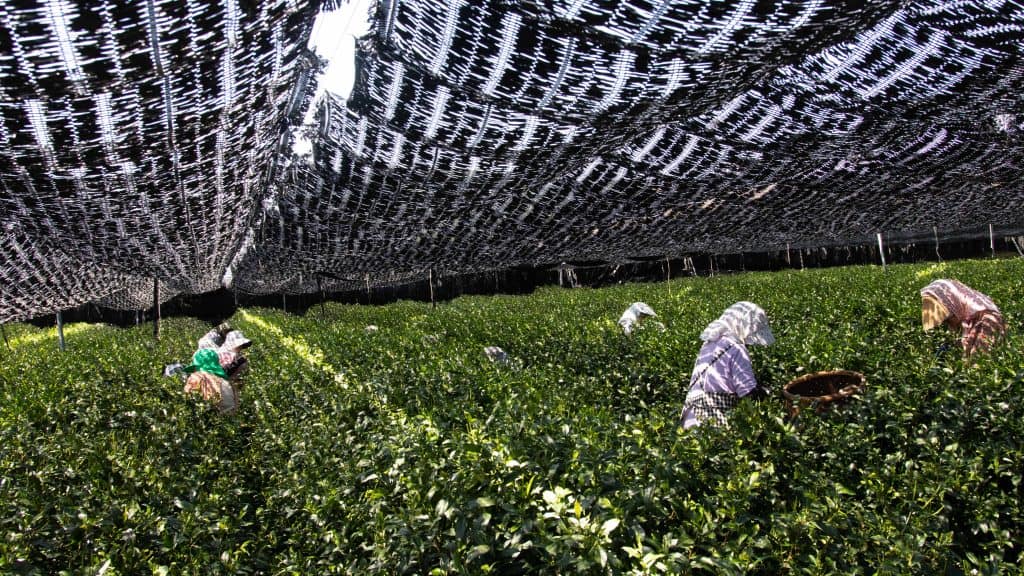
While Japan is still credited as the core producer of authentic matcha, especially those of ceremonial grade, China surpasses it by production volume. Records showed that Japan produced 4,176 metric tons of matcha in 2023, while China’s production for 2025 is forecasted to go beyond 5,000 metric tons. This skyrocketing demand is unfortunately outpacing both countries’ matcha supplies, as it is now projected to reach a market value of approximately $4,700 million in 2028, seeing a sizable increase from its recorded $2,900 million market value in 2023 (Wasay, 2024). In combination with limited production areas, labor-intensive processes, and climate-related stressors, the future and stability of the matcha industry faces many interconnected risks.
Something’s brewing…
The majority of matcha consumers are unaware of the meticulous cultivation and production processes behind the green gold. Despite tea being the second-most consumed beverage worldwide, the modern-day growing, harvesting, and processing of all tea like matcha is geographically locked to the Asian and African continents, with a small portion of Latin America, due to the specific climate conditions needed by tea plants to grow. The perennial tea shrub requires a warm, humid climate and a nutrient-rich, but acidic soil. These strict requirements are multiplied for matcha as the smooth mellow umami flavor, Instagram-worthy color, and solid health benefits of high-grade matcha are results of a tighter cultivation and processing window, wherein the youngest tea shoots are harvested within a month. This powdered form of matcha grants it a “multi-functionality” or versatility in the sense that it can easily be stored, transported, measured, and incorporated into other food items, increasing the rate of which it is sought out for, consumed, and even hoarded.
The growth of the matcha market has been on a steady rise throughout the 20th century, but in 2024, a few years after the height of the COVID-19 pandemic, matcha production spiked to more than double its output in 2014. This sudden increase in demand is often attributed to the surge of tourists making up for the years lost in isolation and to the increased health consciousness of humans during and after a global health crisis. This “retaliatory growth” or rebound in economic production, growth (and accompanying carbon emissions) after a period of slow and low economic activity has been present in previous global economic recessions as entire governments and industry aim to “catch up” on the economic productivity and opportunities “lost” during the pandemic lockdowns.
Health and economy-anxious individuals isolated from the outside world likely tried matcha out of hype and a desire to try something new and relate to a community, and found its health benefits – ranging from anti-inflammatory properties, improved cognition, and reduced stress – appealing, especially as the world faced a health crisis that, at the time, had no clear end.
Climate change can drastically change the biodiversity and resilience of tea plants not just through extreme and unpredictable weather conditions, but also through the arrival of new diseases and pests, as well as the disappearance of beneficial organisms and viable land for plantations.
Climate change stands as a major threat to the agriculture sector, and its consequences are exponentially felt for the climate-sensitive tea plants primarily grown in the Global South, which is the most susceptible to climate change. Additionally, climate change not only impacts conditions like temperatures and precipitation, but also the overall ecosystems that the tea plants are a part of. Specifically, climate change can drastically change the biodiversity and resilience of tea plants not just through extreme and unpredictable weather conditions, but also through the arrival of new diseases and pests, as well as the disappearance of beneficial organisms and viable land for plantations. Moreover, unpredictable extreme weather also poses a direct threat to humans manually tending to tea plantations and matcha production. In line with this, climate-related hazards have pushed people working in rural areas to flee to urban areas for more protection against nature, thereby further worsening the labor shortage.
Climate change has further destabilized the supply chain of matcha and its subsequent industries. Staggering records of heatwaves in Japan’s Kyoto region, a key source of matcha’s raw leaf, have already reduced 20 to 25% of its harvests, thus further tightening global supplies and surging prices (Pek, 2025). These shifts in temperature and precipitation can not only reduce the quantity, but also the quality of tea crops, thus having wider implications for supply reliability, market stability, and producer livelihoods for the growers, harvesters, manufacturers, sellers, and traders.
Whisking wisely
The rapid increase in the global consumption of matcha tea products is presented in media discourse through the lens of commodification, thus framing the product as a “favorite among Generation Z.” Widespread media attention has been linked to the growing criticisms over the use of matcha as a form of “cultural erasure,” brought upon by obscuring crucial elements such as cultural rituals, producer labor, historical context, and the challenges faced by the producing countries in coverages. Moreover, concerns over food exploitation are rooted in the reduction of culturally significant items to a market-centered, utilitarian, and superficial narrative, thereby presenting matcha as merely a product detached from their context and cultural foundations.

The promotion of responsible consumption, thus, requires the reintegration of an understanding of these ethical and cultural dimensions. Various studies have pointed to the promotion of “gastronomic heritage” that is ethically accountable and culturally sustainable, while also resisting the reduction of cultural products into mere commodities. Subsequently, green marking efforts must also focus on strengthening the consumers’ environmental knowledge and their awareness of perceived environmental consequences to promote environmentally conscious consumer behavior. These, along with consistent efforts, can lead to sustainable consumer behavior, defined as actions taken to satisfy current needs while simultaneously benefiting or limiting the impact on the environment.
The soaring global demand for matcha places immense pressure on producing regions that are already struggling with severe climate changes. This includes records of high temperatures that disrupt agricultural yields. The intensive farming required to produce high-quality tea necessitates the use of heavy nitrogen fertilizer application. As such, assessing the environmental burden is crucial, especially due to the excess reactive nitrogen and nitrous oxide emissions that escape into the environment as pollutants, which significantly contribute to climate change.
In line with this, the acidic soil requirement of tea shrubs can also prompt producers to manually manipulate soil pH levels for suitable tea growth. However, the soil acidification and its consequences for soil health are increased exponentially given the fact that tea plantations are monocultures that are limited to the planting and replanting of one type of plant species further aggravating the ecological impact of the industry from alienating some organisms to increasing soil erosion susceptibility.
Additionally, the entire process of matcha production is energy-intensive as the powdering process requires a large source of heat to wither, dry, and pack. This requirement is mostly met with a large amount of fuel like firewood, oil, or natural gasses, depending on the country.
Nevertheless, the entire process contributes further to the climate crisis through deforestation, use of non-renewable fuel, pollution of soil and water from cultivation practices, and the shifting of entire ecosystems brought about with its strict soil and climate requirements.
Various analyses must be vital for policymakers and other stakeholders in providing indicators to help them balance complex objectives that include the mitigation of environmental impacts, preserving of consumer health benefits, and resisting the reduction of gastronomic heritage to commodification. The decision to promote sustainable consumption acts from both the producers and consumers must be a balancing act that requires measured precision that ensures environmental improvements to be achieved without compromising the intrinsic cultural and health benefits of matcha. In other words, perhaps when the next matcha craze pops up on social media, consumers and markets are able to participate in its enjoyment more mindfully.
References
Hirono, Y., Sano, T., & Eguchi, S. (2021). Changes in the nitrogen footprint of green tea consumption in Japan from 1965 to 2016. Environmental Science and Pollution Research, 28(33), 44936–44948. https://doi.org/10.1007/s11356-021-13767-z
Huang, Y., Goh, R. M. V., Pua, A., Liu, S. Q., Sakumoto, S., Oh, H. Y., Ee, K. H., Sun, J., Lassabliere, B., & Yu, B. (2021). Effect of three milling processes (cyclone-, bead- and stone-millings) on the quality of matcha: Physical properties, taste and aroma. Food Chemistry, 372, 131202. https://doi.org/10.1016/j.foodchem.2021.131202
Kumarihami, H. M. P. C., & Song, K. J. (2018). Review on Challenges and Opportunities in Global Tea Industry. The Korean Tea Society, 24(3), 79–87. https://doi.org/10.29225/jkts.2018.24.3.79
Liu, Z., Wang, Q., Ma, Y., & Zhao, M. (2025). Influence on soil ecology, tea yield, and quality of tea plant organic cultivation: a mini-review. Frontiers in Agronomy, 7. https://doi.org/10.3389/fagro.2025.1557723
Mukhopadhyay, M., & Mondal, T. K. (2017). Cultivation, Improvement, and Environmental Impacts of Tea. Oxford Research Encyclopedia of Environmental Science. https://doi.org/10.1093/acrefore/9780199389414.013.373
Pek, M. (2025). Japan’s heat-stressed matcha tea output struggles to meet soaring global demand. Reuters. https://www.reuters.com/business/japans-heat-stressed-matcha-tea-output…
Song, R., Kelman, D., Johns, K., & Wright, A. (2012). Correlation between leaf age, shade levels, and characteristic beneficial natural constituents of tea (Camellia sinensis) grown in Hawaii. Food Chemistry, 133(3), 707–714. https://doi.org/10.1016/j.foodchem.2012.01.078
Wang, Q., & Wang, S. (2020). Preventing Carbon Emission Retaliatory Rebound post-COVID-19 Requires Expanding Free Trade and Improving Energy Efficiency. Science of the Total Environment, 746, 141158. https://doi.org/10.1016/j.scitotenv.2020.141158
Ye, J.-H., Fang, Q.-T., Zeng, L., Liu, R.-Y., Lu, L., Dong, J.-J., Yin, J.-F., Liang, Y.-R., Xu, Y.-Q., & Liu, Z.-H. (2023). A comprehensive review of matcha: production, food application, potential health benefits, and gastrointestinal fate of main phenolics. Critical Reviews in Food Science and Nutrition, 64(22), 1–22. https://doi.org/10.1080/10408398.2023.2194419
Zhuang, Y. (2025, July 24). The Latest Casualty of Social Media Hype Is Your Matcha Supply. New York Times [Digital Edition]. https://link.gale.com/apps/doc/A849224905/AONE?u=anon~a22ec3ec&sid=book…;
Recent News
You may also like these articles

Updating of Medical Records Second Semester SY 2026-2027
14 November 2026 TO: Undergraduate and Graduate Students FROM: Higher Education Office of Health Services-College SUBJECT: Updating of Medical Records Second Semester SY 2026-2027 Please

Promotion of Faculty in the Senior High School (Memo U2627-050)
(Memo # U2627-050) I am pleased to announce that upon the recommendation of the Senior High School Committee on Faculty Rank and Permanent Appointment and the endorsement of the Vice President for Basic Education, I am approving the promotion of the following faculty members in the Senior High School:

Demise of Mr Silvestre P Villarin(Memo U2627-049)
(Memo U2627-049) We extend our condolences to Fr Jose Ramon “Jett” T Villarin SJ and his family on the passing of his father, Mr Silvestre Villarin, on 18 November 2026 at the age of 96. Fr Villarin is the former University President, a faculty member of the Department of Physics, and the Executive Director of the Manila Observatory.

Growing with purpose: How Mekeni Food Corporation turns adversity into shared value
From a small backyard operation in Porac, Pampanga, to an internationally recognized food brand exporting to 25 countries, Mekeni Food Corporation's journey demonstrates how businesses

[AGS] National Book Week
Open a Book, Stories Unfold, Wonders Flow Let us come together as one AGS community to celebrate the 92nd National Book Week with the theme

Three Ateneo-incubated startups secure DOST-PCIEERD’s startup grant fund
Last 9 November, during the opening day of Philippine Startup Week 2026, Soolok Properties Inc, Pili AdheSeal Inc, and Saltric Power (PDG Engineering Services), three