NUS Seafaring Voyages
19 Aug 2019 | Jan Mrázek Associate Professor, Southeast Asian Studies Department, NUS Expedition leader of many NUS seafaring voyages

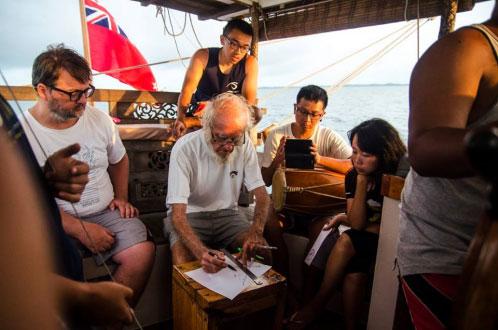
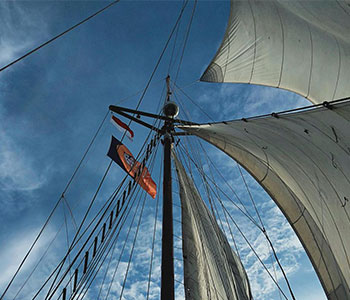
Since January 2017, different units from across the National University of Singapore have organized seafaring voyages (about five every year), on which students, alumni and teaching staff set out from the future-, global-oriented island city and explore its maritime, archipelagic neighbourhood, stopping in market towns, remote villages and uninhabited islands. Initially, most of the voyages have been extracurricular, but since 2019, students have also sailed as a part of a university course in the Department of Southeast Asian Studies, entitled “Sea, Islands, Vessels: A Voyage of Exploration.” As the essay by Elizabeth Wan (one of the student shipmates) suggests, transformative, revelatory immersion – the literal and the figurative overflow into each other when we talk about the sea – is one goal of these voyages: an immersion into another world that, one realizes, is one own. A realisation – experiential, intense and harsh realisation — of interconnectedness – also of the self and the (natural and other) environment — is another. Each voyage has a somewhat different focus – from natural sciences to Southeast Asian studies – but all are by necessity deeply interdisciplinary, or rather unbound by the limit of any discipline: on each voyage, students from different parts of the university live together in the small space of the boat, helping each other live in and understand the different environment, engaging in conversations among themselves and with the people they visit. The sea connects people – those on the boat as well as those on different islands, including Singapore — in intense and often harsh ways, different from the apparent smoothness and speed of internet and smartphones — and it helps people realize that everything is interconnected, harshly and intensely: the natural environment, or, for example, any piece of garbage on a beach, or any particular island, destroyed or not yet, turned into an “eco-friendly resort” or “nature reserve” or not yet (i.e., an island- and money-grabbing machine of destruction; see also the article by Abu Hanifah ranslated by student shipmate Amirul), is never an object or action separate from “us.” To read more on the experiences and observations of my student shipmates, please visit our blogs (https://blog.nus.edu.sg/borneoduewest/, https://blog.nus.edu.sg/ahoyanambas19 , https://www.instagram.com/ahoy_anambas/)
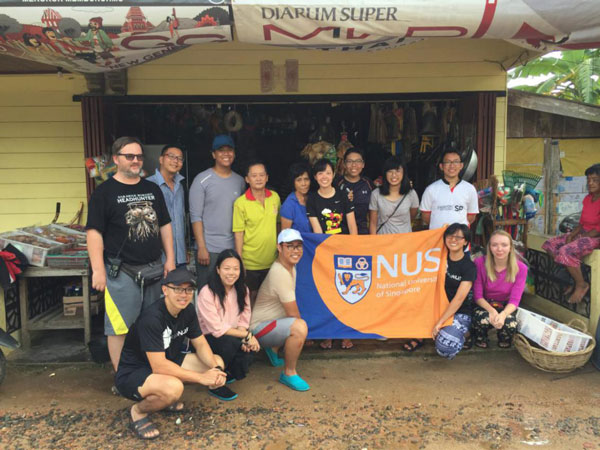
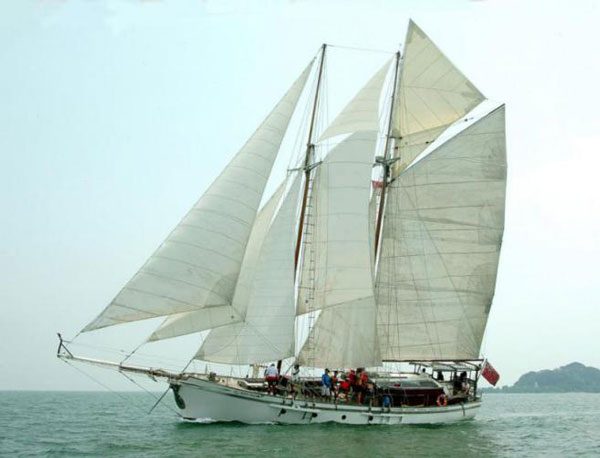
“The ancient sea world unifies and forms the background of everything” [i] During the two weeks of each voyage, a dozen students and I lived together on the deck of Four Friends, an old wooden motor-sailing vessel, evocative of nineteenth century sailing boats, but, built in Malaysia, in some ways quite like a local fishing boat.
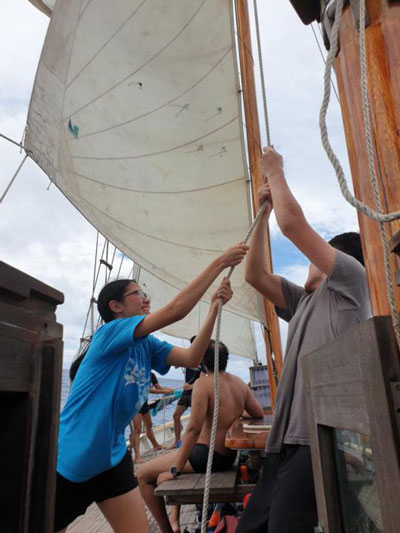
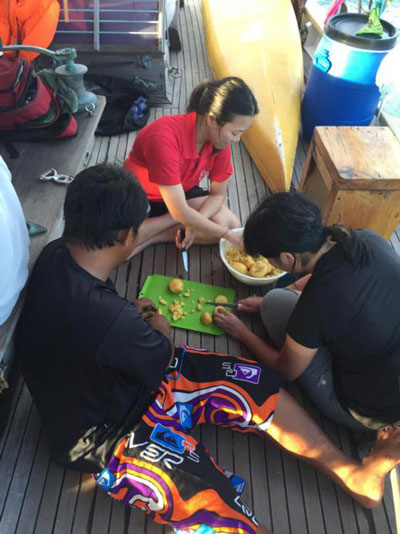
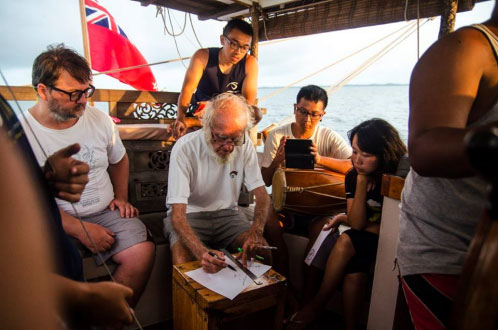
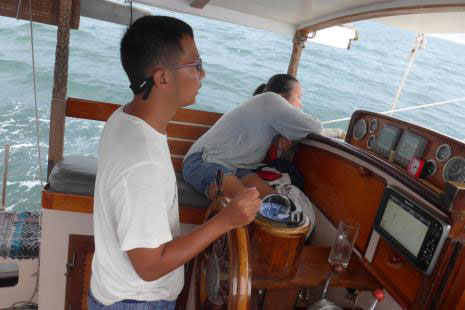
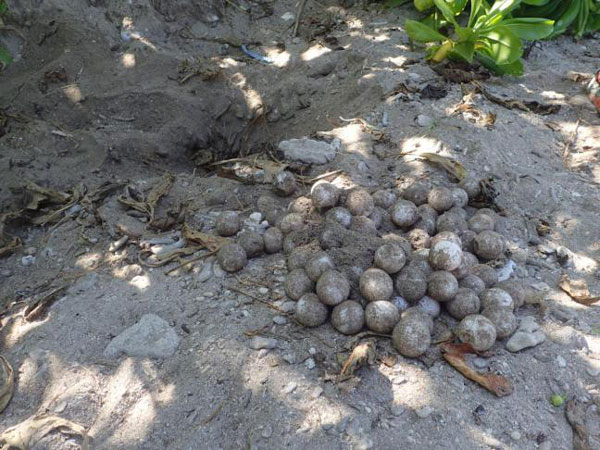
It was an intense experience: of beauty, pleasure, fatigue, discomfort, disorientation, nausea, and fear. We were learning how to navigate, steer, keep watch, hoist sails, and otherwise work as a crew; but also to simply live on the boat, move about, and perform life’s “basic functions.” This meant learning about the sea—the boat (as a space for being and as an instrument through which one is at sea), the archipelagic land-seascape, the currents, the winds, the weather—in an immediate, originary way, as if we were learning to walk and see again. We stopped on many islands, some inhabited, most not, but all with marks of humanity (an airline lifejacket on the beach of the extremely remote Tokong Kemudi island; some garbage, sometimes from other countries, brought by the sea on most beaches; signs of coconut harvesting and turtle egg collecting on some).
We saw pristine green islands covered with dense, impenetrable forest, and red islands, the color of soil, with no vegetation left, utterly destroyed by mining. We visited tiny fishing communities, maritime market towns built over water, and tin mines abandoned by foreign companies and now exploited on a small scale by locals. We talked to fishermen on boats, satisfying both our and their curiosity, bartering provisions or asking for directions and local knowledge. Many people were as eager to learn about our world as we were about theirs, even as preconceptions about what is “ours” and “theirs” were quickly shattered.
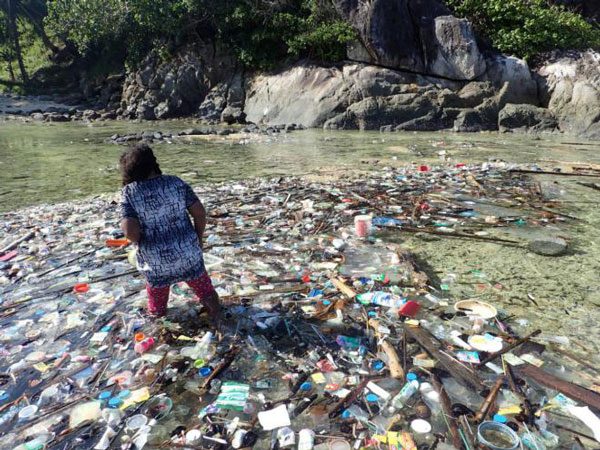
We were utter outsiders, but not simply that: we were realizing how interconnected our worlds are, across and through the sea. In the Riau Islands, one feels strong cultural and economic links with Singapore and Malaysia (for example, language, food, etc., is closer to Singapore than to, say, Java). Our group was ethnically predominantly local Chinese and Malay (with a couple of “others,” to use the Singaporean categorization), just like the communities we visited. Even islands far from any ferry service or mobile phone coverage, are places where people, often from afar, come and stay, or move on after weeks, months, or years. Island communities are both remote and strikingly cosmopolitan, and we were perhaps less out of place and less unknown than it might seem.
Singapore is commonly known to fishermen even in distant settlements, as the place where their best fish is eventually sold, through multiple middlemen. More than an object of desire (the way Singapore figures for the middle and upper classes in Jakarta or Manila), here it is an important although distant node in a trade network. Some older fishermen remember bringing fish directly to Pasir Panjang Wholesale Market in Singapore, before borders became less porous. Places like Tanjung Pinang and Tambelan function as smaller but locally important nodes and entrepôts, to where fish flows, and from where rice and other commodities come, as well as the occasional school teacher or nurse. Children are also sent to higher schools there.
I mentioned the dead, red islands, devastated by mining. Relatively near Singapore, one sees barges loaded with sand, headed in the direction of the city state. As one approaches Singapore and the more “developed” Indonesian islands nearby, large-scale human destruction is more apparent everywhere. Certainly some of the “legal” things we saw and talked about with villagers, such as a particular kind of “development,” especially on islands closest to Singapore, with the involvement of money from both Singapore and far away continents—seemed like nothing but (super)piracy. But kekerasan, violence and hardness, permeates everything, and all levels of the “lively communication and interchange,” between the various islands, trade nodes, and middlemen. For example, “dynamite fishing”—with disastrous effects on sea life and the livelihood of local fishermen—continues to be practiced. While some such forms of violence and destruction strike one as outrageous, in other cases one feels one is not in a position to judge —such as widespread illegal and environmentally destructive collecting of turtle eggs, which is an important source of nutrition and culinary pleasure in the islands.
On the sea, one experiences “the ancient sea world that unifies and forms the background of everything” (in the words of the Indonesian historian Adrian Lapian) of which humanity forms a small element. Martin Henz, a colleague of mine who pioneered the seafaring voyages, works in computer science and engineering, and he likes to think about our experience in terms of systems theory: physical, climatic, biological, economic, cultural and political elements are interconnected and interdependent parts of a system. On the voyage, this total interconnection, including people and the natural world, is not encountered as a theory, but rather, like the sea, it unifies and forms the background to thought. People are part of this ancient sea world, but not its absolute center; that is, if they are the center, they have the centrality of the king, who, as we know from Lapian’s writings, is in some ways just another pirate, only a particularly violent/hard one. It is almost a platitude to say that the ocean makes one realize one’s smallness, but there is a truth in this sensation that is fundamental to understanding the sea world and our (non-)positionality—even when one focuses on people, even when one realizes their great powers of destruction, they are merely part of the ancient sea world that unifies everything. Even when one can never quite exceed one’s own or human perspective, at sea one feels particularly strongly its limits and how transitory it is.
Students from various academic fields and disciplines came together on these voyages. That enriched our conversations, steered it in interesting and difficult ways, and helped and complicated our understanding and practical dealings with whatever we encountered.
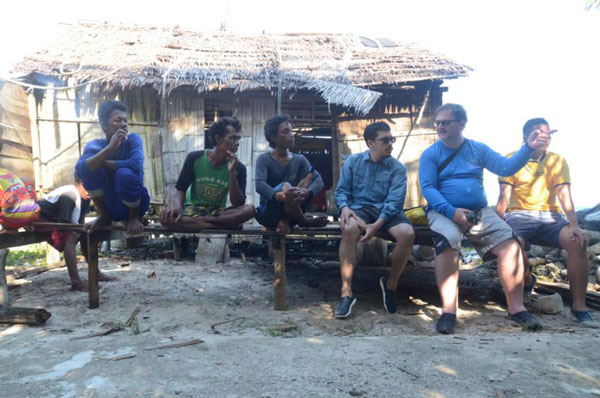
Living together in the small space of the boat, working in a team and caring for each other’s well-being, sharing new experiences, “getting to know intimately each other’s bowel movements” (as one student put it) and egos, learning to respect each person’s privacy, loneliness, nausea, or cheerfulness, we were constantly reminded that the world is not neatly separated by disciplines, but everything and everyone is interconnected, through dependence, exchange, and violence: “the ancient/sea world unifies and forms the background of everything.”
[i] This is an abridged and slightly edited excerpt of my essay “The Prison and the Sea” (Suvannabhumi 11/1 [2019]).
Recent News
You may also like these articles

Growing with purpose: How Mekeni Food Corporation turns adversity into shared value
From a small backyard operation in Porac, Pampanga, to an internationally recognized food brand exporting to 25 countries, Mekeni Food Corporation's journey demonstrates how businesses

Three Ateneo-incubated startups secure DOST-PCIEERD’s startup grant fund
Last 9 November, during the opening day of Philippine Startup Week 2026, Soolok Properties Inc, Pili AdheSeal Inc, and Saltric Power (PDG Engineering Services), three
Ateneo de Manila Grade 2 students are the little Earth helpers
It was a great day for saving the world when Ateneo Institute of Sustainability (AIS) came to Ateneo Grade School to give a session on
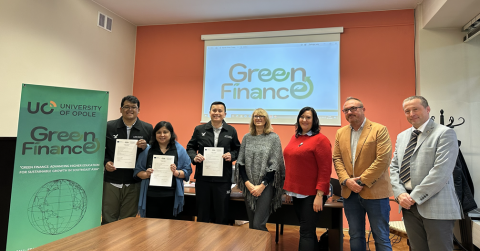
JGSOM representatives complete green finance training in Poland, sets sights on 2027 micro-credential launch
Representatives of Ateneo de Manila University's John Gokongwei School of Management (JGSOM) completed the second phase of their Erasmus+ Green Finance international mobility activities at
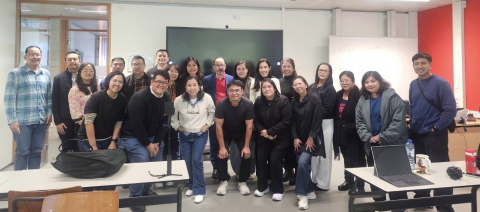
JGSOM Representatives Participate in Green Finance Training at the University of Twente
Enschede, Netherlands | October 15–16, 2026 Representatives of Ateneo de Manila University's John Gokongwei School of Management (JGSOM) participated in a specialized Green Finance training
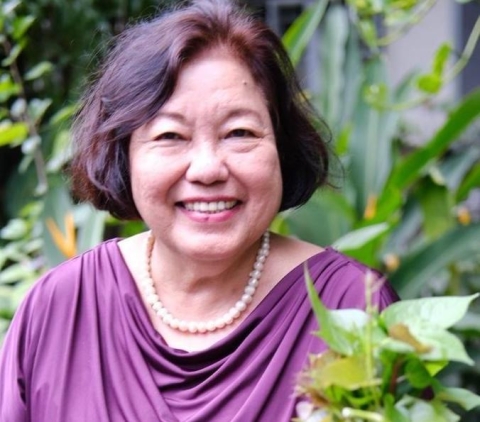
Professor Emeritus Dr Emma Porio highlights climate resilience and biodiversity at international conferences
Emma E Porio, PhD, Professor Emeritus of Ateneo de Manila University and Principal Investigator of Ateneo's Manila Observatory Center for Climate Resilience and Public Health