Welcome to Interdiscipline: Global and Area Studies Conversations!
08 Sep 2026 | Ricardo Leong Institute for Global and Area Studies





The Interdisciplinary and Layered Social Chains of Value Analysis
By: Joselito T. Sescon*
Value chain analysis is attributed to the study of tracing each additional economic value along the chain of a commodity’s component parts and stages of production. Done most likely in a high-technology center is an electronic gadget’s concept and technical design comprising the highest proportion of the total value added. Then parts and components are source from different countries, while manufacturing, final assembly and packaging are in a chain of several closely located places, until finally toward global logistics, transport and market distribution. The analytical focus is on value contribution of each place, stage, and component to the final commodity value. They are all part of the supply chain, but the focus is on value formation and its location in the chain.
The global value chain framework, pioneered by sociologist Gary Gereffi in the late 1990s and early 2000s, is an analytical tool still actively used today to decipher how commodities are designed, manufactured, and distributed across multiple countries. However, for wholistic social analysis it is too narrow, specific only for economic analysis. It treats the periphery (gaps, discontinuity, brokenness) as a passive link in a corporate sequence while completely ignoring how non-market social relations, informal economies, and localized cultural frictions actively mirrors the place and people surrounding the chain.
To go deeper into interdisciplinary social science studies, we reframe the traditional global value chain framework into the study of multi-layered chains of values that is socially and broadly generated by peoples, communities and places. These are not linear interpretation of values like in the global economic value chains, but rather pro- and anticyclical interpretation of social value formations relative to commodity value chains.

Social value is broad to include cultural, political, spiritual, natural, and socio-economic. Multi-layered chains of values is a people-centered approach of social analysis asking mainly questions on how peoples, communities, and places value not just on commodities but all tangible and intangible things in their environment.
A place, community, or peoples could be located at the heart or periphery in the global economic value chains but deeper knowledge of the different facets of their social lives is to learn and study the layer of chains of value formations. Any introduction of new economic value formation as part of the global value chain whether at the core, peripheral or marginal, shall interact either weakly or strongly with current multi-layered chains of social value formations. These are formed cultural, political, spiritual, natural and socio-economic chains of values.
One good example is migration and identity value formation. As people migrate there is a chain of identity value formation specifying original parts of identities that are treasured, hidden, openly declared, cast away, disremembered, then negotiated and newly embraced. Applied to whole migrant communities will show how people negotiated their identities by forming new chains of value formation relative to states and policies and host communities. Migration study is interdisciplinary, combining and integrating identity chains of value formations with the places of origin and destination relative to economic global value chains.
Social chains of value encompass value creation, disruption, brokenness, gaps, discontinuity, detachment, recreation that embody social, economic, political and cultural milieu of places, communities, and societies. For the study to be rooted in history, for example, we can focus on the profound movements of chains of values in the longue durée (long term) that reveals the enduring ecological, geographic, and vernacular realities that sustain and organize a region’s population over decades and centuries. A study can begin centred on a commodity significantly produced in a certain place or community. The study then expands to other layers of chains of value formation relative to the commodity chain. For example, Dacudao (2023) studied and wrote on the history of Davao through the lens of the abaca industry in the past.
The chain of social values is an open description defined entirely by shifting social conditions. Because time, age, and geography constantly rewrite how human connections are made or broken; a cultural, social, natural, material value in their entirety cannot be permanently fixed into static or immutable links. A value can appear on a chain of values, becoming part of a living map of human actions, where we are able to see and understand how communities intentionally realize and protect what they deem collectively meaningful against external systemic capture.
Multi-dimensional and layered chains of value is a pragmatic methodology and analysis to understand why people do what they do, going beyond and providing alternate narratives to resistance and or acquiescence that are seen at the surface rather than the undercurrents. In the end this is a better tool and methodology to understand people’s cultural, moral values and political positions that are the usual source of social friction, misunderstanding and conflict.

Mr Joselito T. Sescon is an assistant professor of Economics and director of the Ateneo Center for Asian Studies, Rosita G Leong School of Sciences (RGLSOSS), Ateneo de Manila University.
Interdiscipline: Global and Area Studies Conversations is a community space for commentaries, dialogue, and expert analysis by RGLSOSS faculty and researchers working across global and area studies. It brings together scholars of China, Europe, Japan, Korea, Southeast Asia, and other regions to examine pressing regional and global issues while reflecting on the changing ways in which we understand regions, connections, and the world.
Area studies has long brought disciplinary perspectives into conversation through sustained attention to particular places, histories, languages, societies, and cultures. Yet the boundaries that define regions and fields of study are neither natural nor fixed. They have been shaped by changing political, economic, and intellectual contexts, and continue to be reworked as people, ideas, institutions, commodities, and problems move across borders (Cumings, 1997).
Global studies responds to these connections by moving beyond exclusively national or disciplinary frames. Rather than treating the “global” as a scale that supersedes the regional or local, it invites interdisciplinary, multicentric, and multilevel approaches that examine interactions among global, regional, national, and local processes (Nederveen Pieterse, 2013). From this perspective, global and area studies are complementary forms of inquiry: global perspectives illuminate connections and processes that traverse regions, while area-based knowledge provides the historical, cultural, and empirical grounding necessary to understand how those processes take different forms in particular places.
Interdiscipline creates a space for this conversation. Taking interdisciplinarity to mean the interaction and hybridization of knowledge across established disciplinary boundaries (Frickel, 2004, as cited in Fuchsman, 2012), the forum encourages scholars to think across disciplines, regions, and scales. In doing so, it seeks more context-sensitive, critically reflexive, and plural understandings of contemporary regional and global affairs.
Works cited
Cumings, B. (1997). Boundary displacement: Area studies and international studies during and after the Cold War. Bulletin of Concerned Asian Scholars, 29(1), 6–26.
Fuchsman, K. (2012). Interdisciplines and interdisciplinarité: Political psychology and psychohistory compared. Issues in Integrative Studies, 30, 128–154.
Nederveen Pieterse, J. (2013). What is global studies? Globalizations, 10(4), 499–514.
Recent News
You may also like these articles

Tickets available for Heiwa no Senritsu: Mga Himig ng Kapayapaan
Tickets are now available for the upcoming orchestral concert, Heiwa no Senritsu: Mga Himig ng Kapayapaan, which will take place on 8 December 2026, 7:00

Join Ateneo Art Gallery for the Curator's Walkthrough and Exhibition Reception of "Printmaking: From Albrecht Dürer to Kiki Smith"
Ateneo Art Gallery presents a Curator’s Walkthrough of Printmaking: From Albrecht Dürer to Kiki Smith with guest curator Tony Godfrey on 20 November 2026 (Friday)

Interdiscipline: Global and Area Studies Conversations
Imagining the Mahjong Table as a Third Space By: Erwin Guile Dizon* Once a game reserved for private gatherings at home, mahjong is seeing a
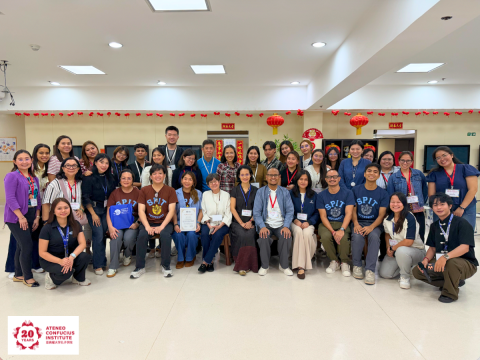
Ateneo Confucius Institute empowers local Chinese teachers through creative skills workshop
The Confucius Institute at Ateneo de Manila University (CI-Ateneo) held its annual training program for local Chinese language teachers on 24 October 2026, adopting a

Cultures of care: Mental health and pathways to well-being in Southeast Asia
The Ateneo Initiative for Southeast Asian Studies (AISEAS) and the Department of Psychology, both under the Dr Rosita G Leong School of Social Sciences (RGLSOSS)

Interdiscipline: Global and Area Studies Conversations
Public Mental Health in Southeast Asia By: Maria Regina Hechanova* In 2021, 80.4 million cases of mental disorders were reported across ASEAN countries - an