Interdiscipline: Global and Area Studies Conversations
10 Nov 2026 | Ricardo Leong Institute for Global and Area Studies


Imagining the Mahjong Table as a Third Space
By: Erwin Guile Dizon*
Once a game reserved for private gatherings at home, mahjong is seeing a renaissance in the Philippines’ social scene. Though Lacap’s (2026) article from the Daily Tribune primarily discusses how the game is making rounds in Metro Manila, online posters and event announcements show that the game is thriving well beyond the confines of the National Capital Region. Major cities such as Cebu, Davao, Iloilo, and Ilocos to name a few, have mahjong communities who organize gaming sessions for the love of the game. And while widely known as a game involving money, gambling, and funerals, the so called mahjong renaissance veers away from the often negative stigma that has hounded the game. As Lacap (2026) and Singian-Serzo (2026) both note, younger players have focused the game as part of a movement against digital fatigue, social events, and partly an influence of pop culture references such as the iconic scene from the hit movie Crazy Rich Asians.
With mahjong clubs popping up here and there with different groups hosting mahjong sessions in various open spaces such as restaurants, cafes, and other such public or semi-public spaces, this invites inquiry regarding the capacity of the mahjong table as an emerging third space where people or enthusiasts can come together to socialize and mingle with like-minded members of their playing community.
The concept of a third space is borrowed from American sociologist Ray Oldenburg who coined the term “third place”' which is defined as "a space for informal, free social interaction, essential to democracy" different from home and workplace (Oldenburg and Christensen 2023). These third spaces are often a public setting that allows peoples to connect and converse with their community (Roberts-Ganim 2023). At an individual level, psychologist Elena Tourini, PhD says that third places provide an important role by offering a break from the demands of work-home life by providing a space for relaxation, enjoyment, and social engagement (TBR News Media 2026). In the broader scheme of things, the common interests that bring people together in a third space act like a societal glue that binds people together to construct communities (Beal 2024).
The ability of third spaces to keep society together comes from what Kasley Killiam from Adam England (2026) describes as essential community resources and places where friends, family, and neighbors can meet, spend time together, and engage in civic life. And while a wide range of spaces can be called and claim to be third spaces, a UNESCO article by Oldenburg and Christensen (2023) mentions that not all spaces who claim thirdness are true third places. To them, a third place is often a watering hole or place of gathering wherein conversation is the main activity. In that same article, they list down features that define a third place, and these include the following:
a. Neutral ground and open to anyone;
b. Unstructured and participants come and go as they please;
c. Not expensive;
d. Conversation is the main activity, though playing games like chess and mahjong are also common;
e. Near your home or workplace;
f. It has regulars, though strangers are not out of place; and
g. Chatter, joking, and teasing are integral parts.
Can we consider the supposed renaissance of mahjong in the Philippines' social scene an emerging third space or place?
Mahjong was initially confined within the walls of one’s residence. What was once a game played almost exclusively with one’s immediate or perhaps also extended family, allowed for a limited degree of public accessibility. Because of this, the old and perhaps more familiar avenue for playing mahjong is best categorized within the constructs of the first space. And though the game had little to do with the pressures of home life except perhaps for the social responsibility of participating actively and quickly lest one wanted to incur the ire of one’s amma (grandmother in Hokkien) or auntie who often followed the strict rules of the game, the mahjong game at home was meant for private consumption and for socialization within closed ranks. At this critical point alone, this version of the mahjong table did not have the capacity for thirdness.
The second scenario of the mahjong table’s ability to project space-ness was its occasional presence in funeral parlors as a popular pastime for some of the attendees. Often accompanied by playing cards, the image of a mahjong game happening during a wake popularized the notion that mahjong was a gambling game that was often publicly viewable during wakes. When checked with the features of a third place a number of observations can be made. First, the funeral setting is a strong deterrent to the ability of this variation of mahjong to become a third space. The peculiar conditions of the funeral setting controls who has access to the mahjong table. Likewise, mahjong is far from the center of activity during a wake thus decentering it as a focal point for social or community interaction, which it also is unable to do since there is often a limited number of sets to play with in the first place. Given this initial but significant hurdle, this second case of the mahjong table cannot truly fit with the idea of third spaces.
In the current period of the mahjong renaissance, the mahjong table is no longer just confined to the space at home nor at the funeral parlor. Now often situated in cafes, restaurants, and other public spaces, the mahjong table finds itself in a location that is typically already associated with third spaces. Pertaining now to the details of the mahjong sessions, they tend to be targeted activities that center their efforts towards playing and appreciating the mahjong game. Each session is often open to first time players as well as regular and veteran players who can interact with one another given their shared interest in the game. Next, the physical space and the available number of sets allows for multiple players to participate; thus, increasing the social aspect of mahjong table. On the matter of financial accessibility, it is no secret that joining these mahjong communities may entail a degree of investment since hosting organizations often charge a fee to reserve their venue and provide food and drinks to their participants. The price range can vary significantly depending on the host institution. And since the mahjong game has effectively transformed from either an intimate or gambling event to one heavily focused on the social aspects of playing, the opportunities for conversation, chatter, jokes, and teases have allowed the mahjong table to become a platform for establishing new friendships, and perhaps rekindle old ones.
The concept of the third place coined by Ray Oldenburg highlighted the importance of an alternative space that is separate from one’s home and work as a place where people and individuals can socialize with a community that they feel that they belong to. In his and the words of more recent scholars, the third space helps contribute to the functioning of society by creating spaces that provide opportunities for societies to connect with one another in ways that can glue society together.
The mahjong table’s sense of space has transformed. From the home which is private and limited to invited individuals only, or the funeral parlor where access is limited to those who are related to the deceased and the focus of the event is not the tabletop game, the mahjong renaissance that is happening in the Philippines implies a more open and accessible space to any member of the Filipino society.


Erwin Guile "EG" Dizon is the Director of the Ricardo Leong Center for Chinese Studies, and a board member of the Philippine Association for Chinese Studies. Though his main research is focused on the relationship between China and ASEAN, and the navigated identities of overseas Chinese communities, he is also an advocate of using Chinese culture as a means of bridging cultural divides among differing cultures.
Works Cited
Beal, J. (2024, September 24). What are Third Places and Why Do They Matter? . Retrieved from Albert Shanker Institute: https://www.shankerinstitute.org/blog/what-are-third-places-and-why-do-they-matter
England, A. (2026, February 3). Why Third Places Are Essential to Creating Community in Modern Society. Retrieved from verywellmind: https://www.verywellmind.com/why-third-places-matter-8584788
Lacap, E. (2026, October 13). Mahjong renaissance: Metro Manila’s newest social scene. Retrieved from Daily Tribune: https://tribune.net.ph/2026/10/12/mahjong-renaissance-metro-manilas-new… https://tribune.net.ph/2026/10/12/mahjong-renaissance-metro-manilas-new
Oldenburg, R., & Christensen, K. (2023, March 22). Third places, true citizen spaces. Retrieved from UNESCO Courier: https://courier.unesco.org/en/articles/third-places-true-citizen-spaces
Roberts-Ganim, M. (2023). Third Places: What are they and why are they important to American culture. Retrieved from University of Chicago English Language Institute: https://esl.uchicago.edu/2023/11/01/third-places-what-are-they-and-why-are-they-important-to-american-culture/
Singian-Serzo, L. (2026, September 1). Mahjong is having a moment again. Retrieved from Inquirer.net: https://lifestyle.inquirer.net/580157/where-to-play-mahjong-in-manila/
TBR News Media. (2026, March 22). Editorial: The power of third places. Retrieved from TBR New Media: https://tbrnewsmedia.com/editorial-the-power-of-third-places/
Interdiscipline: Global and Area Studies Conversations is a community space for commentaries, dialogue, and expert analysis by RGLSOSS faculty and researchers working across global and area studies. It brings together scholars of China, Europe, Japan, Korea, Southeast Asia, and other regions to examine pressing regional and global issues while reflecting on the changing ways in which we understand regions, connections, and the world.
Area studies has long brought disciplinary perspectives into conversation through sustained attention to particular places, histories, languages, societies, and cultures. Yet the boundaries that define regions and fields of study are neither natural nor fixed. They have been shaped by changing political, economic, and intellectual contexts, and continue to be reworked as people, ideas, institutions, commodities, and problems move across borders (Cumings, 1997).
Global studies responds to these connections by moving beyond exclusively national or disciplinary frames. Rather than treating the “global” as a scale that supersedes the regional or local, it invites interdisciplinary, multicentric, and multilevel approaches that examine interactions among global, regional, national, and local processes (Nederveen Pieterse, 2013). From this perspective, global and area studies are complementary forms of inquiry: global perspectives illuminate connections and processes that traverse regions, while area-based knowledge provides the historical, cultural, and empirical grounding necessary to understand how those processes take different forms in particular places.
Interdiscipline creates a space for this conversation. Taking interdisciplinarity to mean the interaction and hybridization of knowledge across established disciplinary boundaries (Frickel, 2004, as cited in Fuchsman, 2012), the forum encourages scholars to think across disciplines, regions, and scales. In doing so, it seeks more context-sensitive, critically reflexive, and plural understandings of contemporary regional and global affairs.
Works cited
Cumings, B. (1997). Boundary displacement: Area studies and international studies during and after the Cold War. Bulletin of Concerned Asian Scholars, 29(1), 6–26.
Fuchsman, K. (2012). Interdisciplines and interdisciplinarité: Political psychology and psychohistory compared. Issues in Integrative Studies, 30, 128–154.
Nederveen Pieterse, J. (2013). What is global studies? Globalizations, 10(4), 499–514.
Recent News
You may also like these articles

Tickets available for Heiwa no Senritsu: Mga Himig ng Kapayapaan
Tickets are now available for the upcoming orchestral concert, Heiwa no Senritsu: Mga Himig ng Kapayapaan, which will take place on 8 December 2026, 7:00

Join Ateneo Art Gallery for the Curator's Walkthrough and Exhibition Reception of "Printmaking: From Albrecht Dürer to Kiki Smith"
Ateneo Art Gallery presents a Curator’s Walkthrough of Printmaking: From Albrecht Dürer to Kiki Smith with guest curator Tony Godfrey on 20 November 2026 (Friday)
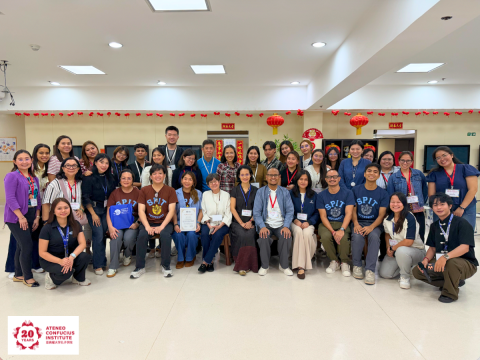
Ateneo Confucius Institute empowers local Chinese teachers through creative skills workshop
The Confucius Institute at Ateneo de Manila University (CI-Ateneo) held its annual training program for local Chinese language teachers on 24 October 2026, adopting a

Cultures of care: Mental health and pathways to well-being in Southeast Asia
The Ateneo Initiative for Southeast Asian Studies (AISEAS) and the Department of Psychology, both under the Dr Rosita G Leong School of Social Sciences (RGLSOSS)

Interdiscipline: Global and Area Studies Conversations
Public Mental Health in Southeast Asia By: Maria Regina Hechanova* In 2021, 80.4 million cases of mental disorders were reported across ASEAN countries - an

[Ateneo Press Review Crew] All Love Lost: Duterte and China’s Entangled Shadow, A Review of Unrequited Love: Duterte’s China Embrace
On 20 May 2026, a harrowing report about a radioactive steel plant located in Tagoloan, Misamis Oriental, Northern Mindanao, hit the headlines. Among the over