
Main Secondary Navigation

  • About Ateneo de Manila
  • Schools
  • Research
  • Global
  • Alumni
  • News
  • Events

Main navigation

  • Learn & Grow
  • Discover & Create
  • Make an Impact
  • Campus & Community
  • Apply
School of Social Sciences
ABOUT RGLSOSS DEPARTMENTS, PROGRAMS, CENTERS ACADEMIC PROGRAMS RESEARCH & CREATIVE WORK INTERNATIONALIZATION
  • About
  • Flagship Programs
  • Fellows
  • Collaborative Projects
  • Publications
  • Institutional Archives
  • Interdiscipline: Global and Area Studies Conversations

Interdiscipline: 
Global and Area Studies Conversations 

Body

Interdiscipline: Global and Area Studies Conversations is a community space for commentaries, dialogue, and expert analysis by RGLSOSS faculty and researchers working across global and area studies. It brings together scholars of China, Europe, Japan, Korea, Southeast Asia, and other regions to examine pressing regional and global issues while reflecting on the changing ways in which we understand regions, connections, and the world.

Area studies has long brought disciplinary perspectives into conversation through sustained attention to particular places, histories, languages, societies, and cultures. Yet the boundaries that define regions and fields of study are neither natural nor fixed. They have been shaped by changing political, economic, and intellectual contexts, and continue to be reworked as people, ideas, institutions, commodities, and problems move across borders (Cumings, 1997).

Global studies responds to these connections by moving beyond exclusively national or disciplinary frames. Rather than treating the “global” as a scale that supersedes the regional or local, it invites interdisciplinary, multicentric, and multilevel approaches that examine interactions among global, regional, national, and local processes (Nederveen Pieterse, 2013). From this perspective, global and area studies are complementary forms of inquiry: global perspectives illuminate connections and processes that traverse regions, while area-based knowledge provides the historical, cultural, and empirical grounding necessary to understand how those processes take different forms in particular places.

Interdiscipline creates a space for this conversation. Taking interdisciplinarity to mean the interaction and hybridization of knowledge across established disciplinary boundaries (Frickel, 2004, as cited in Fuchsman, 2012), the forum encourages scholars to think across disciplines, regions, and scales. In doing so, it seeks more context-sensitive, critically reflexive, and plural understandings of contemporary regional and global affairs.

Works cited

Cumings, B. (1997). Boundary displacement: Area studies and international studies during and after the Cold War. Bulletin of Concerned Asian Scholars, 29(1), 6–26.
Fuchsman, K. (2012). Interdisciplines and interdisciplinarité: Political psychology and psychohistory compared. Issues in Integrative Studies, 30, 128–154.
Nederveen Pieterse, J. (2013). What is global studies? Globalizations, 10(4), 499–514.


Interdiscipline: Global and Area Studies Conversations

September 2026

  • 08 Sep: The Interdisciplinary and Layered Social Chains of Value Analysis by: Joselito T. Sescon
  • 22 Sep: Japan in Asia: Agency, Partnerships, and Regional Change by: Maria Thaemar C. Tana

October 2026 

  • 20 Oct: Doing Area Studies through In-Country Field Studies by: Javier R. Tionloc
  • 27 Oct: Public Mental Health in Southeast Asia by: Maria Regina Hechanova

November 2026 

  • 10 Nov: Imagining the Mahjong Table as a Third Space by: Erwin Guile Dizon

Article Submission Guidelines: 
  • Article: 800–1,000 words
  • Content photo: Please provide a relevant photo, along with a separate caption for the photo.
  • Bionote: A brief 2–3-line bionote, accompanied by a photo of the author/contributor.
  • Please identify the SDGs that are applicable to the topic:
    • 01. No Poverty
    • 02. Zero Hunger
    • 03. Good Health and Well-being
    • 04. Quality Education
    • 05. Gender Equality
    • 06. Clean Water and Sanitation
    • 07. Affordable and Clean Energy
    • 08. Decent Work and Economic Growth
    • 09. Industry, Innovation and Infrastructure
    • 10. Reduced Inequalities
    • 11. Sustainable Cities and Communities
    • 12. Responsible Consumption and Production
    • 13. Climate Action
    • 14. Life Below Water
    • 15. Life on Land
    • 16. Peace, Justice and Strong Institutions
    • 17. Partnerships for the Goals
  • Please identify the General Topics that are applicable:
    • Academics
    • Research, Creativity, and Innovation
    • Mission & Formation
    • Arts & Culture
    • Sports & Athletics
    • Campus Life
    • Social Engagement & Nation-Building
    • Sustainability
    • Alumni & Advancement
    • Internationalization
    • Administration
    • Health & Safety
    • Milestones & Recognition
  • Please identify the relevant Strategic Priority Area (SPA) of Lux in Domino 2030:
    • Bridging Cultural Divides
    • Educational Reform and Transformation
    • Integral Ecology
    • Universal Health and Wellbeing
  • Posting dates: Every 2nd and 4th Tuesday of each month


    Back to the Leong Institute homepage

Leong Institute Updates

1

28 Aug 2025

AISEAS, RLIGAS bring students to Vietnam for In-Country Field Study 2025

Thirteen (13) students completed their in-country field study to Hanoi and Ho Chi Minh City in Vietnam, from 29 June to 12 July 2025 last...

Ricardo Leong Institute of Global and Area Studies

26 Jun 2025

Leong Institute hosts focus group on defining health needs

This is a follow-up to the 9 June 2025 article “ Leong Institute hosts benchmarking session on anticipated health needs ” On 18 June, the...

Ricardo Leong Institute of Global and Area Studies

09 Jun 2025

Leong Institute hosts benchmarking session on anticipated health needs

On 3 June 2025, the Ricardo Leong Institute of Global and Area Studies (Leong Institute) of Ateneo de Manila University's Dr Rosita G Leong School...
1

12 Nov 2024

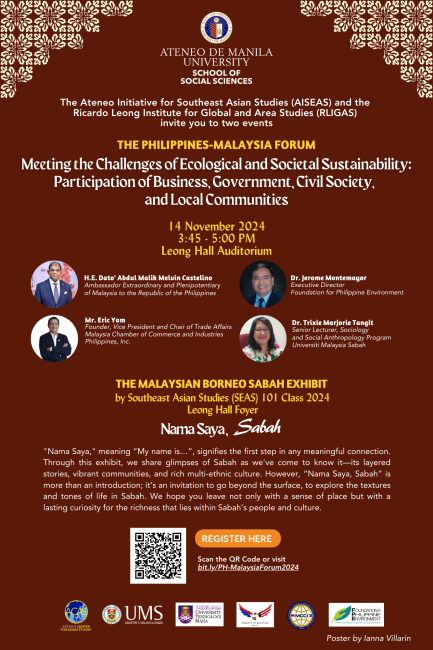
The Philippines-Malaysia Forum and the Malaysian Borneo Sabah Exhibit

The Ateneo Initiative for Southeast Asian Studies (AISEAS) with the Ricardo Leong Institute for Global and Area Studies conducted its in-country field study in Sabah...

Pagination

  • First page « First
  • Previous page ‹ Previous
  • Page 1
  • Page 2
  • Page 3
  • Page 4
  • Page 5
  • Page 6
  • Next page Next ›
  • Last page Last »

Ricardo Leong Institute for Global and Area Studies

Room FH202 Faber Hall
Ateneo de Manila University Loyola Heights campus
Katipunan Avenue, Loyola Heights
1108 Quezon City
Philippines

Contact the Leong Institute

Katipunan Avenue, Loyola Heights, Quezon City 1108, Philippines

info@ateneo.edu

+63 2 8426 6001

Connect With Us
  • Contact Ateneo
  • A to Z Directory
  • Social Media
Information for
  • Current Students
  • Prospective Students
  • International Students
  • Faculty & Staff
  • Alumni
  • Researchers & Visiting Academics
  • Parents
  • Donors & Partners
  • Visitors & Media
  • Careers
Security & Emergency
  • COVID-19
  • Campus Safety
  • Network & Tech
  • Emergency Management
  • Disaster Preparedness
Digital Resources
  • AteneoBlueCloud
  • Archium
  • Rizal Library
  • Ateneo Mail (Staff)
  • Ateneo Student Email
  • Alumni Mail
  • Branding & Trademarks
  • Data Privacy
  • Acceptable Use Policy
  • Report Website Issues
  • Ateneo Network
  • Philippine Jesuits

Copyright © 2022 Ateneo de Manila University. All rights reserved. | info@ateneo.edu | +63 2 8426 6001

Search