
Disaster Risk Reduction
In 2022, the Philippines experienced a significant increase in its risk index. This rise highlights the critical challenge of cascading disasters, where one catastrophe hinders recovery efforts before another strikes. Anticipatory action has become vital to addressing this issue.
The transition from reactive to anticipatory measures is key to disaster resilience. Anticipatory technologies enable proactive preparation for impending hazards, reducing disaster impact and risk. This shift facilitates faster and more efficient responses and recoveries.
At times, exclusion zones were designated for areas with a high potential for disasters. Nevertheless, the purpose of these zones has shifted from barring people entry to ensuring their safety and survival.:
- HOT ZONE: The disaster area with unstable infrastructure and ongoing rescue and recovery operations.
- WARM ZONE: A Triage and Control Area equipped with life-saving medical resources, transportation to hospitals, and mission control.
- SAFE ZONE: An Evacuation Area temporarily housing non-critical victims, pre-positioned relief supplies, and public assistance and information centers.
Strategic placement of safe zones and evacuation centers is determined by factors such as susceptibility to hazards, the presence of vulnerable populations, and local government response capabilities. Local hazard assessments and vulnerability evaluations inform this process. A consolidated approach helps identify the most suitable locations.
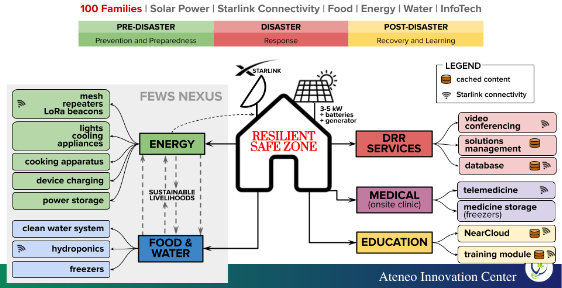
But the key to comprehensive disaster resilience lies in integrating a 'Nexus of Anticipatory Technologies.' This interconnected system addresses essential aspects, including:
- SOLAR PANEL: Providing renewable energy sources for clean water systems and an energy hub that ensures lighting, power storage, connectivity, and cooking facilities.
- STARLINK: Offering vital satellite communications for telecommunications, disaster data records, and cloud-based solutions, facilitating education, entertainment, and management.
- HYDROPONICS: Ensuring food security and an additional income source for the community.
- BRICK OVEN & STOVE: Supporting food preparation, potable clean water generation, and sanitation in the safe zones and evacuation centers.
- WASTE MANAGEMENT: Efficiently handling waste through wetlands and gray water treatment while generating income.
The Ateneo Innovation Center has already developed the integration of this innovative 'Nexus of Anticipatory Technologies' into safe zones and evacuation centers, ensuring not only the capacity to respond effectively to cascading disasters but also self-sustainability in terms of energy, communication, food, clean water, and waste management. This holistic approach empowers communities to thrive under normal circumstances and promotes resilience in the face of ongoing challenges. Furthermore, these safe zones and evacuation centers also serve as hubs for medical services, disaster risk reduction, and community training, enhancing overall disaster preparedness.
Sustainable Technologies for Environment-Friendly and Ecological Resilience (STEER) Project
The STEER project offers communities the opportunity to utilize seven innovative technologies. These cost-effective devices are seamlessly integrated into environmentally resilient homes.
In partnership with Ateneo de Naga University, the DIGDI and STEER initiatives have joined forces to create self-sustaining and resilient houses. This innovative project focuses on constructing homes using Recycled Coarse Aggregate Concrete (RCAC). Here are the key features of the houses:
Solar Photovoltaic (PV) Components: The project has deployed 450 W solar PV components to provide renewable energy for three houses. These solar panels power various devices and systems, reducing reliance on traditional energy sources and promoting efficiency.
Solar Fans and LED Lighting: Solar energy is harnessed to power fans and LED lighting in the houses, enhancing energy efficiency and sustainability.
Clean Water System: Each house is equipped with a clean water system capable of producing 200 liters of drinking water in just one hour, ensuring access to safe drinking water through advanced purification or filtration methods.
NearCloud Device: Partner schools benefit from the Ateneo Innovation Center's NearCloud device, which enables wireless dissemination of learning modules to students, facilitating remote education.
Image Transmission via Radio: An image transmission device is in place to send pictures during emergencies, even in areas with no regular signal, aiding crucial communication during crises.
Hydroponics Setup with LoRa-based Sensors: The project incorporates hydroponics for vegetable cultivation, enhanced by LoRa-based sensors. These sensors monitor and transmit data related to plant growth parameters, facilitating remote monitoring through an IoT analytics platform.
Domestic Liquid Waste Treatment: A waste treatment system is employed to reduce bacteria in domestic liquid waste to 10%, making it suitable for watering plants. This promotes efficient and eco-friendly waste management practices.
Brick Stove and Oven: The brick stove and oven utilize residual heat for water heating while cooking, showcasing a sustainable approach to culinary activities.
Journals
- Sustainable Technologies for Environment-Friendly and Ecological Resilience, Paul M. Cabacungan, Khim Cathleen M. Saddi, Maria Theresa Joy G. Rocamora, Reymond P. Cao, Salvador P. Granada, Paul Ryan A. Santiago, Neil Angelo M. Mercado, Carlos M. Oppus, Cristina F. Gonzales, Nathaniel Joseph C. Libatique, Emma E. Porio & Gregory L. Tangonan
Ateneo Innovation Center
CTC 416, PLDT Convergent Technologies Center
Ateneo de Manila University Loyola Heights campus
Katipunan Avenue, Loyola Heights
1108 Quezon City
Philippines