6.4.2 Water Reuse Measurement
01 May 2025


Measuring Water Reuse Across the University
Ateneo de Manila University systematically measures water reuse across its campuses as part of its institutional commitment to sustainable water management, evidence-based environmental governance, and the responsible stewardship of natural resources. Through the Central Facilities Management Office (CFMO) and the University's campus-wide water monitoring systems, Ateneo tracks both overall water consumption and the volume of alternative water sources that are recovered and reused, including harvested rainwater and treated wastewater. This measurement framework enables the University to assess the effectiveness of its water conservation initiatives, optimize water reuse strategies, and support informed decision-making for campus operations and infrastructure planning.
Institutional Measurement of Water Reuse
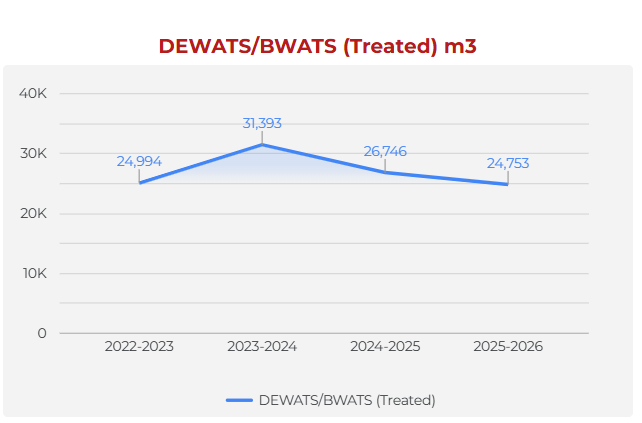
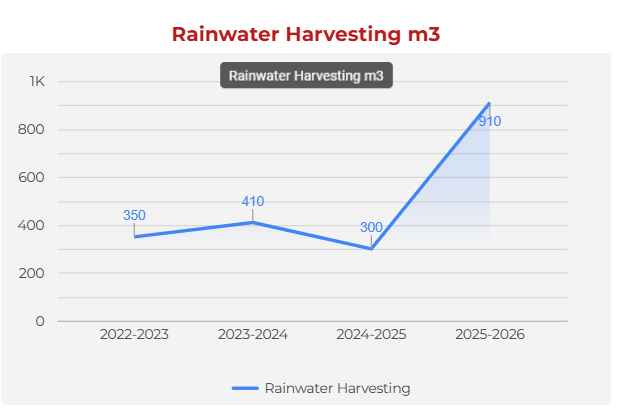
The University recognizes that maximizing water reuse requires not only the implementation of water recycling systems but also the continuous measurement of their performance. Consequently, Ateneo has established a campus-wide monitoring framework that records both the University's overall water consumption and the volume of water recovered through rainwater harvesting and water reuse initiatives.
The table above shows data on BWATS/DEWATS and rainwater measurement. Between academic years 2022–2023 and 2024–2025, the university's water management was overwhelmingly driven by DEWATS/BWATS wastewater treatment, which provided the vast majority of managed water volume on campus. Treated water volume surged from 24,994 m³ in 2022–2023 to a peak of 31,393 m³ in 2023–2024, before tapering slightly to 26,746 m³ in 2024–2025. In contrast, rainwater harvesting maintained a modest profile over the same three-year period, peaking at 410 m³ in 2023–2024 before dipping to 300 m³ in 2024–2025, underscoring a consistent reliance on centralized treatment infrastructure during these academic years.
Measuring Rainwater Reuse for Campus Operations
Rainwater harvesting forms an important component of Ateneo's water reuse measurement system. Rainwater collected from campus buildings is not only utilized for non-potable purposes but is also measured to determine the contribution of harvested water to overall campus water management.
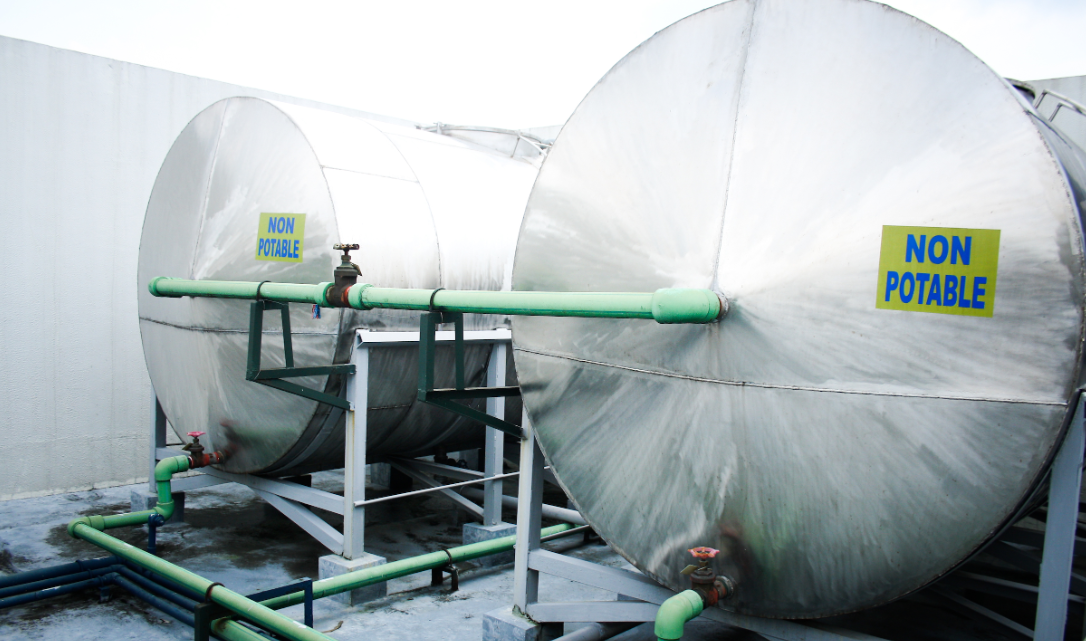
At facilities such as the New Rizal Library and the Cervini Cafeteria, rainwater harvested from rooftop collection systems is filtered and reused for toilet flushing, reducing the demand for potable water within these high-use buildings. The volume of harvested rainwater supplied to these facilities is recorded as part of the University's institutional water metrics, providing measurable evidence of the effectiveness of rainwater reuse infrastructure.
By quantifying harvested rainwater separately from municipal water consumption, Ateneo is able to evaluate the performance of its rainwater harvesting systems, assess opportunities for expanding reuse infrastructure, and demonstrate measurable reductions in potable water demand through sustainable building design.
Supporting Circular Water Management Through Measurement
Measuring reused water is an essential component of Ateneo's circular water management approach. Rather than viewing alternative water sources simply as supplementary resources, the University systematically records their contribution to campus operations, enabling the effectiveness of water reuse programs to be evaluated over time.
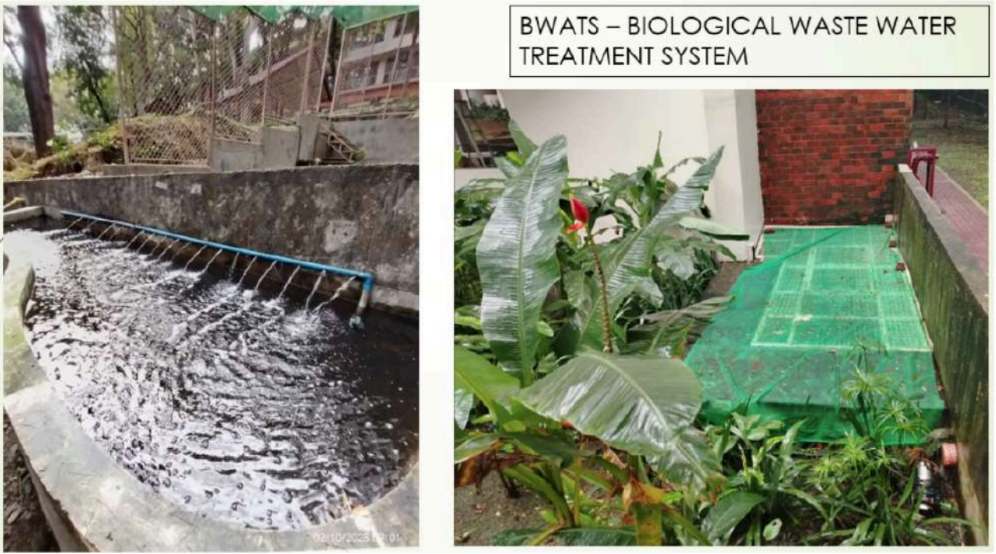
The University's broader water management system incorporates rainwater harvesting, Decentralized Wastewater Treatment Systems (DEWATS), Building Wastewater Treatment Systems (BWATS), and water recycling initiatives that provide non-potable water for irrigation, toilet flushing, grounds maintenance, and cleaning activities. Measuring reused water alongside overall consumption enables Ateneo to quantify the environmental benefits of these systems, including reductions in freshwater demand and improvements in water resource efficiency.
This continuous measurement also supports long-term planning by identifying opportunities to expand reuse infrastructure, improve operational efficiency, and strengthen campus resilience to increasing water demand and climate variability.
Source:
Recent News
You may also like these articles

Growing with purpose: How Mekeni Food Corporation turns adversity into shared value
From a small backyard operation in Porac, Pampanga, to an internationally recognized food brand exporting to 25 countries, Mekeni Food Corporation's journey demonstrates how businesses

Three Ateneo-incubated startups secure DOST-PCIEERD’s startup grant fund
Last 9 November, during the opening day of Philippine Startup Week 2026, Soolok Properties Inc, Pili AdheSeal Inc, and Saltric Power (PDG Engineering Services), three

Ateneo de Manila Grade 2 students are the little Earth helpers
It was a great day for saving the world when Ateneo Institute of Sustainability (AIS) came to Ateneo Grade School to give a session on
JGSOM representatives complete green finance training in Poland, sets sights on 2027 micro-credential launch
Representatives of Ateneo de Manila University's John Gokongwei School of Management (JGSOM) completed the second phase of their Erasmus+ Green Finance international mobility activities at
JGSOM Representatives Participate in Green Finance Training at the University of Twente
Enschede, Netherlands | October 15–16, 2026 Representatives of Ateneo de Manila University's John Gokongwei School of Management (JGSOM) participated in a specialized Green Finance training

Professor Emeritus Dr Emma Porio highlights climate resilience and biodiversity at international conferences
Emma E Porio, PhD, Professor Emeritus of Ateneo de Manila University and Principal Investigator of Ateneo's Manila Observatory Center for Climate Resilience and Public Health