17.4.1 Education for SDGs Commitment to Meaningful Education
01 May 2025


Ateneo de Manila University fulfills its commitment to meaningful education for the Sustainable Development Goals (SDGs) by embedding sustainability and active citizenship directly into its academic and formation programs. Driven by the belief that achieving global goals requires transformative learning, the Ateneo Institute of Sustainability advances Education for Sustainable Development across three priority areas: deepen the knowledge and orientation of University stakeholders on the SDGs, strengthen ecological education and culture for sustainable development in universities, and synergize sustainability initiatives in the University and throughout the country. This commitment comes to life through Ateneo’s progressive student formation pathway—spanning Binhi (first-year socio-cultural awareness), Punla (sophomore community immersion), and Bigkis (junior service-learning merging sustainability coursework with national service)—empowering students to translate classroom learning into meaningful action for the common good.
Ateneo’s SDG Program Under the Ateneo Institute of Sustainability
Achieving the goals stated in the SDGs requires a broad-based transformation in the economic, social, political, and technological dimensions of human life, which need to be supported by cross-disciplinary systems thinking and the rapid upscaling of sustainable development technologies and know-how. Integral to achieving the SDGs are partnerships and education.
The SDG Program of AIS serves as an avenue to mainstream Education for Sustainable Development (ESD) and sustainability synergy via different networks. Working with the different academic units and student organizations, the Program designs modules that seek to build competences pertinent in addressing the world’s wicked problems reflected in the SDGs. Integral to this is the capacity building on ESD of faculty and professionals and sustainability leadership of student groups and organizations. Through this, the Program aims to embed sustainability and integral ecology to be part of the lexicon of the different stakeholders of the University. Additionally, the Program strives to strengthen its knowledge and keeps up to the trends of sustainable development through synergizing with networks. Thus, the Program engages with numerous national and regional networks, such as the ASEAN University Network for Ecological Education and Culture (AUN-EEC), Promotion of Sustainability in Postgraduate Education and Research Network (ProSPER.Net), and the Sustainable Development Solutions Network Philippines (SDSN PH).
The Ateneo SDG Program advances campus sustainability, ecological education, and inter-institutional collaboration through three primary priority areas:
- Deepen the knowledge and orientation of University stakeholders on the SDGs: Mainstreams sustainable development across university units by developing orientation modules, offering program consultancy, and integrating Education for Sustainable Development (ESD) into academic curricula and formation programs. Key initiatives include the Laudato Si’ University-wide Baseline Study, monthly SDG awareness campaigns, and the Radyo Katipunan show Footprints: Stories of Sustainability.
- Strengthen ecological education and culture for sustainable development in universities: Fosters pedagogical innovation and sustainability leadership anchored in integral ecology across academic, co-curricular, and formative spaces. Serving as the Secretariat for the ASEAN University Network - Ecological Education and Culture (AUN-EEC), the program drives regional youth formation through teacher-training ESD modules, sustainable event toolkits, annual conferences, webinars, and workshops.
- Synergize sustainability initiatives in the University and throughout the country: Facilitates inter-university research collaboration and aligns sustainability efforts across academic networks, research centers, local communities, and government bodies. Supporting national and local SDG localization, the program actively leads and participates in working groups including the SDG 2 Zero Hunger Working Group, the SDSN Philippines ESD Working Group, and the ProSPER.Net Expert Advisory Panel on Circular Economy.
From Self to Service: Ateneo’s Integrated Student Formation Programs
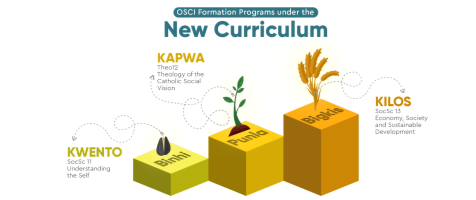
Ateneo de Manila University’s student formation programs connect classroom learning with personal reflection, social awareness, and meaningful engagement with communities. Through a progression that follows students from their first year through their junior year, these programs encourage students to understand themselves not only as individuals but also as members of a wider society. The formation experience gradually moves from self-awareness and social understanding toward deeper engagement with vulnerable communities and, eventually, service-oriented action.
This progression is reflected in Binhi, Punla, and Bigkis, which are integrated into students’ academic and formation experiences. Binhi introduces first-year students to the relationship between the self, society, and culture through exposure and reflection. Punla builds on this foundation by immersing sophomores in communities and institutions representing vulnerable sectors, encouraging social analysis, theological reflection, and meaningful relationships. By their junior year, Bigkis connects students’ learning in sustainable development and national service with practical engagement, allowing them to apply their skills and knowledge in responding to community needs.
Bigkis: Connecting Sustainability Education with Community Engagement
Bigkis is a student formation program for Ateneo de Manila University juniors taking Economy, Society, and Sustainable Development (SocSc 13) and the National Service Training Program (NSTP 12). At the center of the program is the connection between sustainability education and meaningful community engagement, giving students opportunities to apply what they learn about sustainable development to real social and community contexts.
Through SocSc 13, students examine the relationships among the economy, society, and the environment and consider how development can respond to present needs while promoting more sustainable and equitable communities. Bigkis extends these lessons beyond the classroom by providing opportunities for students to work with marginalized communities and organizations through service-learning research and projects. These engagements allow students to see how issues of sustainability are experienced at the community level and to consider how different social and economic conditions shape people's ability to achieve sustainable development.
The program also encourages students to reflect on their own role in creating social change. By engaging directly with communities, students can connect concepts from SocSc 13 with practical experiences and consider how their knowledge, skills, and future professions can contribute to addressing social and environmental challenges.
Bigkis also brings together lessons from Ateneo's broader formation programs. Students are encouraged to synthesize their previous experiences of self-awareness, social engagement, and community immersion with their understanding of sustainable development. This progression helps them recognize the relationship between personal responsibility, social justice, community participation, and sustainability.
Sources:
1. AIS Sustainable Development Goals (SDG) Program
2. Bigkis: Connecting Sustainability Education with Community Engagement
Recent News
You may also like these articles

Growing with purpose: How Mekeni Food Corporation turns adversity into shared value
From a small backyard operation in Porac, Pampanga, to an internationally recognized food brand exporting to 25 countries, Mekeni Food Corporation's journey demonstrates how businesses

Three Ateneo-incubated startups secure DOST-PCIEERD’s startup grant fund
Last 9 November, during the opening day of Philippine Startup Week 2026, Soolok Properties Inc, Pili AdheSeal Inc, and Saltric Power (PDG Engineering Services), three
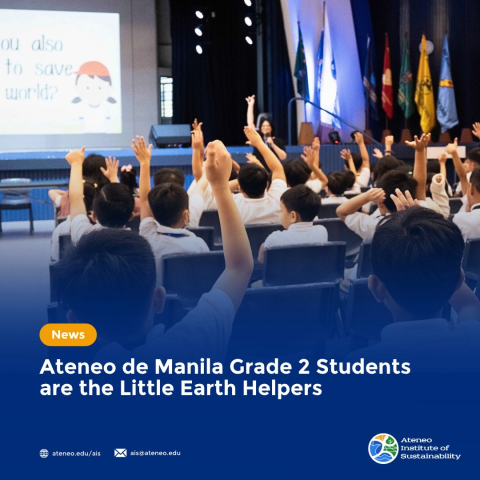
Ateneo de Manila Grade 2 students are the little Earth helpers
It was a great day for saving the world when Ateneo Institute of Sustainability (AIS) came to Ateneo Grade School to give a session on
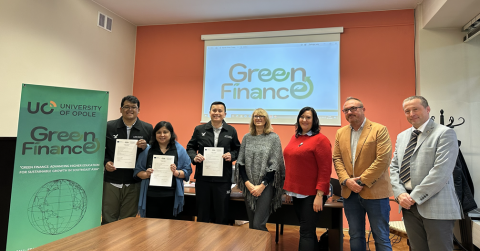
JGSOM representatives complete green finance training in Poland, sets sights on 2027 micro-credential launch
Representatives of Ateneo de Manila University's John Gokongwei School of Management (JGSOM) completed the second phase of their Erasmus+ Green Finance international mobility activities at
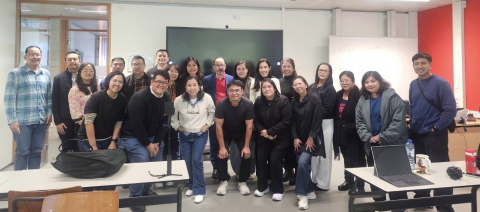
JGSOM Representatives Participate in Green Finance Training at the University of Twente
Enschede, Netherlands | October 15–16, 2026 Representatives of Ateneo de Manila University's John Gokongwei School of Management (JGSOM) participated in a specialized Green Finance training
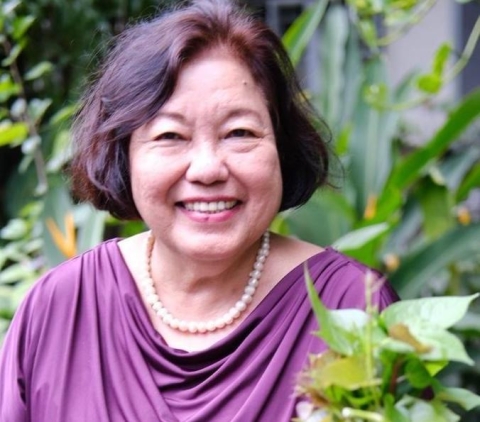
Professor Emeritus Dr Emma Porio highlights climate resilience and biodiversity at international conferences
Emma E Porio, PhD, Professor Emeritus of Ateneo de Manila University and Principal Investigator of Ateneo's Manila Observatory Center for Climate Resilience and Public Health