13.2.1 Low Carbon Energy Tracking
01 May 2025


Low-Carbon Energy Tracking
Ateneo de Manila University systematically measures and monitors the amount of low-carbon energy utilized across its university operations. Through the Campus Facilities and Management Office (CFMO) with the Pollution Control Officer, the University maintains institutional energy monitoring systems that track energy consumption, renewable energy utilization, and greenhouse gas (GHG) emissions performance across its campuses.
The University’s low-carbon energy data is recorded under the official Total Energy Used from Low Carbon Sources dataset, which forms part of Ateneo’s broader sustainability metrics framework. These metrics provide evidence of the University’s ongoing efforts to transition toward cleaner energy sources, reduce carbon emissions, and integrate sustainability principles into campus operations.
The University’s tracking of low-carbon energy utilization confirms its commitment to measuring energy performance as part of its sustainability management practices. Through institutional monitoring systems, Ateneo establishes a reliable foundation for evaluating progress toward cleaner energy use, improving operational efficiency, and advancing its long-term climate action goals.
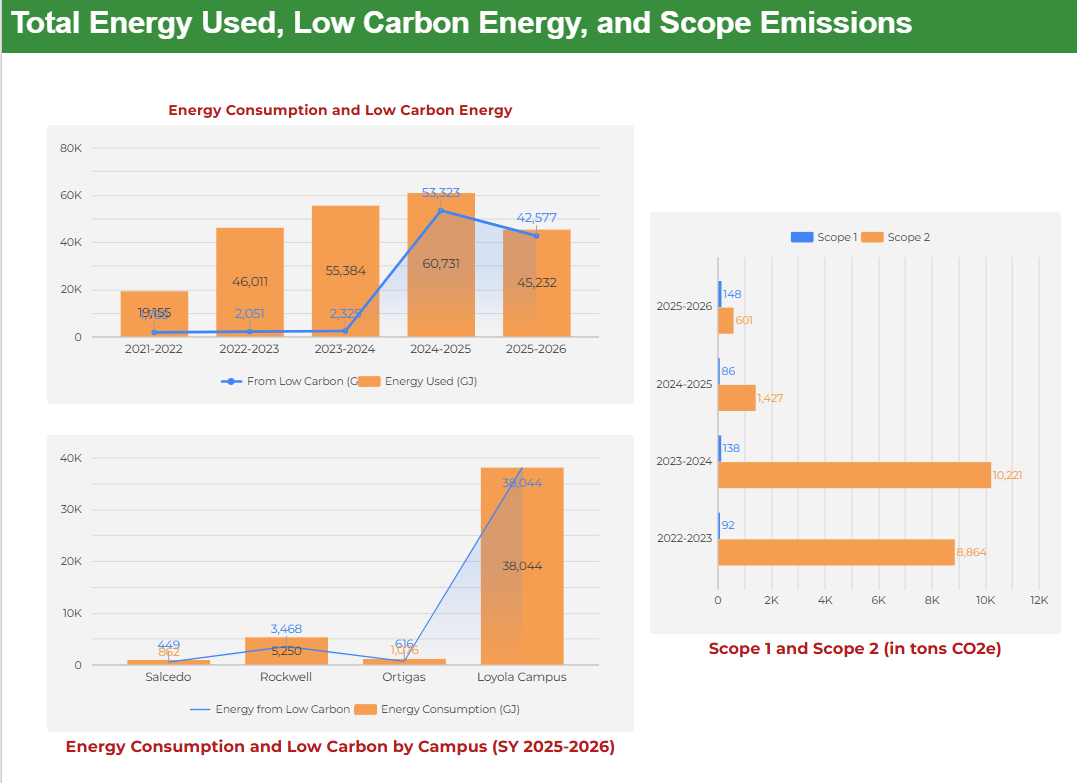
Low-carbon energy utilization on campus recorded a dramatic upward shift, rising from 2,325 kWh in Academic Year 2023–2024 to 53,323 kWh in Academic Year 2024–2025. This surge represents a notable increase of approximately 2,193.46%, reflecting the university's accelerated transition toward low-carbon energy sources and expanded renewable energy integration across campus operations.
Institutional Framework for Low-Carbon Energy Measurement
Ateneo’s low-carbon energy tracking is part of its broader commitment to environmental sustainability and responsible campus operations. The University recognizes that energy consumption is one of the most significant contributors to institutional carbon emissions and therefore prioritizes accurate measurement as a foundation for effective climate action.
The University’s sustainability metrics allow administrators and stakeholders to assess how energy sources evolve over time, measure the effectiveness of renewable energy initiatives, and identify opportunities for further improvements in energy efficiency and emissions reduction.
The monitoring system is managed at the institutional level rather than through isolated facilities or individual projects. This whole-university approach enables Ateneo to evaluate energy performance across its campuses and demonstrate measurable progress toward its sustainability goals.
Energy Monitoring as Evidence of Ateneo’s Climate Action Commitment
Ateneo de Manila University’s low-carbon energy tracking system demonstrates the University’s commitment to evidence-based sustainability management. By measuring energy sources, renewable energy contributions, and associated emissions, Ateneo is able to document progress toward its climate goals and identify pathways for continued improvement.
The systematic monitoring of low-carbon energy use reflects Ateneo’s broader transition toward a more sustainable energy framework. Through institutional data collection, renewable energy integration, and continuous evaluation of energy performance, the University strengthens its capacity to make informed decisions that reduce environmental impact and support long-term decarbonization.
Through comprehensive monitoring, renewable energy initiatives, and continued emissions reduction efforts, Ateneo demonstrates how universities can contribute meaningfully to global climate action while maintaining their educational, research, and community missions.
Source
Recent News
You may also like these articles

Growing with purpose: How Mekeni Food Corporation turns adversity into shared value
From a small backyard operation in Porac, Pampanga, to an internationally recognized food brand exporting to 25 countries, Mekeni Food Corporation's journey demonstrates how businesses

Three Ateneo-incubated startups secure DOST-PCIEERD’s startup grant fund
Last 9 November, during the opening day of Philippine Startup Week 2026, Soolok Properties Inc, Pili AdheSeal Inc, and Saltric Power (PDG Engineering Services), three

Ateneo de Manila Grade 2 students are the little Earth helpers
It was a great day for saving the world when Ateneo Institute of Sustainability (AIS) came to Ateneo Grade School to give a session on

JGSOM representatives complete green finance training in Poland, sets sights on 2027 micro-credential launch
Representatives of Ateneo de Manila University's John Gokongwei School of Management (JGSOM) completed the second phase of their Erasmus+ Green Finance international mobility activities at

JGSOM Representatives Participate in Green Finance Training at the University of Twente
Enschede, Netherlands | October 15–16, 2026 Representatives of Ateneo de Manila University's John Gokongwei School of Management (JGSOM) participated in a specialized Green Finance training

Professor Emeritus Dr Emma Porio highlights climate resilience and biodiversity at international conferences
Emma E Porio, PhD, Professor Emeritus of Ateneo de Manila University and Principal Investigator of Ateneo's Manila Observatory Center for Climate Resilience and Public Health