11.4.2 Promote Sustainable Commuting
25 Mar 2025


Promote More Sustainable Commuting Through Institutional Programs and Infrastructure
Sustainable transportation is an important part of Ateneo de Manila University’s broader commitment to creating a low-carbon and people-centered campus. By providing alternatives to conventional private vehicles and making sustainable mobility more accessible, the University encourages students, employees, and visitors to make transportation choices that are better for both the environment and the campus community. These efforts bring together shared transportation, active mobility, cleaner vehicle technologies, and responsible management of private vehicle use.
Ateneo’s approach goes beyond simply providing transportation options. It combines infrastructure, services, and community participation to make walking, cycling, electric mobility, and ride-sharing practical parts of everyday campus life. Pedestrian-friendly pathways and cycling facilities support active transportation, while electric shuttle services and charging infrastructure provide cleaner alternatives for longer trips. At the same time, parking management and student-led initiatives such as carpooling help address the environmental impact of private vehicle use.
These efforts demonstrate that sustainable mobility is a shared responsibility. The University provides the facilities and systems needed to support greener transportation, while members of the Ateneo community contribute through the choices they make every day. From choosing to walk or cycle to sharing a ride or taking an electric shuttle, these practices show how individual and collective actions can contribute to reducing emissions, improving mobility, and creating a more sustainable campus.
Free Electric Shuttle Service: Zero-Emission Campus Mobility
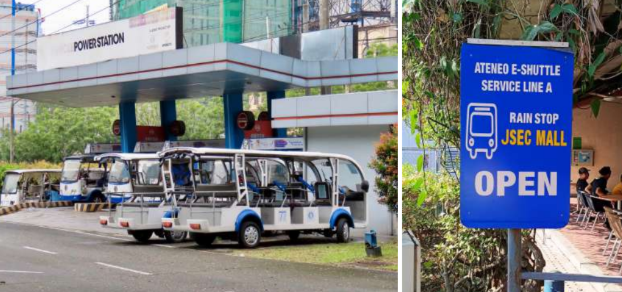
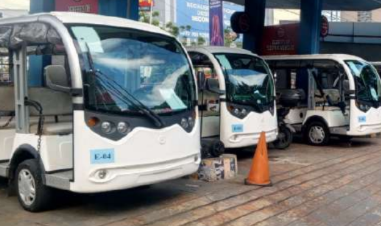
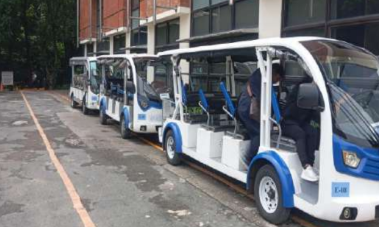
One of Ateneo's flagship sustainable commuting initiatives is the operation of its free electric shuttle service, which utilizes a fleet of 36 electric jeepneys (e-jeeps) to transport members of the University community throughout the campus.
The electric jeepneys operate along two primary campus routes, providing convenient point-to-point transportation between academic buildings, administrative offices, residence halls, parking areas, and other key destinations.
As a free service available to the campus community, the e-jeeps remove financial barriers to choosing sustainable transportation while reducing the need for short private vehicle trips within campus.
Operationally, the electric shuttle system:
- Operates a fleet of 10 zero-emission electric jeepneys;
- Serves approximately 25 trips each day;
- Carries an average of 8 to 10 passengers per trip;
- Efficiently accommodates the University's typical 2–3 kilometer daily internal travel distance.
Because the vehicles are fully electric, they generate zero tailpipe emissions, contributing directly to improved campus air quality while reducing dependence on conventional fuel-powered transport.
The e-jeep system helps minimize internal traffic congestion, reduces travel time between campus destinations, and provides an accessible transportation option for students, employees, guests, and individuals with mobility needs.
The University's continued investment in electric public transportation demonstrates its long-term commitment to replacing carbon-intensive transportation with cleaner alternatives.
 |
 |
Active Mobility: Promoting Walking and Cycling
Ateneo complements its shared transportation initiatives by investing in infrastructure that encourages walking and cycling as practical, healthy, and environmentally sustainable modes of transportation.
Cycling Facilities
The University provides dedicated infrastructure that supports bicycle commuting, including:
- Bicycle lanes integrated into campus circulation;
- Clearly designated cycling routes;
- Secure bicycle parking racks;
- Shower facilities for cyclists.
These facilities remove many of the practical barriers associated with bicycle commuting by allowing cyclists to securely store bicycles and freshen up before attending classes or work.
As a result, cycling becomes a viable commuting option for both students and employees traveling to and around the campus.
Institutional monitoring records bicycles used within the campus facilities each day, demonstrating continued utilization of the University's cycling infrastructure. Ateneo not only reduces transport-related emissions but also promotes healthier lifestyles and improved personal well-being.
Pedestrian-Friendly Campus Design
 |
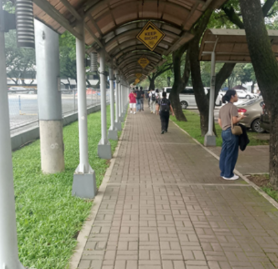 |
Walking remains one of the University's most strongly supported transportation modes.
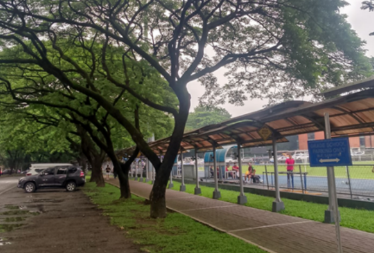
Ateneo has intentionally designed its campus around a pedestrian-first philosophy through the development of:
- Extensive covered walkways;
- Continuous pedestrian pathways;
- Brick-paved walkways;
- Weather-protected circulation routes;
- Barrier-free and disability-friendly access;
- Traffic-calming measures that prioritize pedestrian safety.
These facilities encourage members of the University community to walk comfortably between campus destinations regardless of weather conditions.
The pedestrian-oriented design also creates safer public spaces while minimizing conflicts between vehicles and pedestrians.
Supporting Zero-Emission Vehicles
Ateneo actively promotes the adoption of zero-emission vehicles (ZEVs) by providing infrastructure that supports cleaner transportation technologies.
To encourage members of the University community to transition toward electric mobility, the University provides:
- Electric vehicle charging stations;
- Preferred parking spaces designated for zero-emission vehicles.
These facilities reduce one of the primary barriers to electric vehicle adoption by ensuring that users have convenient access to charging infrastructure while on campus. These figures demonstrate the growing adoption of cleaner transportation modes within the Ateneo community and provide measurable evidence of the University's successful promotion of low-carbon commuting.
Managing Parking to Encourage Sustainable Transportation
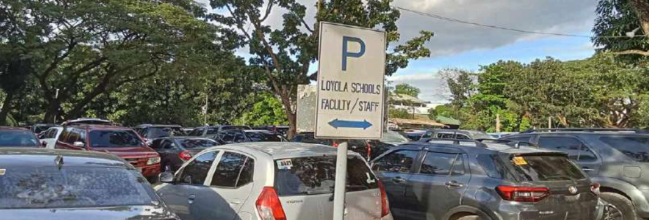
In addition to providing sustainable transportation alternatives, Ateneo also implements measures that discourage excessive reliance on private vehicles. Rather than continually expanding parking capacity, the University intentionally manages parking demand by maintaining approximately 67,930 square meters of ground parking while directing excess vehicle demand toward off-campus locations.
This approach supports several sustainability objectives.
First, it discourages unnecessary single-occupancy vehicle trips by reducing the convenience of bringing private cars onto campus.
Second, it preserves valuable campus space that can instead be devoted to pedestrian areas, green spaces, and community facilities.
Finally, it reinforces the University's broader mobility strategy by encouraging commuters to consider walking, cycling, electric shuttles, school buses, and ride-sharing as practical alternatives.
Parking management therefore functions not only as an operational measure but also as a behavioral strategy that supports more sustainable transportation choices.
Ateneo Student Organizations Embracing Sustainability in Meaningful Ways
Sustainability at Ateneo de Manila University is not limited to large-scale projects or campus policies. It can also be seen in the everyday choices and practices of student organizations. Through their activities and events, student groups have opportunities to reduce waste, conserve resources, and encourage members to become more conscious of their environmental impact. These small but consistent actions show how sustainability can become part of student life and organizational culture.
One example is the effort of the Ateneo Student Exchange Council (ASEC) and the Ateneo Consultants for Organization Development and Empowerment to encourage carpooling during events which they shared in March 2025. Instead of having participants travel separately using individual vehicles, carpooling allows students to share rides and reduce the number of vehicles needed. This helps lower the collective emissions associated with transportation while also making travel more convenient and social for participants.
The efforts of such student organizations demonstrate that sustainability does not always require major changes or expensive solutions. Simple decisions, such as sharing transportation, can contribute to reducing an organization's environmental footprint when practiced consistently. More importantly, these initiatives show how students themselves can become active participants in Ateneo's sustainability efforts.
Source:
1. Transportation: Targeting Low-Carbon Mobility
2. Sustainability in Action: Ateneo Student Organizations Embrace Sustainability
Recent News
You may also like these articles

Growing with purpose: How Mekeni Food Corporation turns adversity into shared value
From a small backyard operation in Porac, Pampanga, to an internationally recognized food brand exporting to 25 countries, Mekeni Food Corporation's journey demonstrates how businesses

Three Ateneo-incubated startups secure DOST-PCIEERD’s startup grant fund
Last 9 November, during the opening day of Philippine Startup Week 2026, Soolok Properties Inc, Pili AdheSeal Inc, and Saltric Power (PDG Engineering Services), three

Ateneo de Manila Grade 2 students are the little Earth helpers
It was a great day for saving the world when Ateneo Institute of Sustainability (AIS) came to Ateneo Grade School to give a session on

JGSOM representatives complete green finance training in Poland, sets sights on 2027 micro-credential launch
Representatives of Ateneo de Manila University's John Gokongwei School of Management (JGSOM) completed the second phase of their Erasmus+ Green Finance international mobility activities at

JGSOM Representatives Participate in Green Finance Training at the University of Twente
Enschede, Netherlands | October 15–16, 2026 Representatives of Ateneo de Manila University's John Gokongwei School of Management (JGSOM) participated in a specialized Green Finance training

Professor Emeritus Dr Emma Porio highlights climate resilience and biodiversity at international conferences
Emma E Porio, PhD, Professor Emeritus of Ateneo de Manila University and Principal Investigator of Ateneo's Manila Observatory Center for Climate Resilience and Public Health