10.6.9 Disability Access Scheme
07 Nov 2024


Comprehensive Disability Access and Inclusive Education Framework at Ateneo de Manila University
Ateneo de Manila University demonstrates a steadfast institutional commitment to fostering a fully inclusive educational environment by embedding comprehensive disability access schemes, targeted academic accommodations, physical infrastructure upgrades, and faculty training initiatives into its core governance. The university implements targeted admissions mechanisms, specialized academic adjustments, peer and professional support networks, and pedagogical empowerment platforms. By combining institutional policy, physical campus enhancements, and systemic capacity-building programs, Ateneo ensures equitable participation, welfare, and holistic development for persons with disabilities (PWDs) and neurodivergent learners across all academic levels.
Institutional Academic Accommodations, Specialized Support, and Accessible Facilities
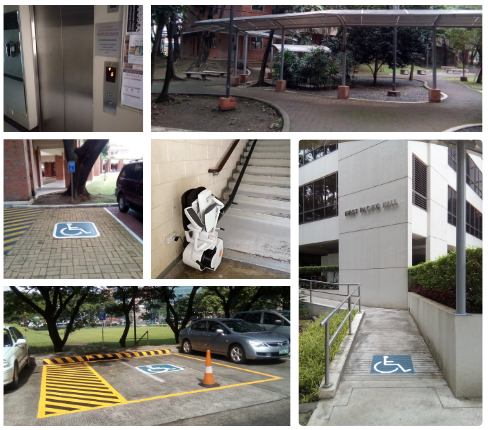 Ateneo de Manila University implements multi-tiered targeted support and mentoring schemes designed to address the specific academic, administrative, and physical needs of students with disabilities. Through centralized admissions policies, the university provides individualized testing accommodations, including extended exam durations, sign language interpreters, and accessible test venues, alongside allocated admission slots per school for PWD applicants. On campus, the Office of the Associate Dean for Student Affairs oversees specialized infrastructure and physical accessibility enhancements, such as the continuous maintenance and operation of motorized stairlifts across college buildings. These physical and structural support schemes operate in tandem with personalized administrative mechanisms such as individualized course scheduling, adapted learning materials, and peer mentoring networks to ensure complete inclusion and academic continuity for all enrolled students. All core policies and facility reports are maintained openly on official university web domains to ensure public access and transparency.
Capacity Building and Inclusive Pedagogy for Neurodiversity
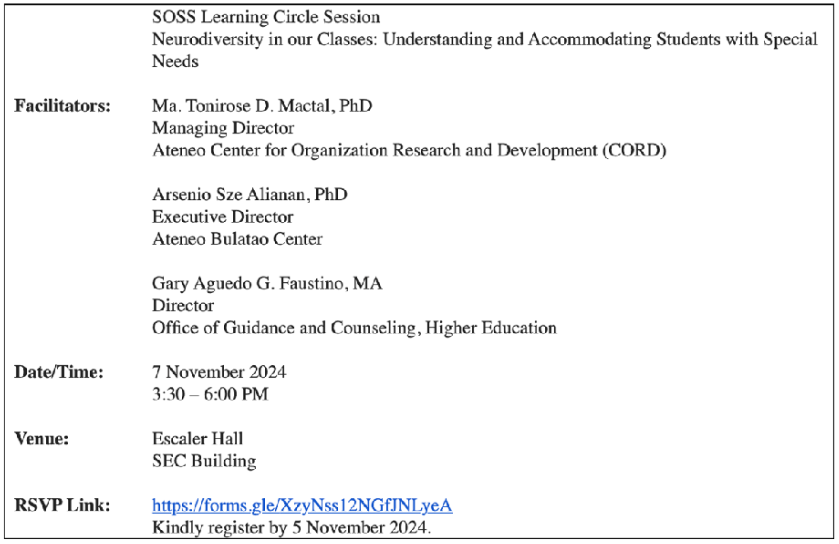
To enhance instructional mentoring and targeted support within the classroom, the Office of the Vice President for Higher Education, in partnership with the School of Social Sciences (SOSS), organized a specialized SOSS Learning Circle session titled "Neurodiversity in Our Classes: Understanding and Accommodating Students with Special Needs". Held on November 7, 2024 (from 3:30 to 6:00 PM), at Escaler Hall, SEC Building on the Katipunan campus in Quezon City, the session featured key facilitators including Ma. Tonirose D. Mactal, PhD (Managing Director, Ateneo Center for Organization Research and Development - CORD), Arsenio Sze Alianan, PhD (Executive Director, Ateneo Bulatao Center), and Gary Aguedo G. Faustino, MA (Director, Office of Guidance and Counseling, Higher Education). The workshop equipped faculty members with practical behavioral and academic accommodation strategies, addressed data privacy protocols regarding disability disclosures, and explored inclusive teaching frameworks through both diversity and deficit lenses. Emphasizing both student-centered targeted adjustments and faculty self-care, the program strengthens the university’s internal mentoring capacity and inclusive educational ecosystem. Details and invitations for this initiative are distributed publicly through open registration forms and university communication channels.
Office of Guidance and Counseling: Neurodiverse Narratives
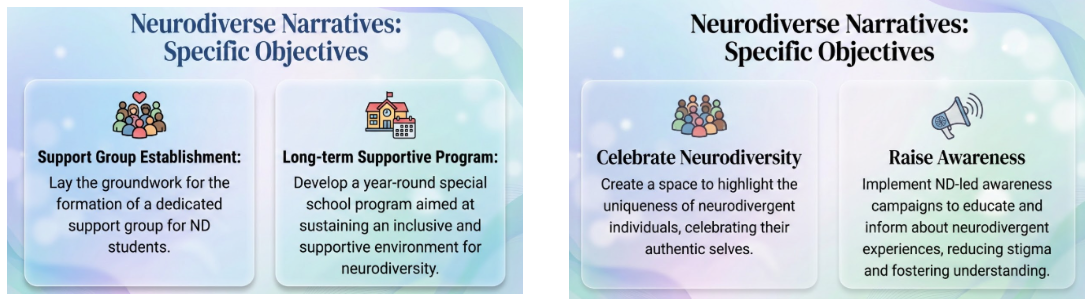
Complementing student-led initiatives is the Loyola Schools Office of Guidance and Counseling (OGC), which provides professional counseling services alongside innovative peer support initiatives that promote inclusion and mental well-being.
Among these is Neurodiverse Narratives, a neuro-affirming support group open to both students and faculty. Unlike traditional support groups that primarily focus on challenges, Neurodiverse Narratives creates a safe and welcoming environment where neurodivergent individuals can connect through shared experiences while celebrating the unique strengths that accompany different ways of thinking.
The initiative encourages participants to move beyond masking and societal expectations by embracing authenticity and self-expression. It provides opportunities for participants to discuss their experiences openly, build supportive relationships, and foster a stronger sense of belonging within the Ateneo community. Sessions are designed to cultivate mutual learning, empathy, and understanding among participants regardless of whether they are students or faculty members.
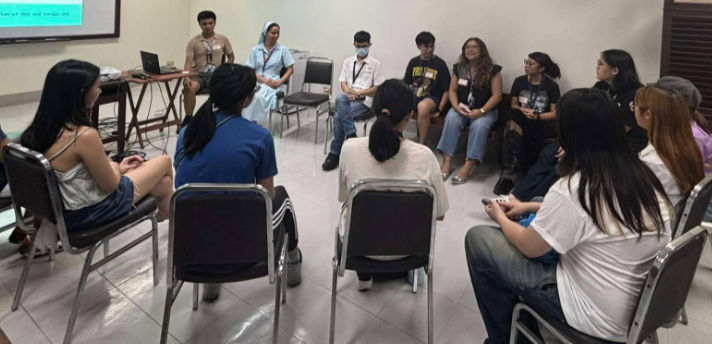
Neurodiverse Narratives extend beyond a single event by continuously providing opportunities for participants to share personal experiences and learn from one another.
Subsequent sessions featured topics including:
- personal experiences of ADHD diagnosis and treatment;
- navigating neurodivergence in academic life;
- personal philosophies on relationships and human connection;
- artistic self-expression through drawing and creativity; and
- documentary storytelling highlighting the experiences of Muslim students in Ateneo.
These sessions demonstrate that Neurodiverse Narratives is not merely an educational program but an ongoing peer support community where participants are encouraged to connect through lived experience, celebrate diverse identities, and build supportive relationships grounded in empathy and mutual understanding.
Source
Recent News
You may also like these articles

Growing with purpose: How Mekeni Food Corporation turns adversity into shared value
From a small backyard operation in Porac, Pampanga, to an internationally recognized food brand exporting to 25 countries, Mekeni Food Corporation's journey demonstrates how businesses

Three Ateneo-incubated startups secure DOST-PCIEERD’s startup grant fund
Last 9 November, during the opening day of Philippine Startup Week 2026, Soolok Properties Inc, Pili AdheSeal Inc, and Saltric Power (PDG Engineering Services), three
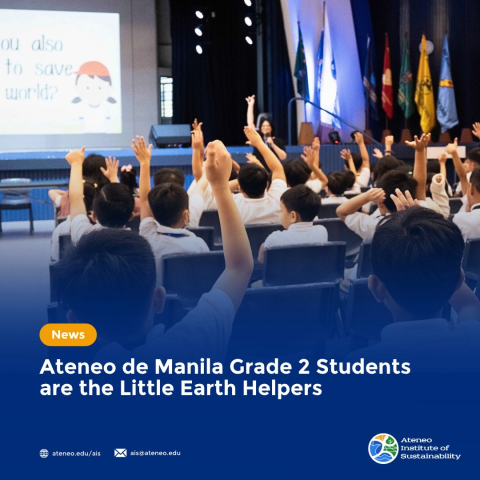
Ateneo de Manila Grade 2 students are the little Earth helpers
It was a great day for saving the world when Ateneo Institute of Sustainability (AIS) came to Ateneo Grade School to give a session on
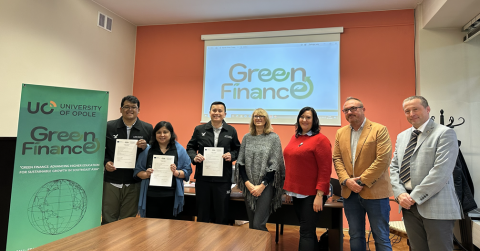
JGSOM representatives complete green finance training in Poland, sets sights on 2027 micro-credential launch
Representatives of Ateneo de Manila University's John Gokongwei School of Management (JGSOM) completed the second phase of their Erasmus+ Green Finance international mobility activities at
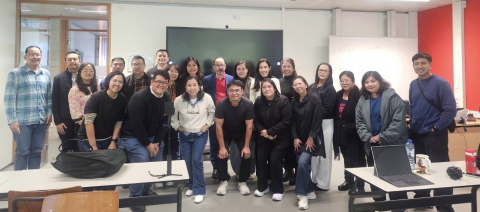
JGSOM Representatives Participate in Green Finance Training at the University of Twente
Enschede, Netherlands | October 15–16, 2026 Representatives of Ateneo de Manila University's John Gokongwei School of Management (JGSOM) participated in a specialized Green Finance training
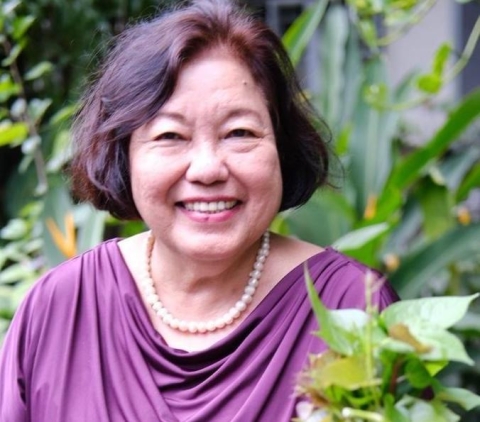
Professor Emeritus Dr Emma Porio highlights climate resilience and biodiversity at international conferences
Emma E Porio, PhD, Professor Emeritus of Ateneo de Manila University and Principal Investigator of Ateneo's Manila Observatory Center for Climate Resilience and Public Health