2.3.3 Sustainable Food Choices on Campus
24 Sep 2024


Ateneo de Manila Sustainable Food Choices on Campus
Ateneo de Manila University maintains campus-wide governance to ensure the availability of sustainable, health-conscious, and ethically sourced food choices across all campus dining facilities. Compliance is enforced across all food business operators (FBOs) via mandatory institutional nutrition audits, while targeted sustainable dietary requirements such as vegan, vegetarian, plant-based meals, and direct farm-to-table sourcing are embedded directly into vendor evaluation frameworks.
Campus-Wide Audit Framework & Provision of Sustainable, Plant-Forward Options
Sustainable and low-carbon dining choices are governed and delivered across campus through the university’s Healthy Cafeteria Initiative:
OFSQA Cafeteria Nutrition Audit Framework (Effective Jan 1, 2025): The Office for Food Safety and Quality Assurance (OFSQA) implemented the Cafeteria Nutrition Audit Checklist (FSQA-R-002) and the Nutrition Facts Assessment Form (FSQA-F-019) to systematically evaluate campus food providers across nine core operational categories. These include mandatory criteria for balanced menu planning, healthy set meals, fortified food items, and regulated food lists.
The 2025 audit cycle confirmed a 100% compliance rating across evaluated campus cafeterias. Under these audited standards, food business operators are required to maintain daily vegetable-based main courses, fresh fruit offerings, and plant-based protein alternatives alongside standard meal sets.
Major dining hubs (such as Gonzaga Hall) complement universal audit standards with dedicated, labeled plant-forward sections. These hubs provide daily grain bowls, fresh salads, local vegetable dishes (e.g., Sayote Guisado, sauteed greens), and plant-based options to support religious, ethical, and low-carbon dietary preferences.
 |
From policy to plate: Cafeterias hit 100% on FSQA Nutrition Audit
The Office for Food Safety and Quality Assurance (FSQA) released its Cafeteria Nutrition Audit Checklist (FSQA-R-002) and Nutrition Facts Assessment Form (FSQA-F-019), both effective January 1, 2025, as part of the University’s Healthy Cafeteria Initiative. The audit reviewed nine categories, including balanced menu planning, healthy set meals, fortified food items, regulated food lists, and weekly menu submissions. Results showed a 100% compliance rating. These tools provide a structured system for monitoring cafeteria practices, ensuring that food served on campus meets established nutrition and safety standards.
The Office for Food Safety and Quality Assurance has introduced two new tools under the University’s Healthy Cafeteria Initiative: the Cafeteria Nutrition Audit Checklist (FSQA-R-002) and the Nutrition Facts Assessment Form (FSQA-F-019), both effective 1 January 2025.
These instruments provide a structured way to review cafeteria operations across nine key areas, including balanced menu planning, healthy set meals, fortified food items, regulated food lists, and weekly menu submissions. All campus cafeterias are now being audited using these standards, ensuring that food providers are regularly evaluated not only for safety but also for nutritional value.
The Nutrition Facts Assessment Form also allows the University to validate the accuracy of nutritional information and promotes greater accountability among cafeteria operators.
Through these measures, OFSQA reaffirms its commitment to supporting the health and wellness of the University community by strengthening oversight, working closely with food service providers, and continuously improving campus dining practices.
Local & Farm-to-Campus Ethical Sourcing
To minimize the environmental carbon footprint associated with long food supply chains, the University promotes local sourcing networks:
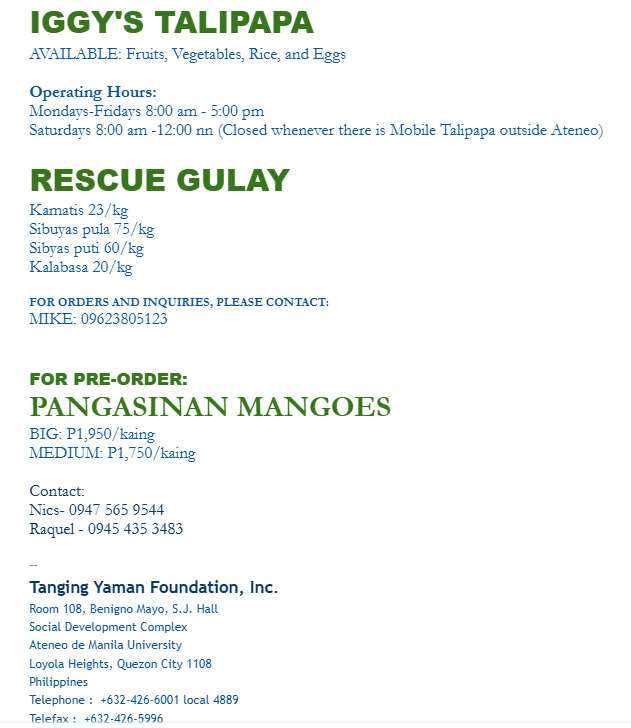
Tanging Yaman Foundation Mobile / Iggy's Talipapa (2025): Operating on campus via the Social Development Complex, the Tanging Yaman Foundation (TYF) facilitates direct farm-to-campus produce sourcing. In Q1 2025, the program disbursed over ₱2.1M in direct support to smallholder farmers in Northern and Central Luzon, supplying the campus community with fresh, ethically grown local produce.
JGSOM Farm-to-Table Student Ventures (SY 2024–2025): The John Gokongwei School of Management (JGSOM) Restaurant Entrepreneurship Program hosts the Farm Fresh Challenge, requiring student-run campus food stalls to design business models and menus using 100% ethically sourced local crops.
JGSOM's BS Restaurant Entrepreneurship program hosts second Farm Fresh Challenge
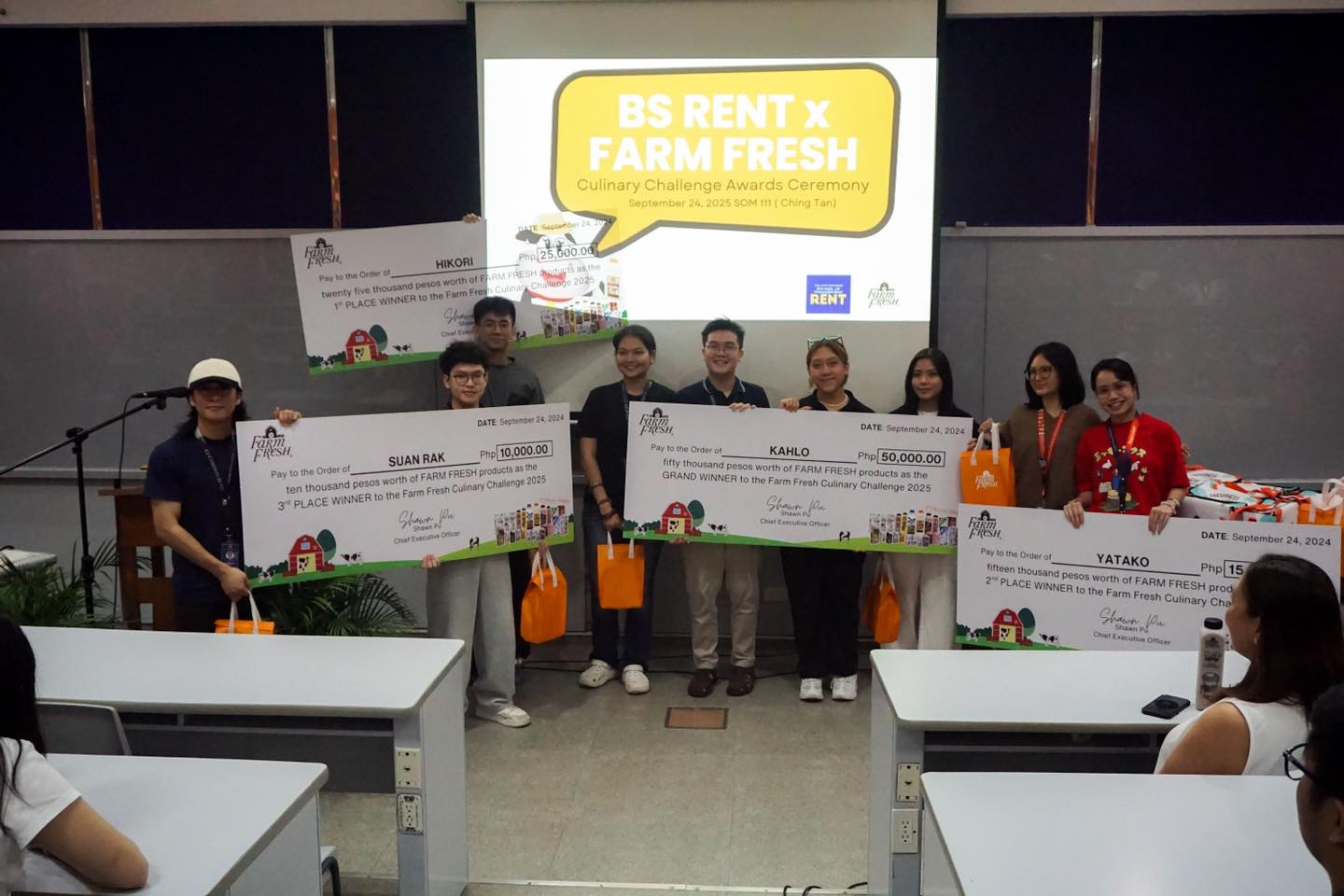 |
The John Gokongwei School of Management's BS Restaurant Entrepreneurship Program proudly hosted the Second Farm Fresh Challenge Awards Ceremony today, 24 September 2024, honoring this year’s top four teams from this exciting competition!
During the awarding ceremony, Dr Annalisa Margarita Mariano-Diaz, Director of the BS REnt Program, shared how these culinary challenges serve as stepping stones to bring out the creativity of our students, empowering them to think beyond the conventional.
In a heartfelt message, Mr Shawn Pu, CEO of Farm Fresh Philippines expressed his excitement about how Farm Fresh serves as a platform to unlock the potential of students in the food and beverage industry, and how he sees a bright future ahead for these future leaders of the industry.
Today's ceremony not only marked the end of this year’s challenge, but also set the stage for future collaborations with renowned brands like Farm Fresh, inspiring even more creativity in the culinary world.
Here are the top four teams that took home the honors:
- 🏆 Champion: Kahlo - P50,000 worth of Farm Fresh products
- 🥈 2nd Place: Yatako - P25,000 worth of Farm Fresh products
- 🥉 3rd Place: Hikori - P25,000 worth of Farm Fresh products
- 🏅 4th Place: Suan Rak - P15,000 worth of Farm Fresh products
Sources:
1. From policy to plate: Cafeterias hit 100% on FSQA Nutrition Audit
2. JGSOM's BS Restaurant Entrepreneurship program hosts second Farm Fresh Challenge
Recent News
You may also like these articles

Growing with purpose: How Mekeni Food Corporation turns adversity into shared value
From a small backyard operation in Porac, Pampanga, to an internationally recognized food brand exporting to 25 countries, Mekeni Food Corporation's journey demonstrates how businesses

Three Ateneo-incubated startups secure DOST-PCIEERD’s startup grant fund
Last 9 November, during the opening day of Philippine Startup Week 2026, Soolok Properties Inc, Pili AdheSeal Inc, and Saltric Power (PDG Engineering Services), three

Ateneo de Manila Grade 2 students are the little Earth helpers
It was a great day for saving the world when Ateneo Institute of Sustainability (AIS) came to Ateneo Grade School to give a session on

JGSOM representatives complete green finance training in Poland, sets sights on 2027 micro-credential launch
Representatives of Ateneo de Manila University's John Gokongwei School of Management (JGSOM) completed the second phase of their Erasmus+ Green Finance international mobility activities at

JGSOM Representatives Participate in Green Finance Training at the University of Twente
Enschede, Netherlands | October 15–16, 2026 Representatives of Ateneo de Manila University's John Gokongwei School of Management (JGSOM) participated in a specialized Green Finance training

Professor Emeritus Dr Emma Porio highlights climate resilience and biodiversity at international conferences
Emma E Porio, PhD, Professor Emeritus of Ateneo de Manila University and Principal Investigator of Ateneo's Manila Observatory Center for Climate Resilience and Public Health