1.4.4 Policy Addressing Poverty
18 Sep 2024


Ateneo de Manila Policy Engagement on Poverty Eradication
Ateneo de Manila University actively participates in national policy formulation to design, advocate for, and implement systemic solutions targeting poverty across all its dimensions. Through institutional research projects, national legislative partnerships, global policy dialogues, and multi-stakeholder convenings, the University directly contributes evidence-based frameworks to address economic vulnerability, food insecurity, informal labor, and regional poverty alleviation.
National Policy Formulation & Legislative Research Collaboration
Ateneo actively partners with national legislative bodies and state policy think tanks to draft and evaluate evidence-based national economic and anti-poverty policies:

House of Representatives (HRep) & Ateneo Legislative Policy Partnership (September 18, 2024): Through a formal institutional collaboration with the Congressional Policy and Budget Research Department (CPBRD) of the House of Representatives, Ateneo co-conducted national policy research seminars. The study "Increasing Food Prices and Its Impact on Food and Nutrition Security" provided legislative guidance on preserving household purchasing power and alleviating poverty caused by agricultural market inefficiencies.
This study investigates the key factors within the agricultural sector that influence food prices, aiming to preserve households' purchasing power by ensuring food security. High food prices often result from inefficiencies in the agri-food system, legislative barriers, and institutional challenges in governance and policy. These issues are intricately linked with food security and poverty alleviation, especially for the most economically vulnerable households, who allocate approximately 60 percent of their income to food expenditures. Escalating food prices can lead to malnutrition and other socio-economic challenges.
The research is conducted by a team of distinguished experts. Albert Lamberte, an Associate Professor and researcher at De La Salle University-Manila, specializes in Environmental and Resource Economics, Microeconomics, and Water Resources. Dr. Marites M. Tiongco, a professor and former dean at De La Salle University (DLSU)-School of Economics, brings her extensive experience in agricultural economics, focusing on food security, poverty, and environmental sustainability. Dr. Karlo Fermin S. Adriano, a Lecturer at Ateneo de Manila University and an Economic Consultant for the Department of Agriculture, contributes his expertise in agricultural policy and economic analysis.
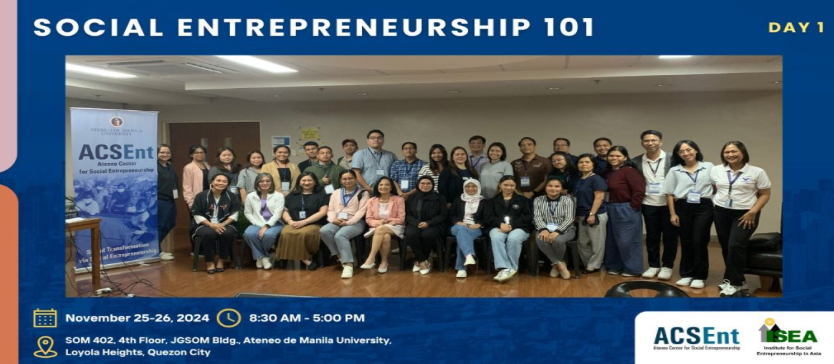
Poverty Reduction Through Social Entrepreneurship Coalition (November 25–26, 2024): The Ateneo Center for Social Entrepreneurship (ACSEnt), in partnership with the Institute for Social Entrepreneurship in Asia (ISEA), hosted the Social Entrepreneurship 101 policy dialogue with Representative Jose Manuel "Joeman" Alba. The forum targeted the passage of the Poverty Reduction Through Social Entrepreneurship (PRESENT) Bill, establishing legal and financial frameworks to scale social enterprises as a primary pathway for national poverty reduction.
The Ateneo Center for Social Entrepreneurship (ACSEnt) and the Institute for Social Entrepreneurship in Asia (ISEA) held a two-day face-to-face introductory course on “Social Entrepreneurship 101” last November 25 to 26, 2024 at SOM 402, 4th Floor, JGSOM Building, Ateneo de Manila University, Quezon City. With this, the participants learned the essentials of social entrepreneurship and listened with experts in the field!
The Day 1 of the #SocialEntrepreneurship101 kicked off with participant introductions followed by a presentation from ISEA President, Marie Lisa Dacanay, She had a lecture-discussion on the handles for understanding Social Entrepreneurship and sharing experiences of social enterprises in developing countries in Asia. Day 1 continued with a session featuring Mark Ruiz of Hapinoy, Raymund Aaron of Villa Soccoro Farm, and Reese Fernandez Ruiz of Rags2Riches, Inc. as they share their experiences as social enterprises and the art of managing multiple bottom lines. In the afternoon, two more social enterprises shared their experiences as social enterprises and the art of managing multiple bottom lines: first, Ms Josie Cardona of Most Holy Rosary Multi Purpose Co-operative and then Citihub Dormitory’s Panya Boonsirithum. ACSEnt Director, Ms Ana Marina Tan served as moderator for Day 1’s sessions.
In Day 2, the Poverty Reduction Through Social Entrepreneurship Coalition members joined the participants and shared their stories and advocacies to the participants. They also had an interactive session with them to personally answer their inquiries. The organizers thanked the PRESENT Coalition members: Foundation for a Sustainable Society, Inc. – FSSI, UP Institute for Small-Scale Industries, Bote Central Inc and HeritageFinds who joined the 2nd day of the training. One of the PRESENT Bill Champions Rep. Jose Manuel “Joeman” Alba also joined for a dialogue on poverty reduction and BEEP (Bamboo Economic Enterprise Program). PRESENT Coalition Convenor, Marie Lisa Dacanay discussed the PRESENT Bill as a platform towards Creating an Enabling Environment for Social Entrepreneurship in the Philippines to the participants of #SocialEntrepreneurship101 Training. She discussed social entrepreneurship as strategy or pathway in accelerating poverty reduction and sustainable development. The Day 2 sessions were moderated by ISEA staff, Gomer Padong.
Sources:
1. Increasing Food Prices and its Impact on Food and Nutrition Security
2. ISEA, ACSEnt hold SE 101 Course with PRESENT Bill Champion Cong. Alba as one of the speakers [Philippines] - Institute for Social Entrepreneurship in Asia
Recent News
You may also like these articles

Growing with purpose: How Mekeni Food Corporation turns adversity into shared value
From a small backyard operation in Porac, Pampanga, to an internationally recognized food brand exporting to 25 countries, Mekeni Food Corporation's journey demonstrates how businesses

Three Ateneo-incubated startups secure DOST-PCIEERD’s startup grant fund
Last 9 November, during the opening day of Philippine Startup Week 2026, Soolok Properties Inc, Pili AdheSeal Inc, and Saltric Power (PDG Engineering Services), three

Ateneo de Manila Grade 2 students are the little Earth helpers
It was a great day for saving the world when Ateneo Institute of Sustainability (AIS) came to Ateneo Grade School to give a session on

JGSOM representatives complete green finance training in Poland, sets sights on 2027 micro-credential launch
Representatives of Ateneo de Manila University's John Gokongwei School of Management (JGSOM) completed the second phase of their Erasmus+ Green Finance international mobility activities at

JGSOM Representatives Participate in Green Finance Training at the University of Twente
Enschede, Netherlands | October 15–16, 2026 Representatives of Ateneo de Manila University's John Gokongwei School of Management (JGSOM) participated in a specialized Green Finance training

Professor Emeritus Dr Emma Porio highlights climate resilience and biodiversity at international conferences
Emma E Porio, PhD, Professor Emeritus of Ateneo de Manila University and Principal Investigator of Ateneo's Manila Observatory Center for Climate Resilience and Public Health