6.5.5 Cooperation on Water Security
01 Jun 2024


Cooperation on Water Security
Ateneo de Manila University’s approach to water security is grounded in the recognition that protecting and managing water resources requires cooperation across local, national, and global levels. Water challenges are interconnected with climate change, public health, agriculture, infrastructure, and environmental governance, making collaboration among universities, government agencies, international institutions, and communities essential.
At the global and national levels, Ateneo participates in partnerships that connect Philippine water research with international expertise while aligning institutional practices with national environmental standards. These collaborations create opportunities to exchange knowledge, strengthen scientific capacity, and translate research into approaches that respond to Philippine water security and climate resilience needs. At the same time, adherence to national water quality regulations reinforces the importance of institutional responsibility and effective environmental governance in protecting water resources.
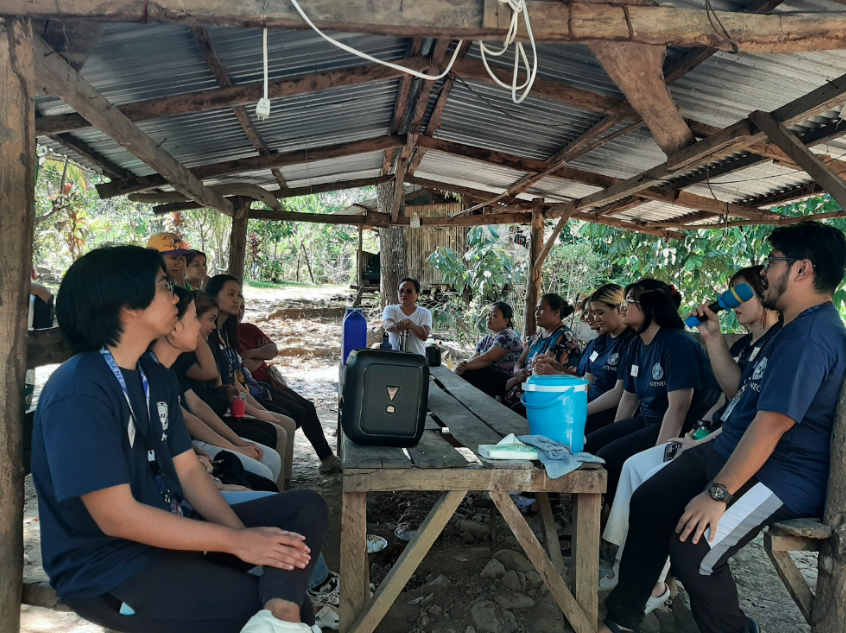
At the regional level, the University brings scientific knowledge directly to communities through educational and engagement initiatives. By working with farmers, community organizations, students, and other local stakeholders, these efforts make water and environmental information more accessible and actionable. Such engagements also recognize the value of local knowledge and community experience in understanding water-related concerns. At the local level, students from the BS Chemistry and BS Materials Science and Engineering programs conducted field work in farming communities in Antipolo City to perform water, soil, chemical, and agricultural products sampling and laboratory analysis. Results from this initiative were communicated back to the farmers.
Global Cooperation: Strengthening Water Security through UK-Phil Research and Collaboration
In December 2024, the Philippine Hydro Hub advanced efforts to strengthen the Philippines’ capacity in hydrology research and water resource management. The collaborative initiative brings together Ateneo de Manila University, the University of the Philippines, and the British Geological Survey, with support from the UK Department for Science, Innovation and Technology and the British Council. Led in part by Dr. Maria Aileen Leah G. Guzman, the project seeks to bridge scientific research and practical applications by connecting researchers with local communities and stakeholders. The Philippine Hydro Hub aims to address water security challenges and strengthen climate resilience, with potential benefits for sectors such as agriculture, energy, and infrastructure.
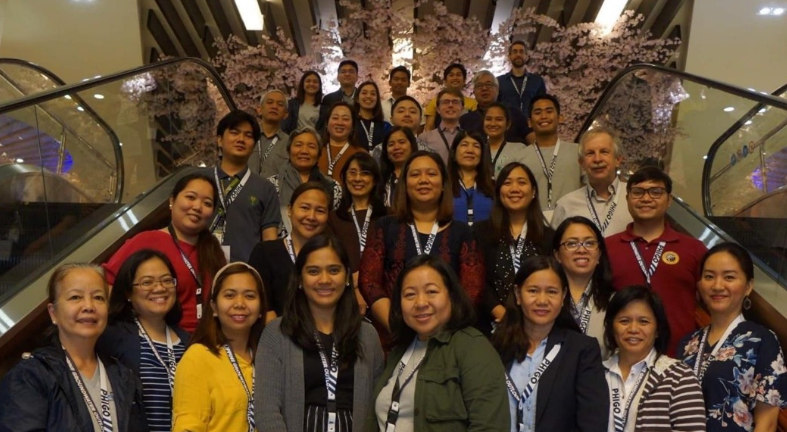
Ateneo's research initiatives emphasize the importance of translating scientific knowledge into practical applications. Rather than limiting research to academic outputs, the University supports collaborations that connect researchers with decision-makers, technical experts, and communities to ensure that scientific findings contribute to improved water management, climate adaptation strategies, and sustainable resource governance.
National Cooperation: Compliance with the Philippine Clean Water Act
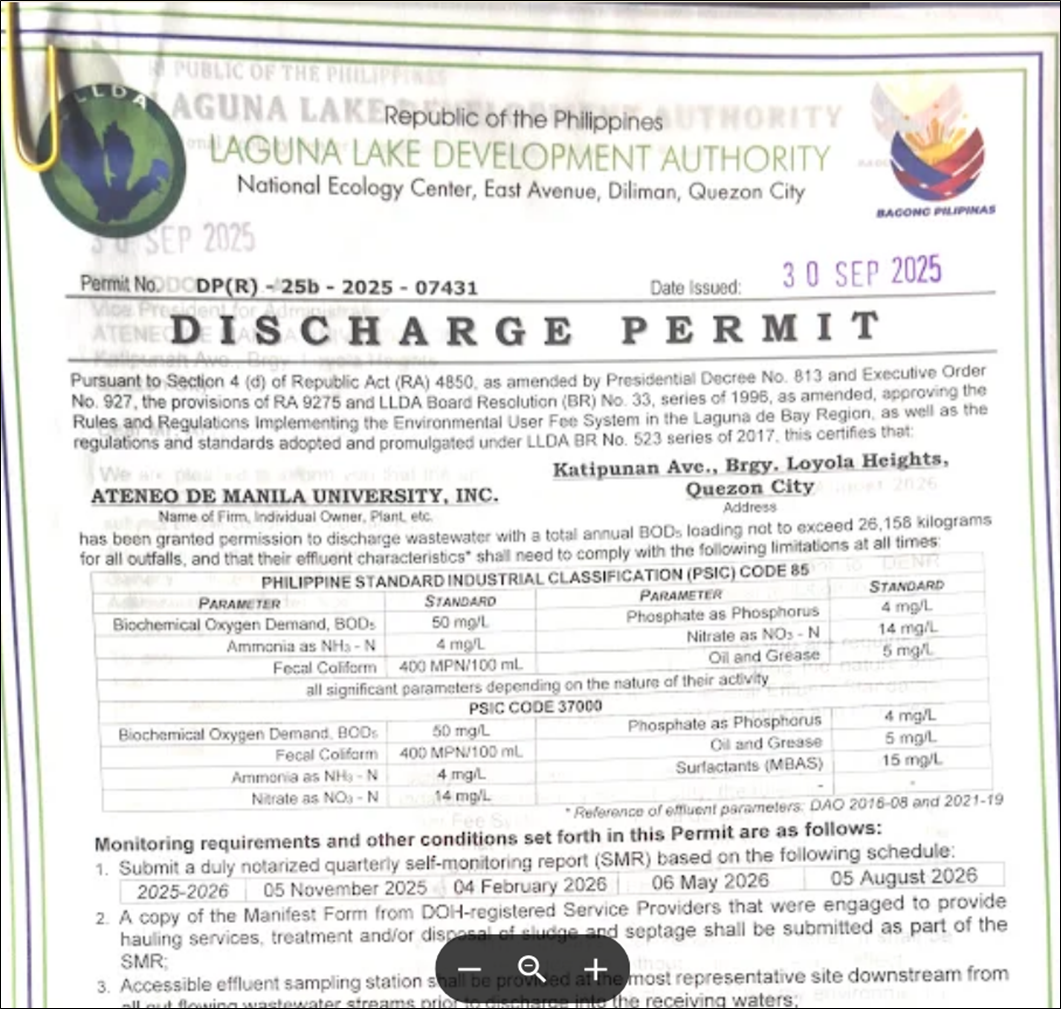
The University adheres to the environmental protection laws of the State as detailed in the Republic Act 9275 Philippine Clean Water Act of 2004, a law designed to protect the country's fresh, brackish, and marine waters from pollution from land-based sources. It establishes a comprehensive water quality management system that sets standards, requires permits for wastewater discharge, and implements penalties for violations. Key objectives include preventing and controlling pollution from industries, agriculture, and household activities, and encouraging a multi-sectoral approach to water quality management.
Below is the copy of the Discharge Permit issued by the Laguna Lake Development Authority in September 2025 as proof of University’s compliance to the Republic Act 9275.
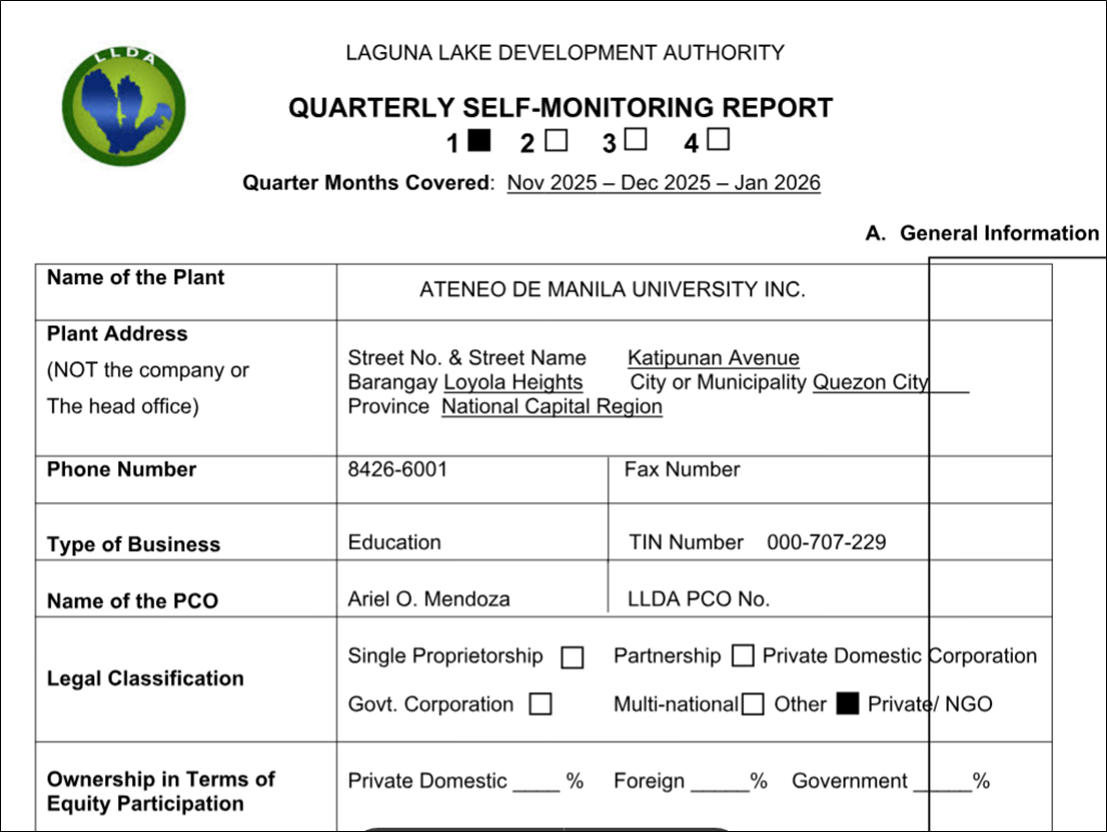
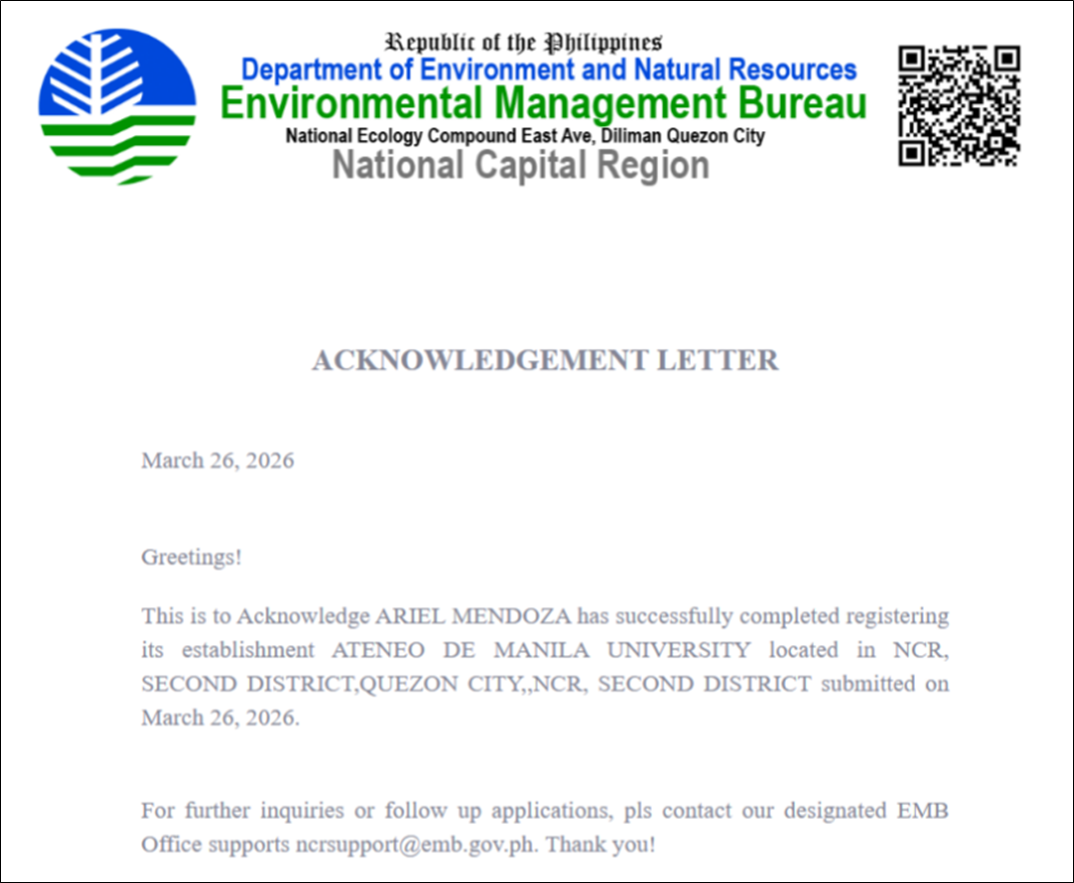
The Grounds Trees and Waste Management Section and the University Pollution Control Officers (PCOs) of Ateneo’s Central Facilities Management Office Custodial Services Group is tasked to monitor all activities pertaining to the above environmental laws and to assess the effectiveness of its program implementation through periodic monitoring and evaluation reports done regularly every 3 months for the Self-Monitoring Reports (SMRs) and every 6 months for the Compliance Monitoring Reports (CMRs) due for submission to the LLDA and DENR respectively. Below is a sample copy of the SMR submitted to LLDA.
Regional Cooperation: Advancing Water Security Through the Philippine Hydro Hub
Ateneo de Manila University, the University of the Philippines–National Institute of Geological Sciences (UP-NIGS), and the British Geological Survey (BGS) are collaborating through the Philippine Hydro Hub: Collaborative Hydrological Research for a Sustainable Water Future to strengthen water science research and advance water security through sustainable water resource management in the Philippines.
On May 3–4, 2025, project researchers visited the Upper Amburayan Watershed in Benguet to examine water management challenges and engage local stakeholders. Discussions with local government representatives and personnel from environmental, water, irrigation, and agricultural agencies highlighted the need for climate change adaptation to protect water resources and sustain agricultural production. The delegation also visited Madaymen, Kibungan, where community representatives shared challenges involving water use, land management, and local farming practices. These consultations will help inform research and collaborative approaches to watershed management, supporting the sustainable use and long-term availability of water for communities and agriculture.
Local Cooperation: Community-Based Water and Soil Analysis Through Student Engagement
In June 2024, 50 BS Chemistry and BS Materials Science and Engineering students participated in the NSTP12-Bigkis Program, working with farming communities in Antipolo City, Rizal to conduct chemical analyses of water, soil, and agricultural products based on community needs. The students conducted field visits, sample collection, laboratory analysis, and consultations. They presented their findings and recommendations to their partner organizations, providing useful information on water safety and product quality. The activity demonstrated how scientific knowledge can directly support communities, particularly those with limited access to laboratory testing due to cost. It also strengthened the connection between science, community engagement, and sustainable development, allowing students to apply their technical skills to address real-world needs.
One resident shared: “hindi namin kaya na magpa-analyze ng tubig dahil may kamahalan. Kaya, nagpapasalamat kami sa mga mag-aaral at sa Ateneo dahil kahit papaano ay nalaman namin na ligtas inumin ang tubig na iniinom namin mula sa bukal.” (We cannot afford the cost for the water testing. We are grateful to the students and to Ateneo because we feel assured that the water from the spring is safe for drinking.)
As a collaborative initiative involving three courses (SocSc13, NSTP12, and Chem 133.02), Bigkis highlights the University's approach to integrating academic learning with social responsibility and community engagement. The program enables students to apply scientific research and laboratory analysis in ways that contribute to community well-being and strengthen local capacity to make informed decisions about environmental and agricultural resources.
Sources:
1. SOSE Research in Hydrology Contributes to UK-Philippine Partnership to Ensure Water Security
2. Community-Based Water and Soil Analysis through Student Engagement
3. EML and BGS Visit Upper Amburayan Watershed in Benguet
Recent News
You may also like these articles

Growing with purpose: How Mekeni Food Corporation turns adversity into shared value
From a small backyard operation in Porac, Pampanga, to an internationally recognized food brand exporting to 25 countries, Mekeni Food Corporation's journey demonstrates how businesses

Three Ateneo-incubated startups secure DOST-PCIEERD’s startup grant fund
Last 9 November, during the opening day of Philippine Startup Week 2026, Soolok Properties Inc, Pili AdheSeal Inc, and Saltric Power (PDG Engineering Services), three

Ateneo de Manila Grade 2 students are the little Earth helpers
It was a great day for saving the world when Ateneo Institute of Sustainability (AIS) came to Ateneo Grade School to give a session on

JGSOM representatives complete green finance training in Poland, sets sights on 2027 micro-credential launch
Representatives of Ateneo de Manila University's John Gokongwei School of Management (JGSOM) completed the second phase of their Erasmus+ Green Finance international mobility activities at

JGSOM Representatives Participate in Green Finance Training at the University of Twente
Enschede, Netherlands | October 15–16, 2026 Representatives of Ateneo de Manila University's John Gokongwei School of Management (JGSOM) participated in a specialized Green Finance training

Professor Emeritus Dr Emma Porio highlights climate resilience and biodiversity at international conferences
Emma E Porio, PhD, Professor Emeritus of Ateneo de Manila University and Principal Investigator of Ateneo's Manila Observatory Center for Climate Resilience and Public Health