Revisiting "Pilipinisasyon sa Ateneo": Fr Mario Francisco SJ on the evolution and future of Atenean nationalism
24 Oct 2026

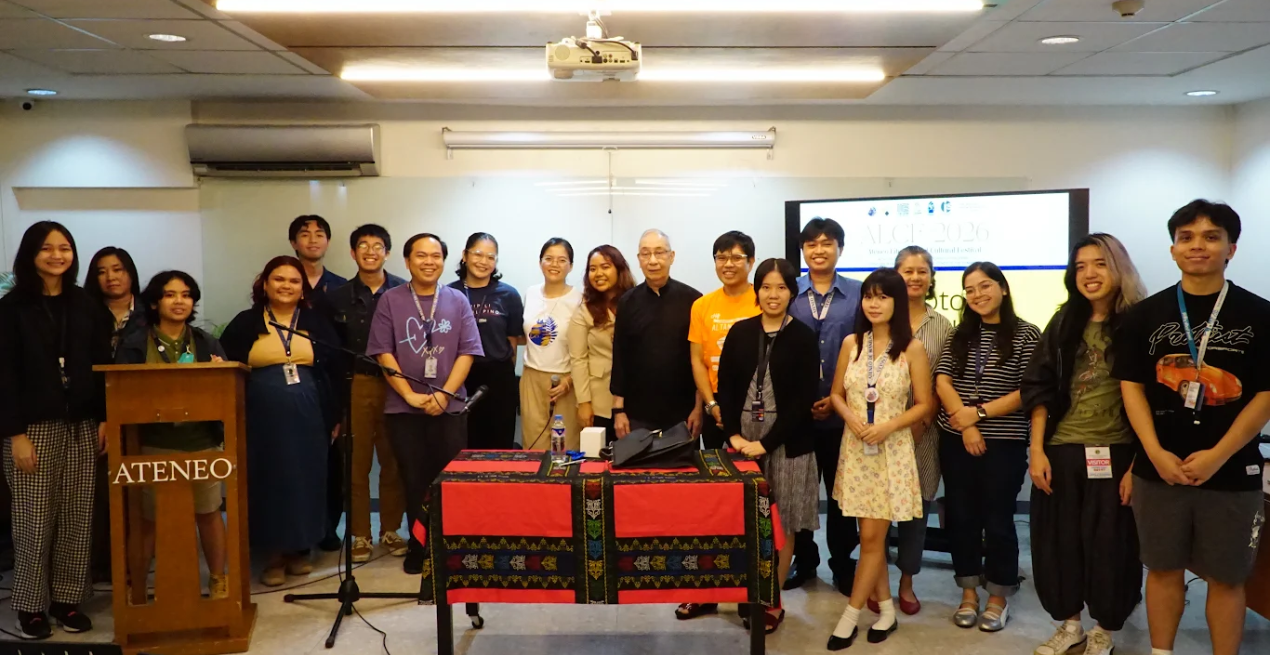
The Literary and Cultural Studies Program (LCSP), in partnership with the Department of Interdisciplinary Studies, officially opened the 3rd Ateneo Literary and Cultural Festival on 14 October 2026, at the NGF Conference Room with a keynote lecture titled “Pilipinisasyon sa Ateneo.”
Delivered by renowned scholar and IS faculty member Fr Jose Mario Francisco SJ, the lecture examined the historical milestones, key figures, and ongoing evolution of the Filipinization movement within the university and its broader impact on Philippine history.
The Four Pillars of "Down from the Hill"
Fr Francisco highlighted the groundbreaking 1969 manifesto “Down from the Hill” as the movement’s central cornerstone, outlining four core tenets that redefined the university’s identity:
- Pamumunong Pilipino (Prioritization of Filipino leadership)
- Wikang Panturo (Adoption of Filipino as a medium of instruction)
- Paksa at Tekstong Pilipino (Focus on local subjects and literature)
- Pakikiisa sa Mahirap at Api (Solidarity with the poor and marginalized)
Reflecting on the era, Fr Francisco discussed how nationalism gained momentum within the Catholic Church during the 1950s and 1960s. "Malakas ang nasyonalismo sa loob ng simbahang Katoliko," he noted, explaining that Filipino Catholics saw a distinct responsibility as the sole Catholic-majority nation in Asia to ground the Gospel in local realities.
This imperative drove Fr Francisco to become the first Filipino Jesuit to formally pursue advanced studies in Filipino literature. “Hindi tama na walang Pilipinong Heswita na may kaalaman sa panitikang Pilipino,” he remarked.
Contextualizing Local Literature and Cultural Identity
Fr Francisco paid tribute to National Artist for Literature Bienvenido Lumbera, a pivotal figure in advancing Filipinization at Ateneo by grounding literary studies in socio-historical contexts.
“Noon pa man, binabasa na ang Florante at Laura sa high school,” Fr Francisco noted. “Pero dahil walang konteksto, nagiging lutang ang pagtalakay dito — natutuon lamang sa banghay at hindi nakikita ang pinanggalingan.”
By embedding local texts within their historical backdrops, Lumbera and early advocates transformed how Ateneans engaged with Philippine literature.
From Internationalization to Taglish: Shift in the Movement
Addressing the present state of the movement, Fr Francisco observed a noticeable shift in academic and public discourse. With the rise of global internationalization, digital technology, and English-dominated social media spaces, the vocabulary of Filipinization has shifted.
“Hindi na Pilipinisasyon ang pinag-uusapan,” he explained. “May mga kurso pa rin na nagtuturo ng Pilipino, pero hindi na iyon ang hot topic.”
He pointed out that while the emergence of cultural studies shares similarities with Filipinization, it introduces post-colonial frameworks outside the original discourse. Furthermore, the evolving lingua franca of today’s youth raises new questions about language identity:
“Hindi kaya na ang lingua franca ng ating mga estudyante ngayon ay Taglish na kaysa sa Filipino?”
When asked how Filipinization applies today, Fr Francisco highlighted the concept of hybridity, stating that “there is no pure Filipino. Rather, what is Filipino is what we imagine ourselves to be.”
An "Amoebic" Legacy and the Way Forward
Fr. Francisco concluded his address by describing the current state of Filipinization as "formless, like an amoeba" — a movement where no single strategy prevailed, but whose open nature allows for continuous reimagining. He left the audience with a challenge: how can the spirit of Filipinization adapt to bridge today’s cultural and economic divides?
“Bakit tila nawala ang bokabolaryo ng Pilipinisasyon sa usaping ito? Kaya siguro maaaring [ito] ang pag-usapan.”
About the Speaker:
Fr Jose Mario Francisco SJ is a Jesuit priest and long-time academic who has taught under the Loyola School of Theology, the Department of English, Philosophy, and the Department of Interdisciplinary Studies. A key figure in Atenean intellectual life, his research and teaching continue to shape conversations on Philippine culture, literature, and theology.
Recent News
You may also like these articles

Updating of Medical Records Second Semester SY 2026-2027
14 November 2026 TO: Undergraduate and Graduate Students FROM: Higher Education Office of Health Services-College SUBJECT: Updating of Medical Records Second Semester SY 2026-2027 Please

Promotion of Faculty in the Senior High School (Memo U2627-050)
(Memo # U2627-050) I am pleased to announce that upon the recommendation of the Senior High School Committee on Faculty Rank and Permanent Appointment and the endorsement of the Vice President for Basic Education, I am approving the promotion of the following faculty members in the Senior High School:

Demise of Mr Silvestre P Villarin(Memo U2627-049)
(Memo U2627-049) We extend our condolences to Fr Jose Ramon “Jett” T Villarin SJ and his family on the passing of his father, Mr Silvestre Villarin, on 18 November 2026 at the age of 96. Fr Villarin is the former University President, a faculty member of the Department of Physics, and the Executive Director of the Manila Observatory.

[AGS] National Book Week
Open a Book, Stories Unfold, Wonders Flow Let us come together as one AGS community to celebrate the 92nd National Book Week with the theme

Three Ateneo-incubated startups secure DOST-PCIEERD’s startup grant fund
Last 9 November, during the opening day of Philippine Startup Week 2026, Soolok Properties Inc, Pili AdheSeal Inc, and Saltric Power (PDG Engineering Services), three
Ateneo Policy Center presents study on local health spending at DBM Fiscal Policy Conference 2026
On 19 October 2026, the Ateneo School of Government, through its research and policy unit, the Ateneo Policy Center (APC), presented findings from a study