ASHS student-researchers make their mark at Division Science and Technology Fair 2026
25 Sep 2026





From studying medicinal plants to developing intelligent systems for disaster response, STEM students at the Ateneo Senior High School (ASHS) are applying scientific inquiry to problems beyond the classroom. This year, their research reached the Division level as select Grade 12 STEM students represented ASHS for the first time at the Quezon City Division Science and Technology Fair (DSTF) 2026.
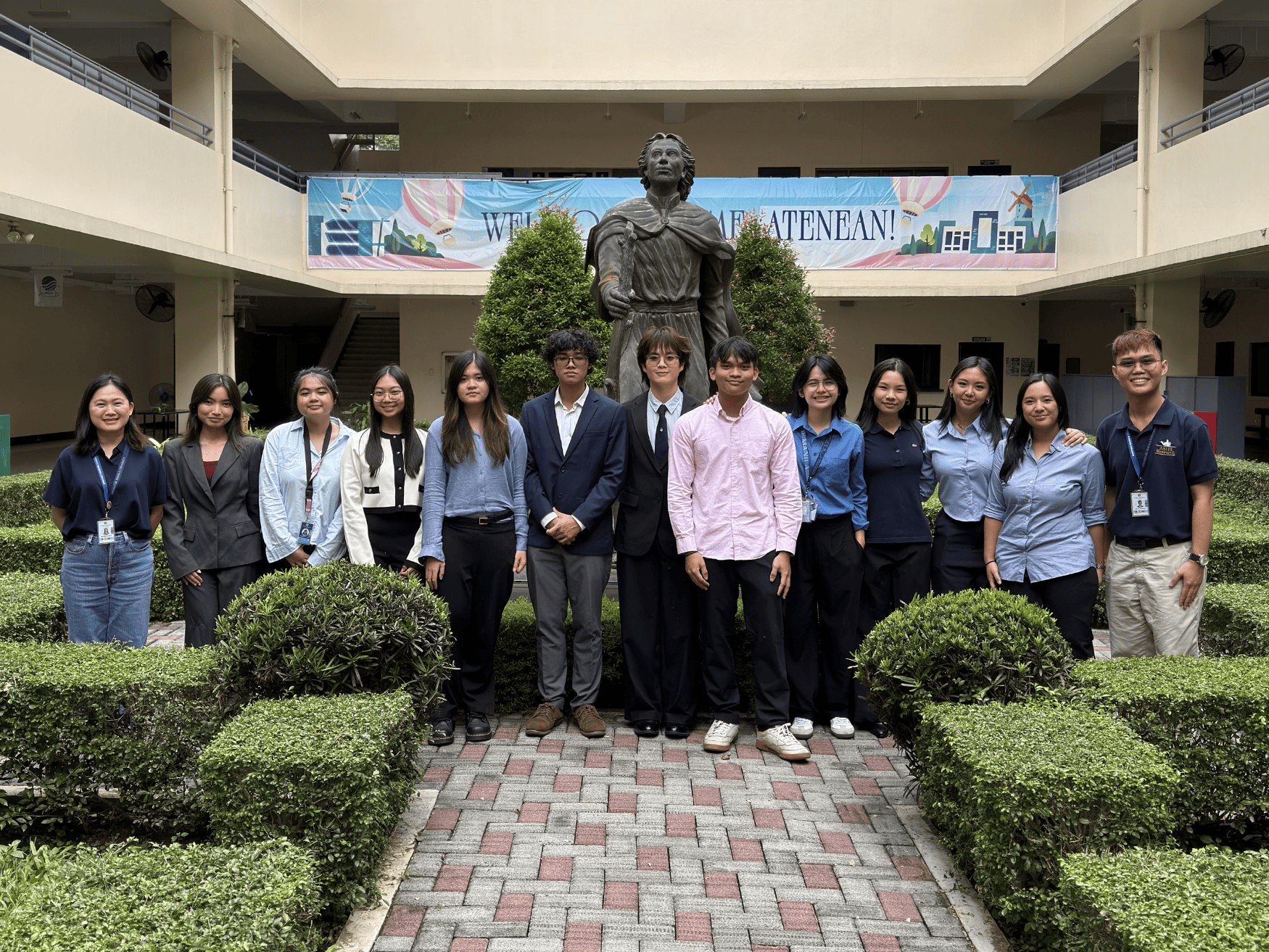
Held online last 11 September 2026, the annual competition was organized by the DepEd Schools Division Office of Quezon City. The DSTF recognizes student researchers who explore real-world problems and develop solutions through science, technology, and innovation. The 2026 DSTF marked a milestone as ASHS made its first-ever representation in the competition since the school's establishment in 2016.
The students competed under TUKLAS, a STEM research competition that gives high school learners an avenue to present research projects grounded in their fields of interest and in real-world problems, issues, and concerns. Entries may be submitted individually or by teams across four research categories.
Leading the ASHS delegation was Rez Floresca, who secured 1st place out of 10 entries in Mathematics and Computational Sciences with “Forgotten Words: Benchmarking NeoBERT for Dementia Detection in Low-Resource Conversational Filipino and English Speech.” The study examined how language models can be used to detect signs of dementia from spontaneous speech, particularly in Filipino-English conversations. It found that incorporating both languages during model training substantially improved cross-lingual performance, highlighting the importance of linguistic representation in clinical language technologies. Rez also received the Best Presenter special award and qualified to represent the Quezon City Division at the Regional Science and Technology Fair (RSTF) this November. The research was advised by Mx Gabriel Danielle Luiz G Eslava.
In Robotics and Intelligent Machines, Yelena Ledesma placed 2nd out of 12 entries and received the Best Presenter special award for “A.P.U.L.A.: AI-assisted Precise Unmanned Lifesaving Aerial System for Early Fire Detection and Suppression.” The project explored the use of a drone equipped with sensors, machine learning, and an extinguishing system to detect and respond to fires, particularly in areas that may be difficult or dangerous for conventional firefighting methods to access. The study found that the prototype could accurately detect fire-related signals and significantly reduce extinguishing time compared with a standard water hose. The research was advised by Mr Lean C Rosendo.
The Robotics and Intelligent Machines category also saw Anya Panganiban, Paris Mabato, and James Carlos place 4th out of 15 entries for “Development and Evaluation of an AI-Integrated IoT Monitoring System for Soil-Grown Iceberg Lettuce (Lactuca sativa var. capitata) in Tropical Urban Farming.” Their study investigated whether an AI-powered monitoring system could improve the growth of lettuce in an urban farming setup by allowing environmental conditions to be monitored and managed more precisely. The researchers found that plants monitored through the system showed significantly greater height compared with those under manual monitoring, although no significant difference was observed in leaf production. The research was advised by Mx Eslava.
Three other ASHS research projects were named finalists in their respective categories. In Life Science, Xarah Yap, Therese Villano, and Amir Akpedonu examined the antibacterial properties of akapulko (Cassia alata) ethanolic extract against Staphylococcus aureus, a bacterium associated with various infections. Their study tested different concentrations of the plant extract and found a significant relationship between concentration and antibacterial activity, pointing to the potential of akapulko as a basis for further research into plant-derived antimicrobial treatments. The research was advised by Mr Rosendo.
In Physical Science, Paul Pintor investigated how drainage inlet designs could be improved to help mitigate flooding in urban Philippine environments. The study combined hydraulic simulations and experimental data with insights from licensed civil engineers to identify design features that could improve water flow, particularly under conditions where drainage inlets are obstructed. The project was also named a finalist under the guidance of Mr Rosendo.
Also named a finalist in Physical Science, Alexa Sy and Sy Singson explored how the geometry of hyperboloid structures could contribute to passive cooling and natural ventilation in tropical urban environments. Their experiments identified a particular combination of dimensions that produced greater reductions in interior temperature and increases in airflow, suggesting possible applications for naturally ventilated structures that rely less on electrically powered cooling. Their research was advised by Mx Eslava.
From language technology and fire detection to urban farming, flood mitigation, plant-based antimicrobials, and climate-responsive architecture, the ASHS entries at the DSTF demonstrate the breadth of questions that student research can explore.
Their first participation in the Division Science and Technology Fair marks another step in the growing research culture of ASHS, giving students opportunities to bring their investigations beyond the classroom and into spaces where science and innovation meet real-world concerns.
Recent News
You may also like these articles

Growing with purpose: How Mekeni Food Corporation turns adversity into shared value
From a small backyard operation in Porac, Pampanga, to an internationally recognized food brand exporting to 25 countries, Mekeni Food Corporation's journey demonstrates how businesses

Three Ateneo-incubated startups secure DOST-PCIEERD’s startup grant fund
Last 9 November, during the opening day of Philippine Startup Week 2026, Soolok Properties Inc, Pili AdheSeal Inc, and Saltric Power (PDG Engineering Services), three
Ateneo de Manila Grade 2 students are the little Earth helpers
It was a great day for saving the world when Ateneo Institute of Sustainability (AIS) came to Ateneo Grade School to give a session on
JGSOM representatives complete green finance training in Poland, sets sights on 2027 micro-credential launch
Representatives of Ateneo de Manila University's John Gokongwei School of Management (JGSOM) completed the second phase of their Erasmus+ Green Finance international mobility activities at
JGSOM Representatives Participate in Green Finance Training at the University of Twente
Enschede, Netherlands | October 15–16, 2026 Representatives of Ateneo de Manila University's John Gokongwei School of Management (JGSOM) participated in a specialized Green Finance training

Professor Emeritus Dr Emma Porio highlights climate resilience and biodiversity at international conferences
Emma E Porio, PhD, Professor Emeritus of Ateneo de Manila University and Principal Investigator of Ateneo's Manila Observatory Center for Climate Resilience and Public Health