Paving the way to ESD: Ateneo de Manila Basic Education explores sustainability integration in academics and formation
22 Jul 2026 | by Teo Suzara and Almia Tumaneng



Over the course of three weeks from June to July 2026, the Ateneo Institute of Sustainability (AIS) hosted a series of Education for Sustainable Development (ESD) in-service sessions for Basic Education faculty members. AIS visited Ateneo Senior High School (ASHS) on 24 June, Ateneo Grade School (AGS) on 2 July, and Ateneo Junior High School (AJHS) on 7 July to share and exchange modes of integrating sustainability in different levels of education in their respective schools.
In order to contextualize education within global realities and the Ateneo de Manila University, the sessions opened with lecturettes covering the social context of education, the meaning of sustainability, the Sustainable Development Goals (SDGs), University initiatives towards sustainability, and case-specific samples of class materials and practices that reflect ESD.
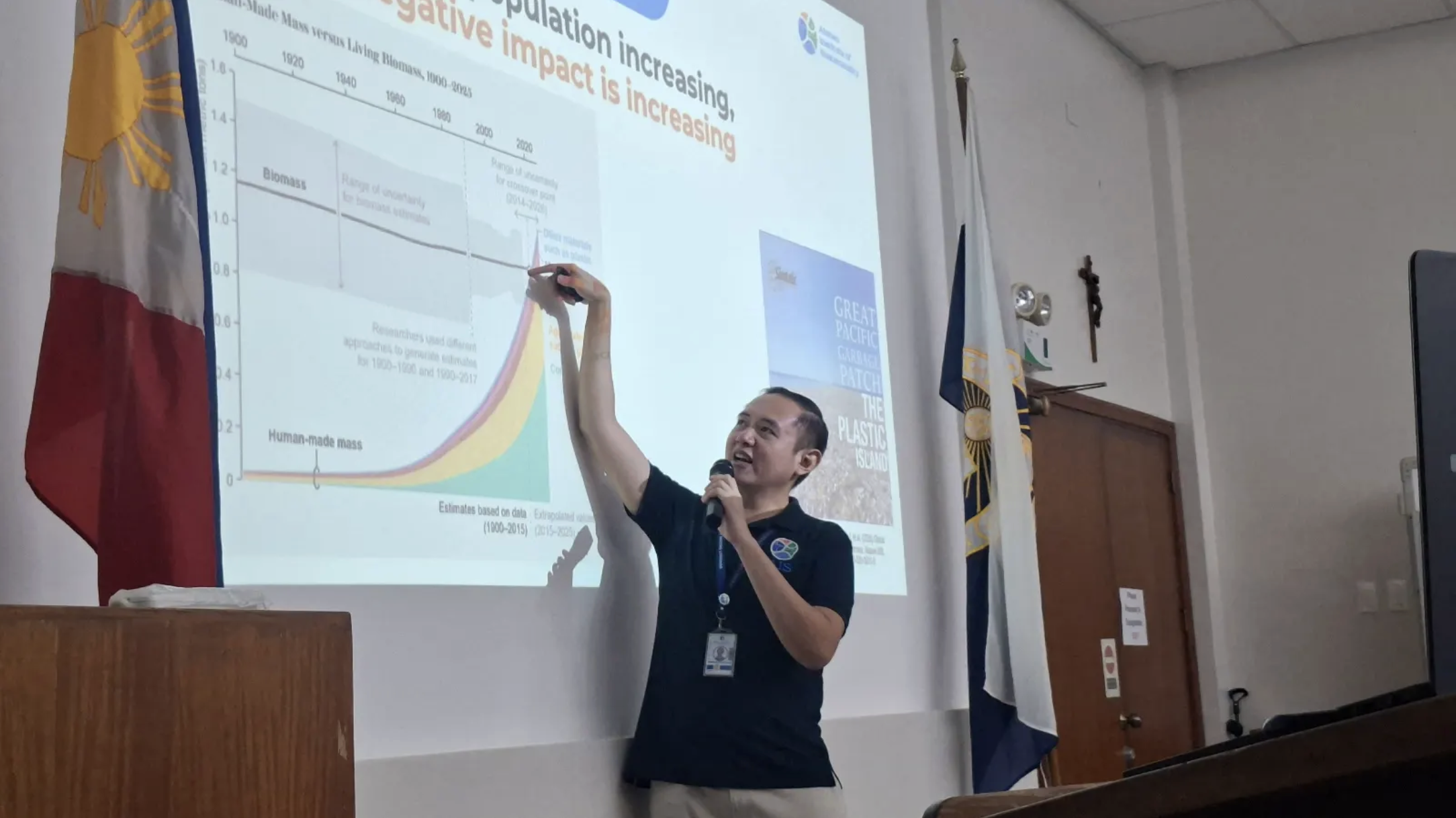
The discussions by Ms Chris A Lacdao-Umali, AIS Program Head for SDGs, Dr Emmanuel D Delocado, AIS Director, and Ms Rizzie Rapada, AIS Program Officer for SDGs, underscored the concept of Integral Ecology, or the understanding that nature affects society as society affects nature. Understanding that sustainability is “everything and everywhere”, the speakers and participants explored the social, economic, and environmental circumstances of salient issues. Through this, the discussion highlighted the multipronged approach of the SDGs, and delivered a public call to pivot towards sustainable action that “meets the needs of the present without compromising the ability of future generations to meet their own needs.”
Beyond introducing the concepts of sustainable development, the sessions also demonstrated how these principles are translated into action within the University. Interactive trivia games were held to raise awareness on the campus’ sustainability and biodiversity features. These aspects were subsequently elaborated upon during the Climate Action Plan (CAP) and Biodiversity Action Plan (BAP) discussions, which provided insights and proposed objectives intended to expand upon these existing efforts in the near future. These were presented by Mr Daniel C. Ratilla, Program Head for Climate and Disaster Resilience, and Mr Theodore J. Cacayan, Program Head for Organizational Sustainability, respectively.

As living documents, both the CAP and the BAP were emphasized as evolving frameworks that will continue to be refined through community consultations, such as the ESD in-service sessions. This carried into an open forum, where faculty members raised questions and shared recommendations on topics including active mobility, campus biodiversity, ecological food systems, waste management, and parent engagement in sustainability education. In response, AIS underscored that building a sustainable university requires institutional policies and collective ownership, with every sector of the community playing a role in shaping and sustaining these initiatives.
From institutional action, the conversations then turned toward classroom practice. Through collaborative workshops and activities facilitated by AIS, faculty members were invited to explore how ESD can be meaningfully integrated into their respective disciplines while remaining grounded in existing learning objectives.
For the AGS and AJHS sessions, participants worked in random groups to ideate academic activities based on sustainability themes such as climate change, resource conservation, and waste management. The activity generated a variety of teaching approaches, ranging from integrating disaster preparedness into Science and English lessons to using music and rhythm to teach proper waste segregation, and connecting climate change with scripture in Christian Life Education. Another activity encouraged the participants to work with their Subject Areas to develop a repository of their existing practices of integrating sustainability and integral ecology in the classroom.
Meanwhile, in ASHS, the activities responded to the school's ongoing curriculum transition for the full implementation of the Strengthened Senior High School Curriculum under DepEd Memorandum No. 012, 2026. Faculty members first reflected on existing practices within their subject areas, identifying ways sustainability had already been woven into their teaching. Building on these reflections, departments then collaborated to identify new opportunities for embedding Education for Sustainable Development more intentionally into the incoming curriculum. Rather than introducing an additional subject, the workshops reinforced sustainability as a guiding perspective that connects disciplines and prepares learners to engage thoughtfully with complex, real-world challenges.

The Education for Sustainable Development in-service sessions reflect the AIS’s continuing commitment to cultivating a culture where sustainability is both understood and lived. Ultimately, these sessions were focused on empowering educators and learners alike to see its relevance in everyday decisions, relationships, and communities. As these conversations continue across Basic Education, AIS hopes that the ideas shared will grow beyond the classroom, inspiring future generations of Ateneans to become thoughtful stewards of both people and the planet.
Recent News
You may also like these articles

Growing with purpose: How Mekeni Food Corporation turns adversity into shared value
From a small backyard operation in Porac, Pampanga, to an internationally recognized food brand exporting to 25 countries, Mekeni Food Corporation's journey demonstrates how businesses

Three Ateneo-incubated startups secure DOST-PCIEERD’s startup grant fund
Last 9 November, during the opening day of Philippine Startup Week 2026, Soolok Properties Inc, Pili AdheSeal Inc, and Saltric Power (PDG Engineering Services), three

Ateneo de Manila Grade 2 students are the little Earth helpers
It was a great day for saving the world when Ateneo Institute of Sustainability (AIS) came to Ateneo Grade School to give a session on

JGSOM representatives complete green finance training in Poland, sets sights on 2027 micro-credential launch
Representatives of Ateneo de Manila University's John Gokongwei School of Management (JGSOM) completed the second phase of their Erasmus+ Green Finance international mobility activities at

Karin Fernandez of AJHS guidance team presents paper on inclusive education in Chengdu
Karin Isabel O Fernandez, School Counsellor Associate of Ateneo de Manila Junior High School (AJHS), presented her research at the International University Social Responsibility Summit

JGSOM Representatives Participate in Green Finance Training at the University of Twente
Enschede, Netherlands | October 15–16, 2026 Representatives of Ateneo de Manila University's John Gokongwei School of Management (JGSOM) participated in a specialized Green Finance training