Ateneo GSB deepens ethical leadership formation for nation-building
29 Jul 2026





Peace, Justice and Strong Institutions
Quality Education
Decent Work and Economic Growth
As business becomes increasingly shaped by artificial intelligence and digital technologies—one thing ought to remain deeply human: leadership. Yet ethical leadership itself is under strain. The 2024 EY Global Integrity Report found that 38% of respondents would be prepared to behave unethically to improve their career progression or financial position—a figure that rises to 51% among senior managers and 67% among board members.
The need for ethical leadership is particularly urgent in the Philippine setting. The country scored 32 out of 100 and ranked 120th among 182 countries in Transparency International’s 2025 Corruption Perceptions Index, indicating persistently high perceptions of public-sector corruption.
Against the country’s wider polycrisis and the unintended consequences that come with it, competence alone is not enough to lead a responsible business. Business leaders need character and purpose, grounded in ethical decision-making, to make decisions that remain humane despite the pressures of their environment.
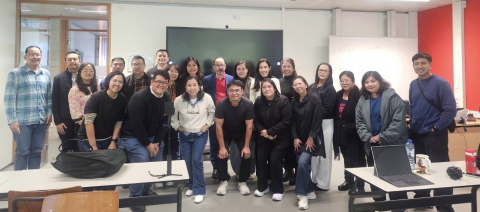
Responding to this urgent need, the Ateneo Graduate School of Business (AGSB) gathered faculty members and students for a Faculty Learning Session on Deepening Ignatian Values in Teaching and Learning on 25 July 2026, at the Bernas Seminar Room of the Ateneo Professional Schools–Rockwell.
The event formed part of a continuing series of initiatives aimed at strengthening the integration of ethical leadership and Ignatian values across the MBA curriculum. It also supported AGSB’s curriculum development and Association to Advance Collegiate Schools of Business (AACSB) accreditation efforts by examining how the school’s mission could be translated into an Ignatian pedagogy that ultimately forms responsible business leaders who create social impact.
AGSB Dean Jowett Magsaysay situated the initiative within the school’s broader responsibility to respond to what organizations and society now require of leaders. Drawing from conversations with advisers from diverse sectors, he observed that their perspectives arrived at a shared priority.
“All of them converge on the same concept, same phrase: responsible business leadership,” Magsaysay said.
If responsible business leadership is the goal, however, the Ignatian Deepening Session underscored that formation must begin with the educators responsible for nurturing and cultivating it.
The event featured a witnessing talk by Jake Allan K. de Guzman, a faculty member of the Department of Leadership, Ethics, and Human Resources Management and author of The Call to Lead. Through reflection, storytelling, and journaling—de Guzman invited participants to examine how their own identity and sense of purpose shape the way they teach.
In a post-session interview, de Guzman cited educator and author Parker J Palmer to explain why teachers must first possess the depth they hope to awaken in their students: “Deep speaks to deep, and when we have not sounded our own depths, we cannot sound the depths of our students’ lives.”
That emphasis on lived witness was reinforced by Dr Marcial Balgos, Chair of the Department of Leadership, Ethics, and Human Resources Management. He cautioned against allowing values integration to become merely a technical or mechanistic response to accreditation requirements.
“The key to not being too mechanistic about it would be for all the faculty, or at least most of the faculty, to live out these values in their lives, so that when they teach these concepts, they don’t remain as concepts,” Balgos said.
Living these values, however, must also be supported by intentional systems that translate them into student formation. Dr Leveric Ng, Chair of the Department of Strategic Management and Marketing, emphasized the need to move from articulation to action—and from the syllabus to the psyche.
“To move strategic Ignatian integration beyond just talking about it, we must pivot from passive articulation to measurable intentionality and actual impact,” Ng said.
“We must intentionally form ethical character — instilling the courage our students need to turn reflection into self-transformation, and self-transformation into tangible social impact,” he added. “Actual impact is realized when our mission moves from the syllabi to our students’ psyche.”
During the interactive workshop, faculty members and students explored how Ignatian values could be incorporated more explicitly into course rubrics and assessment methods across management disciplines. The discussions highlighted the need for continuous exploration of how these values can be deepened across the curriculum, ensuring that students graduate not only with essential MBA competencies, but also with the character and sense of purpose needed to become ethical leaders of responsible businesses.
The session presented ethical leadership not as a single subject or an accreditation requirement, but as a formation goal shared across the MBA curriculum.
This reflects AGSB’s larger vision as an institution: to become a business school for and with others—one that forms leaders who are not only competent, but whose character is anchored in Ignatian values and whose purpose is directed toward serving others.
Framing this vision through the concept of Ikigai, Dean Magsaysay emphasized, “Responsible business leadership is what the world needs; Jesuit education for this changing world is what AGSB does well; Ignatian values that underpin Jesuit education are what we are deeply passionate about.”
Through its continuing efforts to deepen ethical leadership and Ignatian formation, AGSB seeks to move from transformative learning to helping transform the Philippines by forming ethical leaders of responsible businesses.
Facebook link below: https://www.facebook.com/watch/?v=2345386165867147
Recent News
You may also like these articles

Growing with purpose: How Mekeni Food Corporation turns adversity into shared value
From a small backyard operation in Porac, Pampanga, to an internationally recognized food brand exporting to 25 countries, Mekeni Food Corporation's journey demonstrates how businesses

Three Ateneo-incubated startups secure DOST-PCIEERD’s startup grant fund
Last 9 November, during the opening day of Philippine Startup Week 2026, Soolok Properties Inc, Pili AdheSeal Inc, and Saltric Power (PDG Engineering Services), three
JGSOM Representatives Participate in Green Finance Training at the University of Twente
Enschede, Netherlands | October 15–16, 2026 Representatives of Ateneo de Manila University's John Gokongwei School of Management (JGSOM) participated in a specialized Green Finance training

JGSOM advances development of EU co-funded micro-credential in green finance
EnschRepresentatives of the John Gokongwei School of Management (JGSOM) of Ateneo de Manila University participated in the Erasmus+ Green Finance Transnational Project Meeting held at

Filipino representation for global leadership: Ateneo de Manila at the 28th International Leadership Association Global Conference
Ateneo de Manila represented the Philippines at the International Leadership Association (ILA) Global Conference. Held in Toronto, Canada from 28 to 31 October 2026, the

Alumnus James Rellera brings Ateneo startup to Silicon Valley through global Jesuit partnership
A graduate of Ateneo de Manila University's BS Information Technology Entrepreneurship (BS ITE) program is taking his startup to Silicon Valley through a new international