Radical Hope and Climate Action: MCR-Ateneo opens 2026 Climate Research series
16 Jun 2026 | Louise Anne Estanislao & Matteo Suzara







The My Climate Risk – Ateneo de Manila University (MCR-Ateneo) Regional Hub opened their second webinar series for 2026, “Climate Research ‘As If People Mattered’”. The first session was held last 22 May 2026 with the title "Forging Possibilities from Crisis: Radical Hope through Grassroots Action in the Philippines", and featured Dr Justin See, Lecturer at the University of Melbourne. Dr See specializes in climate change adaptation and mitigation, community engagement, and international development. This session was notably held during Laudato Si’ Week, an annual observance to mark the publication of Laudato Si’: On Care for our Common Home, Pope Francis’ encyclical on environmental stewardship.
To open the session, Dr Emma Porio of the Department of Sociology and Anthropology shared her experiences with communities from Itbayat, Batanes and the Dumagat-Remontados from Tanay, Rizal. These communities’ ways of life face multiple challenges, and she emphasized the need for dialogues to foster inclusivity and to empower sustainable practices in the margins. Her discussion ended with a reminder to pursue climate research with CARE (Collaboration, Accountability, Responsiveness, and Empowerment) for actionable science that serves both humanity and the environment, a play on the common refrain from the MCR network.

Dr See opened his talk by challenging the notion that frontline communities are merely victims of climate change. Instead, he emphasized that they actively shape their own futures. Drawing from the work of JK Gibson-Graham, he described research as a generative practice that contributes to the worlds people collectively build. Central to his discussion was the idea of “radical hope.” Neither blind optimism nor cynical resignation, he anchored radical hope as beginning with dissatisfaction toward injustice and environmental harm while remaining committed to collective action. Dr See described this orientation as a form of “hopeful pessimism” that recognizes the limits of existing systems yet refuses to surrender the possibility of change.
He illustrated these forms of hope through four case studies from the Philippines. The Save Kabatok advocacy campaign in Tacloban, which opposed a proposed causeway project that threatened local ecosystems and livelihoods, demonstrated how hope can take shape through collective struggle. In San Jose, Tacloban, residents challenged distant relocation plans and asserted the importance of preserving the social and economic ties that sustained their communities. Meanwhile, the Fun-Life Project, also in Tacloban, focused on the psychosocial and recreational needs of young people, demonstrating how care itself can become a form of recovery and resilience. Finally, in UP Diliman, Dr See highlighted the “Other Futures” workshop where students and designers used speculative storytelling to imagine housing and everyday life in a future marked by extreme weather. Together, these cases showed how communities practice radical hope by defending, repairing, and reimagining their worlds.
The Open Forum provided a richer discussion on maladaptive practices and also touched on experimenting with the global climate. In responding to questions on the difference between understanding climate adaptation in the Global North versus the Global South, Dr See illustrated how certain projects tend to be designed in the former but are tested in the latter. Similarly, maladaptive practices include countries from the latter adapting the practices of the former. He thus emphasized that context matters most especially in climate adaptation as different regions have different conditions.
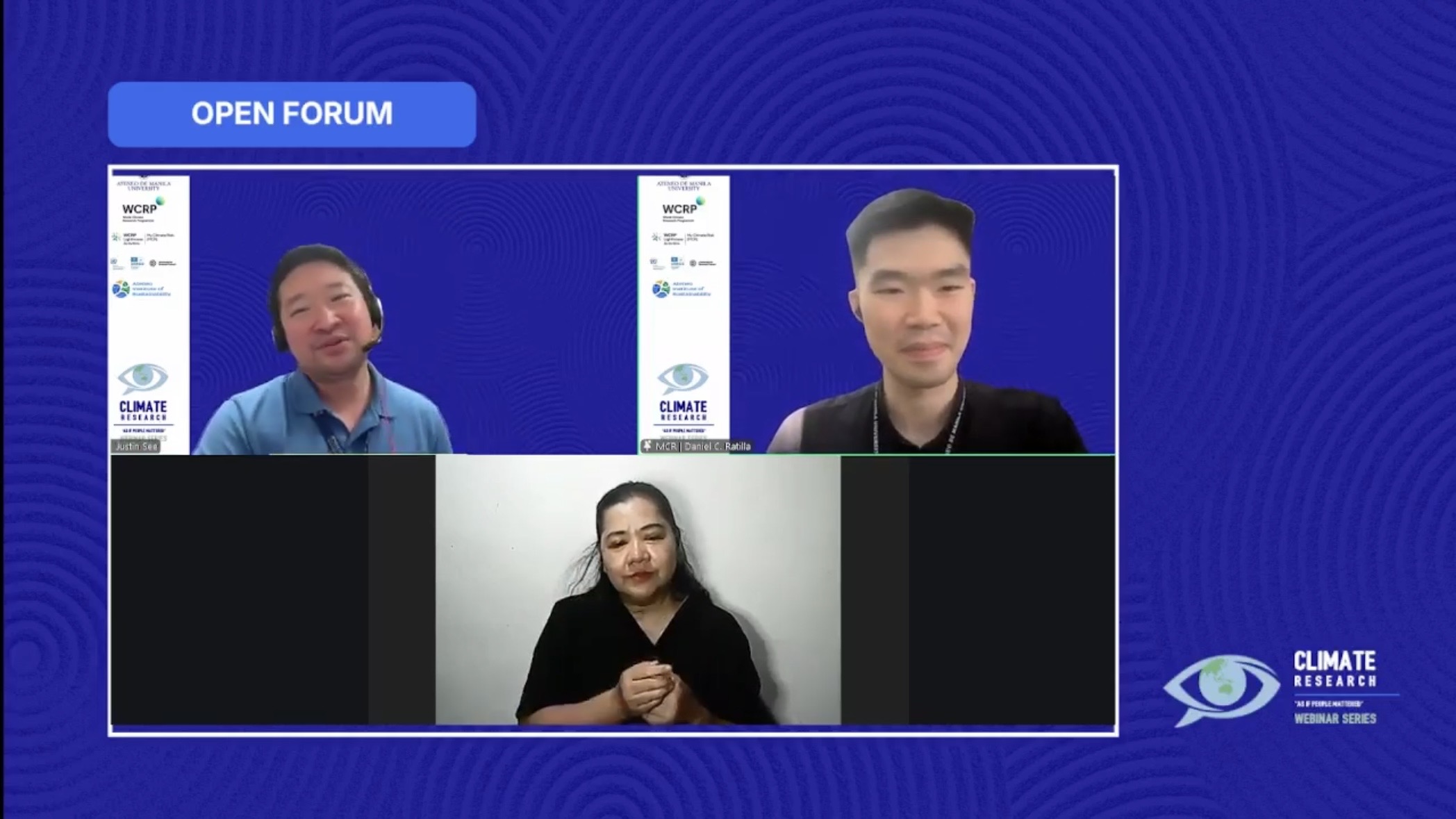
To end the program, Dr Inez Ponce de Leon synthesized the webinar by echoing the importance of listening to communities on their own terms. Solutions cannot simply be copied and applied everywhere. Instead, climate responses must be grounded in the realities, experiences, and stories of the people most affected, recognizing that no single template can address every challenge.
The session was attended by participants from the Philippines, Australia, Kenya, and Qatar, among others. This webinar is part of the 2026 iteration of the “Climate Research ‘As If People Mattered’” webinar series, and was its inaugural session. The series occurred from May to June 2026. Information on other similar events by MCR-Ateneo can be accessed here.
Recent News
You may also like these articles

Growing with purpose: How Mekeni Food Corporation turns adversity into shared value
From a small backyard operation in Porac, Pampanga, to an internationally recognized food brand exporting to 25 countries, Mekeni Food Corporation's journey demonstrates how businesses

Three Ateneo-incubated startups secure DOST-PCIEERD’s startup grant fund
Last 9 November, during the opening day of Philippine Startup Week 2026, Soolok Properties Inc, Pili AdheSeal Inc, and Saltric Power (PDG Engineering Services), three

Ateneo de Manila Grade 2 students are the little Earth helpers
It was a great day for saving the world when Ateneo Institute of Sustainability (AIS) came to Ateneo Grade School to give a session on

JGSOM representatives complete green finance training in Poland, sets sights on 2027 micro-credential launch
Representatives of Ateneo de Manila University's John Gokongwei School of Management (JGSOM) completed the second phase of their Erasmus+ Green Finance international mobility activities at

Karin Fernandez of AJHS guidance team presents paper on inclusive education in Chengdu
Karin Isabel O Fernandez, School Counsellor Associate of Ateneo de Manila Junior High School (AJHS), presented her research at the International University Social Responsibility Summit

JGSOM Representatives Participate in Green Finance Training at the University of Twente
Enschede, Netherlands | October 15–16, 2026 Representatives of Ateneo de Manila University's John Gokongwei School of Management (JGSOM) participated in a specialized Green Finance training