Bottom-up approaches for climate attribution centered in second MCR-Ateneo Climate Research webinar
16 Jun 2026 | Almia Tumaneng & Rhys Romano









The My Climate Risk – Ateneo de Manila University (MCR-Ateneo), hosted by the Ateneo Institute of Sustainability (AIS), organized the second session of the 2026 iteration of the “Climate Research ‘As If People Mattered’" webinar series. The session was titled “Integrating Bottom-Up Approaches into Climate Attribution: Evidence from Amazonia and the Pantanal” with speaker Dr Maria Barbosa, Wildfire Scientist at the UK Centre for Ecology and Hydrology. Held on World Environment Day, the session served as a meaningful space to reflect on the state of our common home. Mr Daniel C Ratilla, Program Head for Climate Disaster and Resilience of the Ateneo Institute of Sustainability and Focal Point of MCR-Ateneo Hub, served as the moderator of the session.
Dr Ma Laurice Jamero, Resilience Coordinator of the Klima Laboratory and Collaborator of the MCR-Ateneo, delivered the opening remarks. She emphasized the importance of indigenous and local knowledge in the study of climate change, and raised the topic to not only be considered as a technical issue but also a matter of equity and justice.
Dr Barbosa opened the discussion by contextualizing the negative consequences brought by the 2024 fire season in the Amazonia and Pantanal, two of Brazil’s biomes and among the most environmentally critical on the planet. She explained how this led to forest loss, poor air quality, food shortages, water pollution, negative health impacts, and disproportional impacts on Indigenous and traditional communities in the Amazonia and Pantanal.
In discussing attribution analysis, or investigating the footprint of climate change on a particular event, Dr Barbosa introduced the ConFLAME Model which simulated the interactions between different variables to predict the monthly burned area of the locations. To gain deeper insight, she further contextualized the methodology by introducing community knowledge as a source of valuable information in tracking the evolution of the fire season over the years in the Amazonia and Pantanal, and as a means to validate the model’s approach. Integrating community knowledge involved workshops for three main stakeholder groups in the discussion: volunteer firefighters, indigenous communities in Amazonia, and a multistakeholder group composed of indigenous leaders, fire brigade members, researchers, civil society organizations, and policymakers. Dr Barbosa shared that the workshops involved each of the three stakeholder groups to allow for continuous communication between researchers and stakeholders, and to provide space for these stakeholders to provide iterative feedback.
In congruence with the validation of the model and variables by the multistakeholder workshops, Dr Barbosa defined the approach for the final model as interactions between a series of explanatory variables specific to Amazonia and Pantanal. This final model showed that the 2024 burned area was two times larger in Amazonia and 3.5 times larger in Pantanal due to anthropogenic climate change, with 1.5 times higher likelihood in Amazonia and seven times higher likelihood in Pantanal.
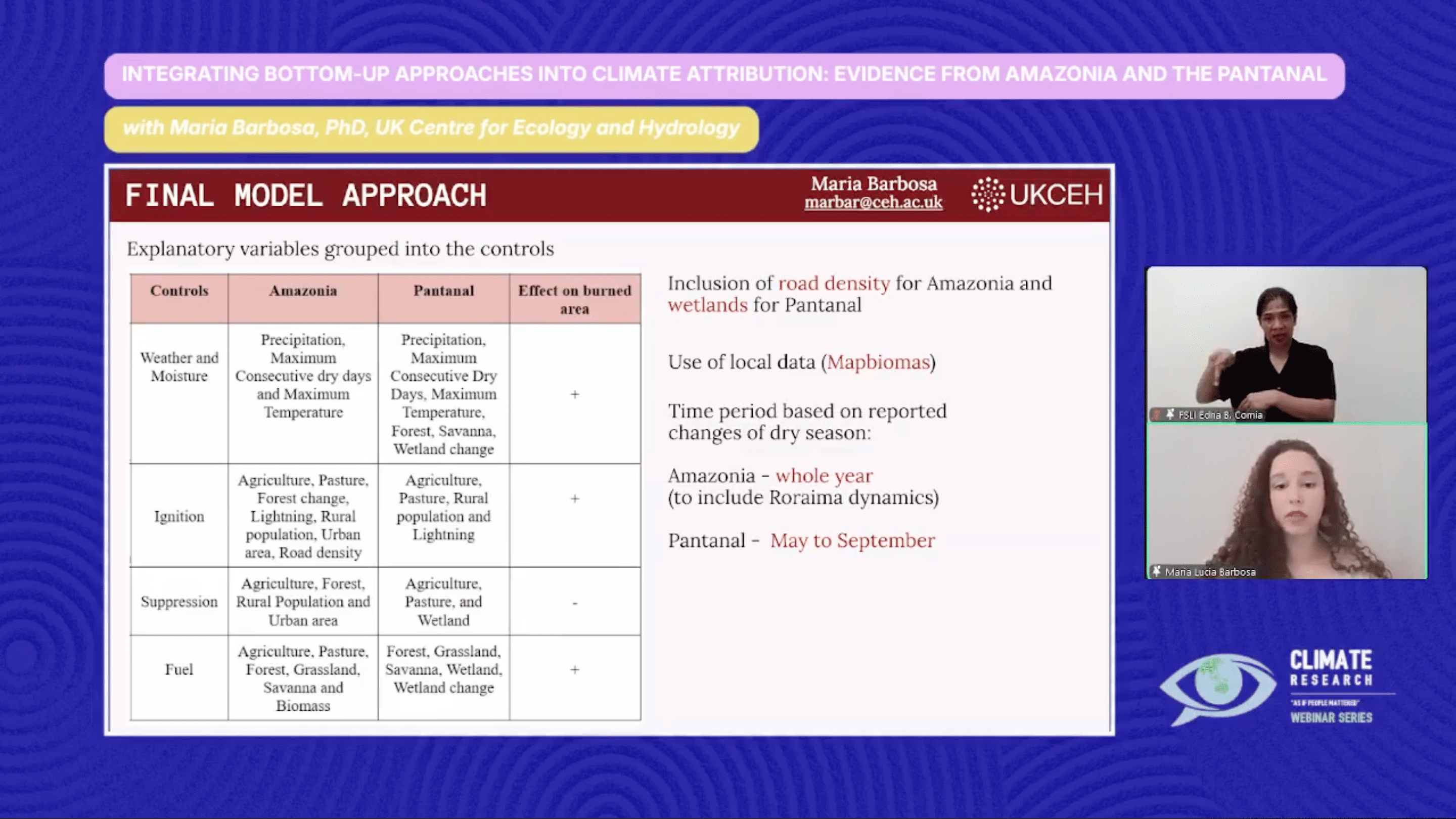
To conclude, Dr Barbosa reiterated the inadequacy of the impacts that scientists are making in this field, with issues in research visibility. She emphasized that discussions of research results and findings often lack traction, thus the impacts of scientists’ research fall short in achieving concrete results. She also reinforces the importance of conducting research with the communities rather than simply for the communities, where researchers should find value in learning from the communities to better contextualize research findings, as well as seeing them as having agency in their own right.
Following the plenary, the Open Forum allowed Dr Barbosa to share her perspective on local wildfire support and research funding, and the perceived saliency of wildfires. She underscored the need to professionalize firefighting in the biomes, given the voluntary nature of the brigades, and prevention and management for vegetated areas, and stressed the importance of simplifying bureaucratic financial processes to increase the accessibility of funding directly to local communities. Most notably, she stated her belief that wildfires will soon be recognized within the mainstream loss and damage framework, but that the scientific community also still needs to further develop research on wildfires and related climate events while making the results more accessible to local communities.
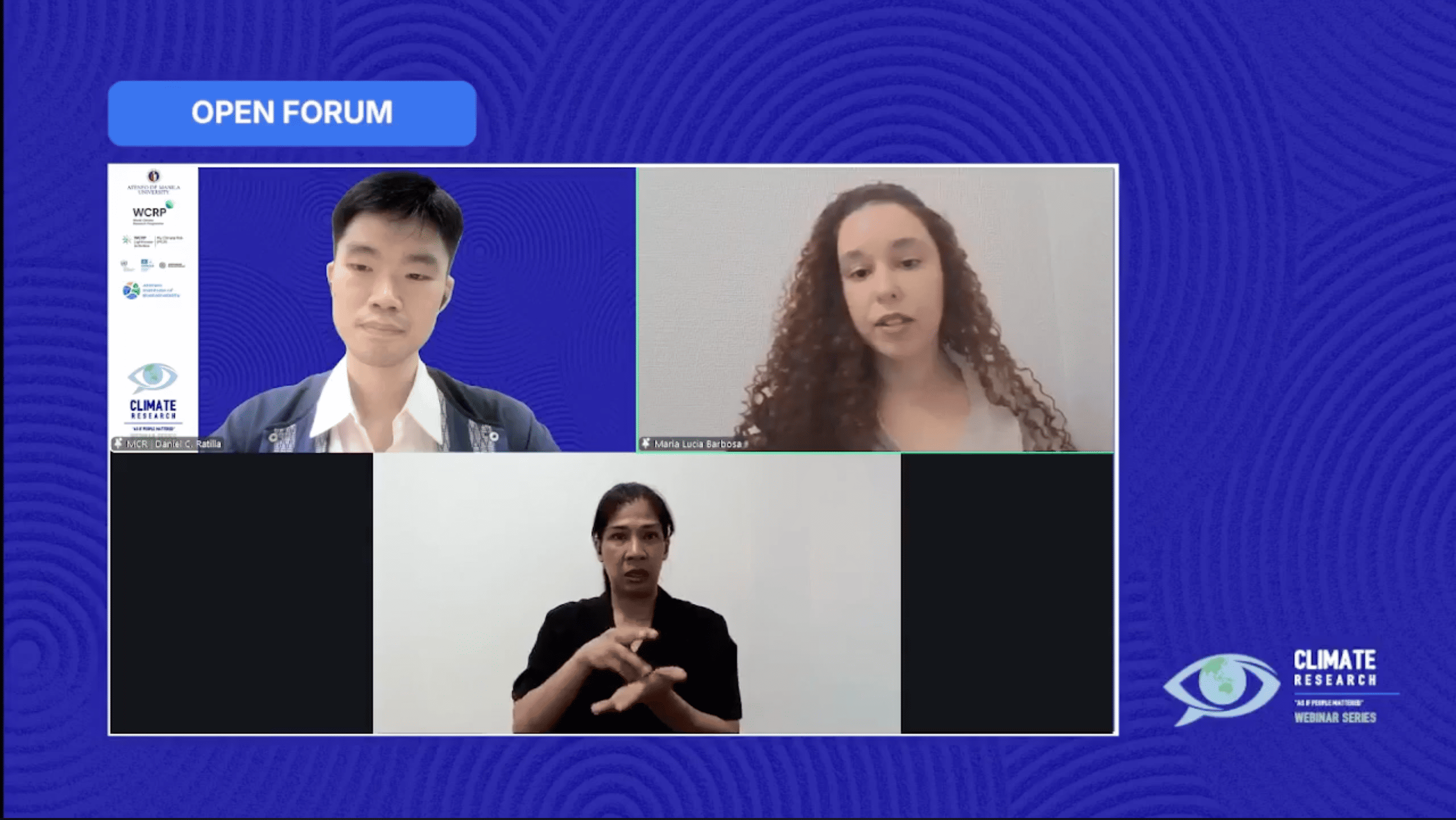
To close the session, Mr Reginald Rex Barrer, Lecturer at the Ateneo School of Government, synthesized the seminar by highlighting the value of indigenous knowledge in bottom-up approaches to combat climate change while reflectively noting a different perspective on fire as a tool of care and early onset technology rather than as an element of destruction.
The session was attended by participants from the Philippines, Burkina Faso, Qatar, and the United Kingdom, among others. This webinar is part of the 2026 iteration of the “Climate Research ‘As If People Mattered’” webinar series, and was its second session. The series occurred from May to June 2026. Information on other similar events by MCR-Ateneo can be accessed here.
Recent News
You may also like these articles

Growing with purpose: How Mekeni Food Corporation turns adversity into shared value
From a small backyard operation in Porac, Pampanga, to an internationally recognized food brand exporting to 25 countries, Mekeni Food Corporation's journey demonstrates how businesses

Three Ateneo-incubated startups secure DOST-PCIEERD’s startup grant fund
Last 9 November, during the opening day of Philippine Startup Week 2026, Soolok Properties Inc, Pili AdheSeal Inc, and Saltric Power (PDG Engineering Services), three
Ateneo de Manila Grade 2 students are the little Earth helpers
It was a great day for saving the world when Ateneo Institute of Sustainability (AIS) came to Ateneo Grade School to give a session on
JGSOM representatives complete green finance training in Poland, sets sights on 2027 micro-credential launch
Representatives of Ateneo de Manila University's John Gokongwei School of Management (JGSOM) completed the second phase of their Erasmus+ Green Finance international mobility activities at

Karin Fernandez of AJHS guidance team presents paper on inclusive education in Chengdu
Karin Isabel O Fernandez, School Counsellor Associate of Ateneo de Manila Junior High School (AJHS), presented her research at the International University Social Responsibility Summit
JGSOM Representatives Participate in Green Finance Training at the University of Twente
Enschede, Netherlands | October 15–16, 2026 Representatives of Ateneo de Manila University's John Gokongwei School of Management (JGSOM) participated in a specialized Green Finance training