Hot days make for icy weather, study finds
30 Aug 2025



The Philippines, like other tropical countries, is known more for its balmy climate than for hailstorms. But a new Philippine study — the first of its kind — has found that the country’s hottest days are, in fact, more likely to produce hail.
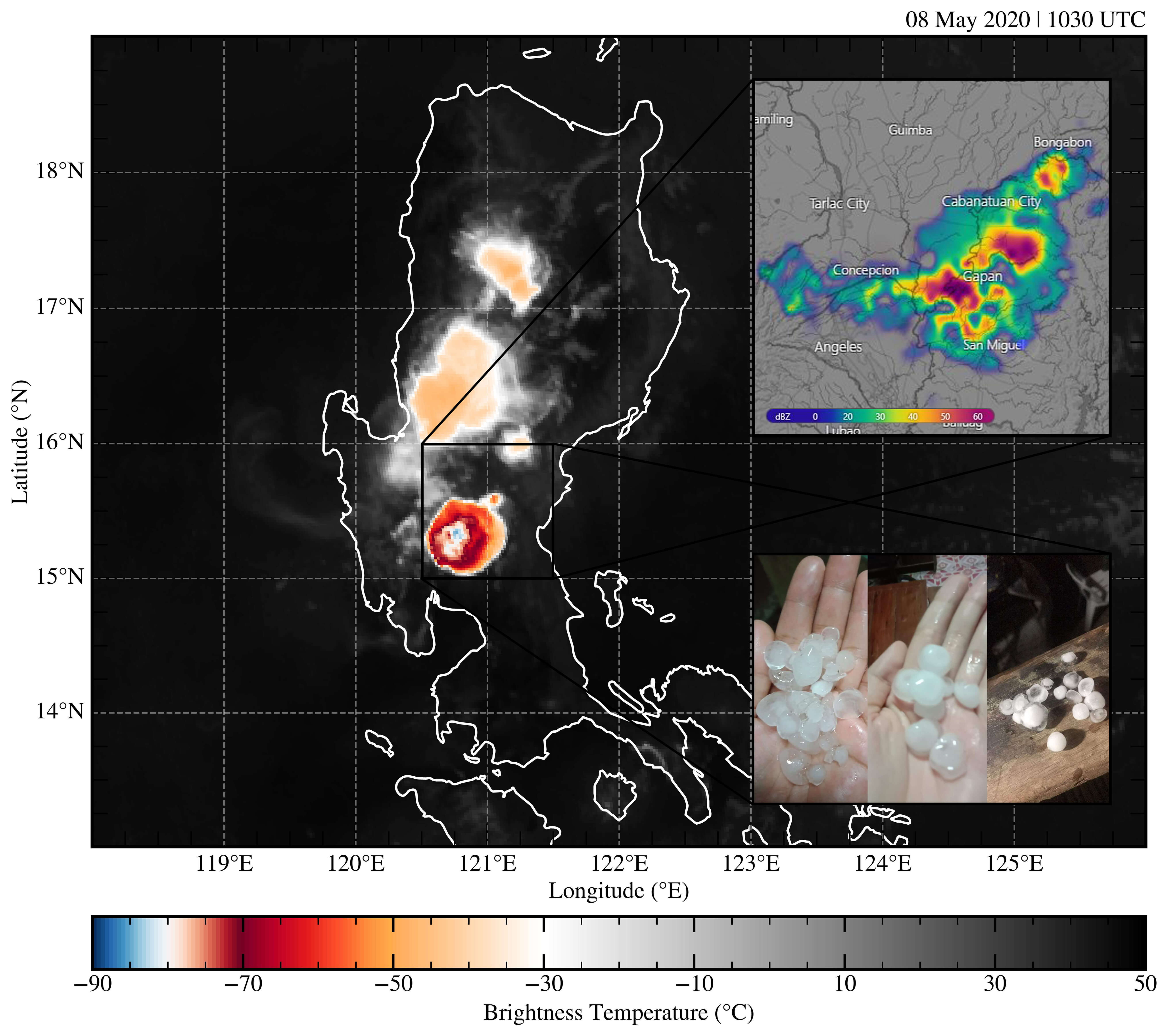
Hailstorms are so uncommon in the Philippines that, even in an age of pervasive social media updates, they are still met with amazement and astonishment.
“Most people are surprised when hail happens because it is relatively rare in the Philippines,” said Dr Lyndon Mark P Olaguera, senior author of the study. “Many take photos or videos and share them online. Some are scared since it’s unusual, while others just treat it as a strange kind of rain. People usually explain it as part of strong thunderstorms, and some interpret hail as a warning or sign of climate change.”
The largest hailstones ever recorded in the country fell in Cabiao, Nueva Ecija, on 8 May 2020. These ice balls reportedly reached up to 5 centimeters in diameter, larger than golf balls. High surface temperatures on that day provided the ideal conditions for temperature-driven air movements or convection. Using satellite and radar data along with high-resolution weather modeling, the researchers confirmed the presence of strong updrafts and favorable conditions for hailstorms at the time.
Ice born from hot air
The counterintuitive connection between heat near the ground and ice falling from the sky is partly explained by a meteorological factor known as Convective Available Potential Energy (CAPE), a measure of how much energy is available to fuel rising air. High CAPE values indicate conditions favorable for convective activity, wherein hot air near the Earth’s surface rapidly rises and carries moisture into towering thunderclouds. Within these clouds, powerful updrafts can carry water droplets high enough into much colder layers of the atmosphere, where they freeze and eventually grow into hailstones.
Also, the presence of dry air in the mid-troposphere can actually increase the likelihood of hailstones surviving to reach the ground. Dry air enhances evaporative cooling, which strengthens downdrafts and accelerates the descent of hail. Because the hailstones spend less time passing through warmer air on their way down, they are less likely to melt completely before hitting the ground.
Groundbreaking study of tropical ice
Covering nearly two decades' worth of data, from 2006 to 2024, the Philippine study is the first-ever comprehensive analysis of hail occurrences in the country. The researchers found that hail events were most frequent during the dry-season months of March, April, and May — precisely the period when surface temperatures peak and the atmosphere is primed for thunderstorms. Most hailstorms were found to have occurred during the mid-to-late afternoon, the hottest part of the day.
Interestingly, while Luzon recorded the most hail events overall, relatively larger hailstones were observed more in the Visayas and Mindanao. The study attributes this to the weaker influence of the Southwest Monsoon in those regions, which allows localized convective storms to persist later into the year.
Invaluable importance of citizen science
For their study, the researchers relied on a wide range of sources — not just instrument data, but also local government records, news media, and geotagged social media posts. This multi-source, crowd-informed approach proved especially valuable given the country’s sparse ground-based hail detection capabilities. This shows the invaluability of citizen science and public reporting in monitoring hailstorms and other severe weather hazards.
As climate change increases the likelihood of extreme weather, empowering the public to participate in data gathering may prove essential for the development of early warning systems in the Philippines. Looking ahead, the researchers stress the need to expand the country’s weather monitoring and forecasting capabilities. They recommend that local disaster preparedness focus not only on typhoons and floods, but also on less familiar hazards which can catch communities off guard — such as tornadoes and waterspouts, as well as hailstorms.
The study Spatiotemporal Analysis of Hail Events in the Philippines was authored by Marco Polo A Ibañez, John A Manalo, and Generich H Capuli of DOST-PAGASA; and Dr Lyndon Mark P Olaguera of the Ateneo de Manila University and the Manila Observatory.
SOURCE:
https://archium.ateneo.edu/physics-faculty-pubs/192/
For interview requests and other inquiries, please email media.research@ateneo.edu. Visit archium.ateneo.edu for more information about our latest research and innovations.
Recent News
You may also like these articles

Updating of Medical Records Second Semester SY 2026-2027
14 November 2026 TO: Undergraduate and Graduate Students FROM: Higher Education Office of Health Services-College SUBJECT: Updating of Medical Records Second Semester SY 2026-2027 Please

Promotion of Faculty in the Senior High School (Memo U2627-050)
(Memo # U2627-050) I am pleased to announce that upon the recommendation of the Senior High School Committee on Faculty Rank and Permanent Appointment and the endorsement of the Vice President for Basic Education, I am approving the promotion of the following faculty members in the Senior High School:

Demise of Mr Silvestre P Villarin(Memo U2627-049)
(Memo U2627-049) We extend our condolences to Fr Jose Ramon “Jett” T Villarin SJ and his family on the passing of his father, Mr Silvestre Villarin, on 18 November 2026 at the age of 96. Fr Villarin is the former University President, a faculty member of the Department of Physics, and the Executive Director of the Manila Observatory.

Growing with purpose: How Mekeni Food Corporation turns adversity into shared value
From a small backyard operation in Porac, Pampanga, to an internationally recognized food brand exporting to 25 countries, Mekeni Food Corporation's journey demonstrates how businesses

[AGS] National Book Week
Open a Book, Stories Unfold, Wonders Flow Let us come together as one AGS community to celebrate the 92nd National Book Week with the theme

Three Ateneo-incubated startups secure DOST-PCIEERD’s startup grant fund
Last 9 November, during the opening day of Philippine Startup Week 2026, Soolok Properties Inc, Pili AdheSeal Inc, and Saltric Power (PDG Engineering Services), three