APC and EROPA convene experts from Southeast Asia to discuss strategy on transitioning from “Zero-COVID-19 to Living with COVID-19”
02 Feb 2022



On January 19, 2022, the Ateneo School of Government through the Ateneo Policy Center (ASOG-APC) and the Eastern Regional Organization for Public Administration (EROPA) conducted a policy roundtable discussion titled “Recalibrating Inclusive Health and Economic Recovery in Southeast Asia: From Zero-COVID-19 to Living with COVID-19” via Zoom and Facebook Live.
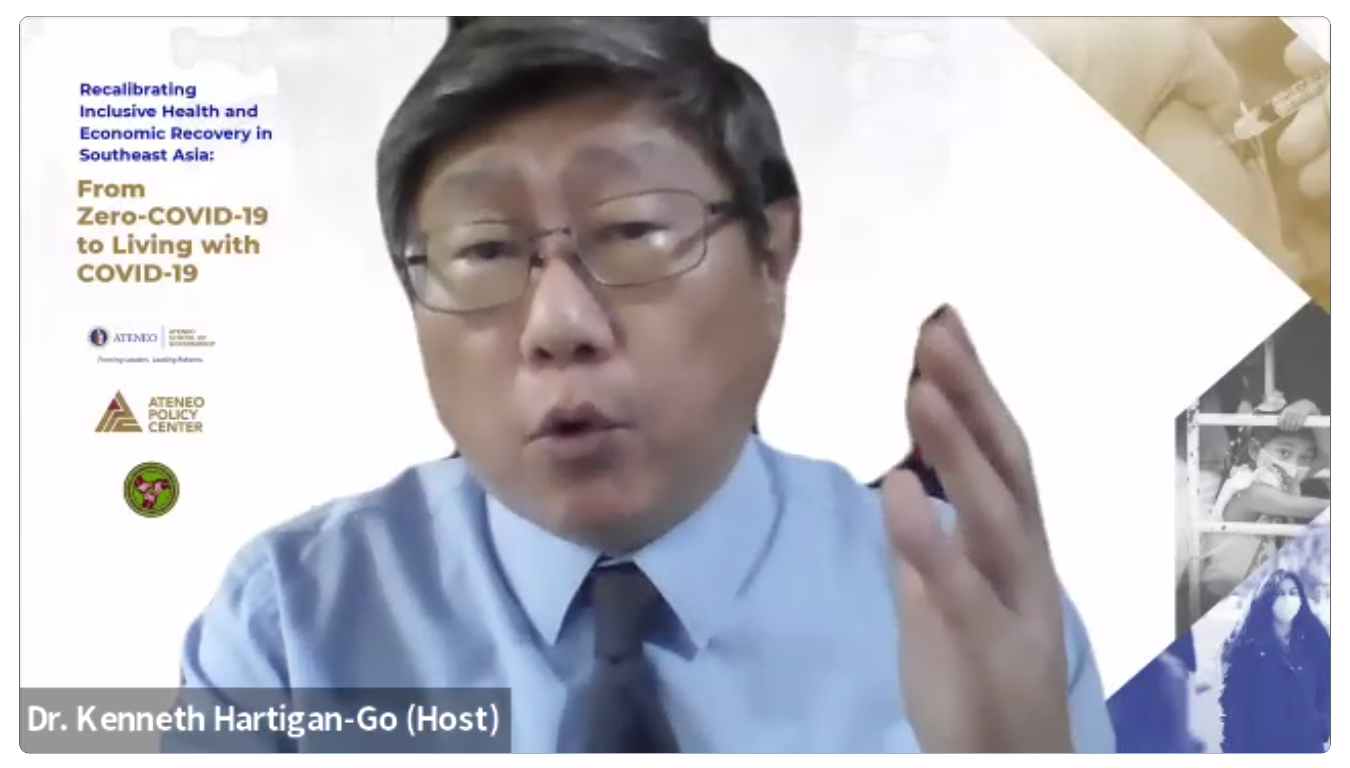
The policy roundtable discussion featured emerging lessons from Asia focusing on economies that have, more or less, flattened the COVID-19 curve, kept morbidity and mortality rates very low, and on the spectrum where countries have continued struggling with its containment. Dr. Kenneth Hartigan-Go, APC Senior Fellow, opened the webinar by prompting the key questions “how do we manage social policy coherence?” and “how can we build back better?”
Dr. Manuel M. Dayrit, Professor of the School of Medicine and Public Health of the Ateneo de Manila University (AdMU) and Former Secretary of the Philippine Department of Health (DOH), began by providing a retrospective on the COVID-19 situation in the Philippines. The severe acute respiratory syndrome (SARS) in 2003, he stressed, was contained even if it was less transmissible since DOH has alerted the hospitals, local health agencies, and foreign posts through constant communication. However, the country was unintendedly not prepared for the COVID-19 pandemic, clarifying that “the main bureaucracy that [was] supposed to lead [the people] defaulted” which consequently relied upon the mitigation strategy of imposing lockdowns. He stressed that “the public, in general, were not really empowered to be able to take matters in their hands and really protect themselves”.
Prof. Dr. Eko Prasojo, Professor of the Faculty of Administrative Sciences of Universitas Indonesia and Former Vice Minister for Administrative Reform, sequenced the policy discussion by underscoring that the Government of India was in denial over the coronavirus in early 2020. Despite implementing key policies and strategies such as social assistance fund, community movement limitations, testing capacity increase, and vaccination program acceleration, as their cases rose, there existed weak authority in local policy-making, unclear division of administrative authority, and unclear budget allocation. Observing these major challenges, Dr. Prasojo then calibrated three determinant variables for a facilitative health leadership: (1) intergovernmental relations and state capacity; (2) regulatory framework; and (3) citizen awareness. He added that multi-level governance can elevate the country in having an integrated health policy.
Given that Singapore is one of the countries being noted to bring down COVID-19 cases very rapidly, Dr. Kai Hong Phua, Adjunct Senior Research Fellow of the Institute of Policy Studies of the Lee Kuan Yew School of Public Policy, underlined that the country initially focused on local residents notwithstanding that 30 to 40 percent of the populace comes from foreign residents and workers. While Singapore was extending its health policy to the latter, Dr. Phua pointed out that the strategy that worked best in Singapore is “test, isolate, and vaccinate”. With the numbers infected now in control, and a high rate of vaccination including boosters, the policy is changed towards endemicity and that of living with Covid-19. The lessons from the Singapore case is to first have an expert advisory committee to provide the latest evidence to a Ministerial Task Force of the Ministry of Health with the relevant ministries. Government must communicate frequently across all sectors of society. A systematic ‘circuit breaker’ approach to calibrate the spread of disease with the control measures, was enforced effectively, to reach a balance of “Lives versus Livelihoods” in the trade-off between health issues and the economy.
Provided that Taiwan has a lower stringency index, Dr. Chien-jen Chen, Academician of Academia Sinica and Former Vice President, shed light on their lessons from the 2003 SARS outbreak by reforming their epidemic prevention system. In containing COVID-19, he accentuated leadership and building public trust and accountability as key elements for global solidarity and international collaboration to prevent future pandemics. He shared that having both low stringency index and COVID-19 mortality were the results of Taiwan’s no city lockdown, no mass testing, e-quarantine system, rapid announcement of travel warning through cell broadcast, telesurveillance of pandemic status, electronic fencing system, and care and support services for the people.
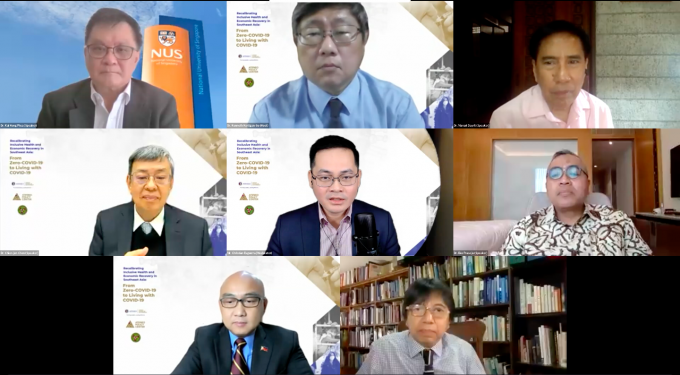
Mr. Christian Esguerra, News Anchor of ABS-CBN News Channel (ANC), opened the moderated discussion to accommodate questions from the attendees. Vital to the discussion were: Dr. Dayrit who stressed that “public trust eroded” when “the Philippines was not making sense of the numbers” as “there was no narrative that was collectively understood by the country”; Dr. Prasojo who observed that “uneducated villagers in Indonesia will only listen to informal leaders” thus announcements “should not be too formal” for the people to understand; Dr. Phua who urged that “there should be a public health-centralized response” for a “cost-effective and health-sustainable system” and a much clearer public health education, and; Dr. Chen who advocated for people empowerment, inter-ministerial coordination, and risk communication.
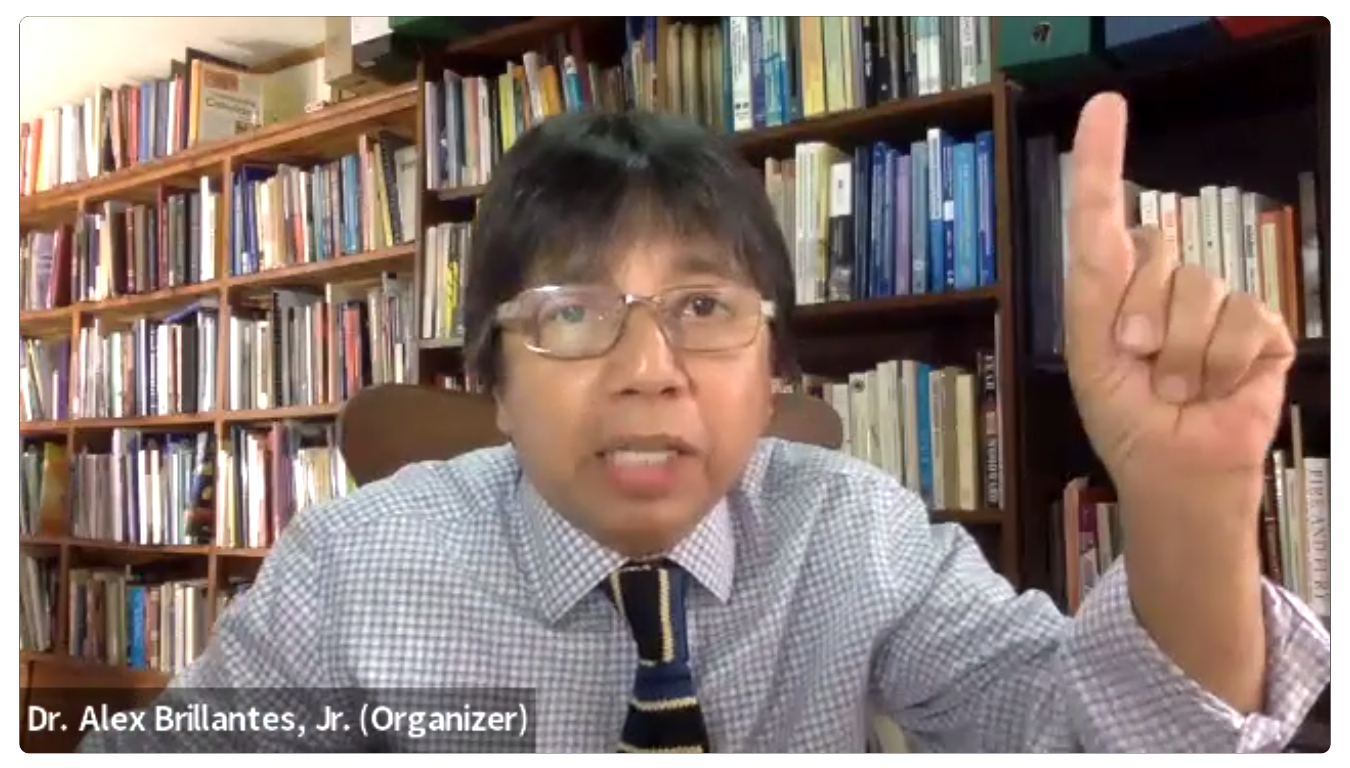
Synthesizing the policy roundtable discussion, Dr. Alex Brillantes, Secretary-General of EROPA, elaborated seven key indicators for a much more responsive and coordinated public health emergency response. These are the importance of: (1) context; (2) coordination; (3) institutional leadership; (4) continuous citizen engagement; (5) communication; (6) capacity-building, and; (7) globalization. He concluded the webinar by reiterating the call for global cooperation: no one is safe unless everybody is safe. Learning from each other, just like through this webinar, is instrumental to transitioning to Living with COVID-19 and building back better.
More than 400 participants across Southeast Asia attended the event.
The recording of the webinar can be accessed through this link
Recent News
You may also like these articles
Ateneo Policy Center presents study on local health spending at DBM Fiscal Policy Conference 2026
On 19 October 2026, the Ateneo School of Government, through its research and policy unit, the Ateneo Policy Center (APC), presented findings from a study
Turning health resources into services: ASOG conducts executive education course on health financing and public financial management
The Ateneo School of Government (ASOG) conducted Understanding Local Health Financing and Public Financial Management for Universal Health Care Implementation, a two-day executive education course
ASOG and VMLP Quezon Chapter Strengthen Legislative Leadership Through PILLAR Program Module on Session Management
The Ateneo School of Government (ASOG) through its Executive Education Center, in partnership with the Vice Mayors’ League of the Philippines (VMLP) – Quezon Provincial

ASOG Memo No. 2627-34 - Commencement Speaker 2026
Memo #2627-34 11 November 2026 TO : The Ateneo de Manila Community in Higher Education FROM : [Sgd.] JENNIFER S. ORETA, PhD Dean, Ateneo School

ASMPH staff undergo DOLE Mandatory 8-Hour Safety and Health Training
Administrators and staff of the Ateneo School of Medicine and Public Health (ASMPH) participated in the Department of Labor and Employment (DOLE) Mandatory Eight-hour Safety
ASOG holds course on communication for development: Policy and advocacy communications for public sector leaders
The Ateneo School of Government (ASOG), through its Executive Education Center, conducted a training course on Communication for Development: Policy and Advocacy Communications for Public