Homily: A Home of the Heart
04 Aug 2026


This homily was delivered by University Church Rector, Fr Norberto Ma. L Bautista SJ on the Solemnity of the Dedication Anniversary of the Church of the Gesù and the official launching of the 25th Anniversary Series of the Gesù (31 July 2026).
We are here today to celebrate two beautiful memories: the Feast of our dear Father Saint Ignatius of Loyola, and the silver jubilee year of the Dedication of the University Church of the Gesù next year in 2027. Actually, this year 2026 is also the 25th anniversary of the cornerstone laying of this church; we will also celebrate the 25th year of the building of the Immaculate Conception Chapel in 2029; and the 25th anniversary of the Carillon Bells in 2030. We start today a five-year series of anniversaries of the Gesù.
This is the first time that we are celebrating a community Ignatian Mass on this day, 31 July, at the Church of the Gesù in recent memory. We intend to have community Masses here in the coming years [forever] to celebrate the actual feast day of our dear Founder and Father, Saint Ignatius of Loyola.
The dedication of a church is a formal liturgical rite that sets aside a newly built building [exclusively] for worship, prayer, and sacred ceremonies. In other words, a dedication solemnly converts a secular physical structure into a holy place. Dedication rites typically feature several major symbolism-heavy rituals such as entry into the church, sprinkling of holy water, anointing of the altar and walls, incensation, lighting of the candles, first Eucharist, and Holy Communion.
This tradition stems from the consecration of the Tabernacle in the wilderness and the grandiose dedication of King Solomon's First Temple in Jerusalem (1 Kings 8), marked by prayer, sacrifices, and communal celebration.
In the 4th century, after Christianity was legalized in the Roman Empire under Constantine, Christians began dedicating new basilicas with solemn multi-day festivals, sermons, and processions.
We remember St Ignatius having a devotion to churches, chapels, and shrines. In March 1522, after recovering from a shattered leg at his home in Loyola, Ignatius set off on a pilgrimage. He stopped at this mountain shrine dedicated to the Blessed Virgin Mary to make a vow of chastity - the Sanctuary of Our Lady of Arantzazu in Oñati, Spain. This was his first major act of devotion on his post-conversion journey. He prayed here for spiritual strength to overcome his past worldly temptations before embarking toward Montserrat.
In the same month, Ignatius made a full general Confession of his past sins to a Benedictine monk. He then spent the entire night of 24 March 1522 in an all-night vigil before the altar of the Black Madonna. Following the rites of chivalry, he hung up his sword and dagger at the altar and surrendered his fine clothes to a beggar, donning a rough sackcloth robe and sandals instead. This night marked his symbolic transformation from a worldly knight to a "soldier for Christ." This happened at the Abbey of Santa Maria de Montserrat in Catalonia, Spain.
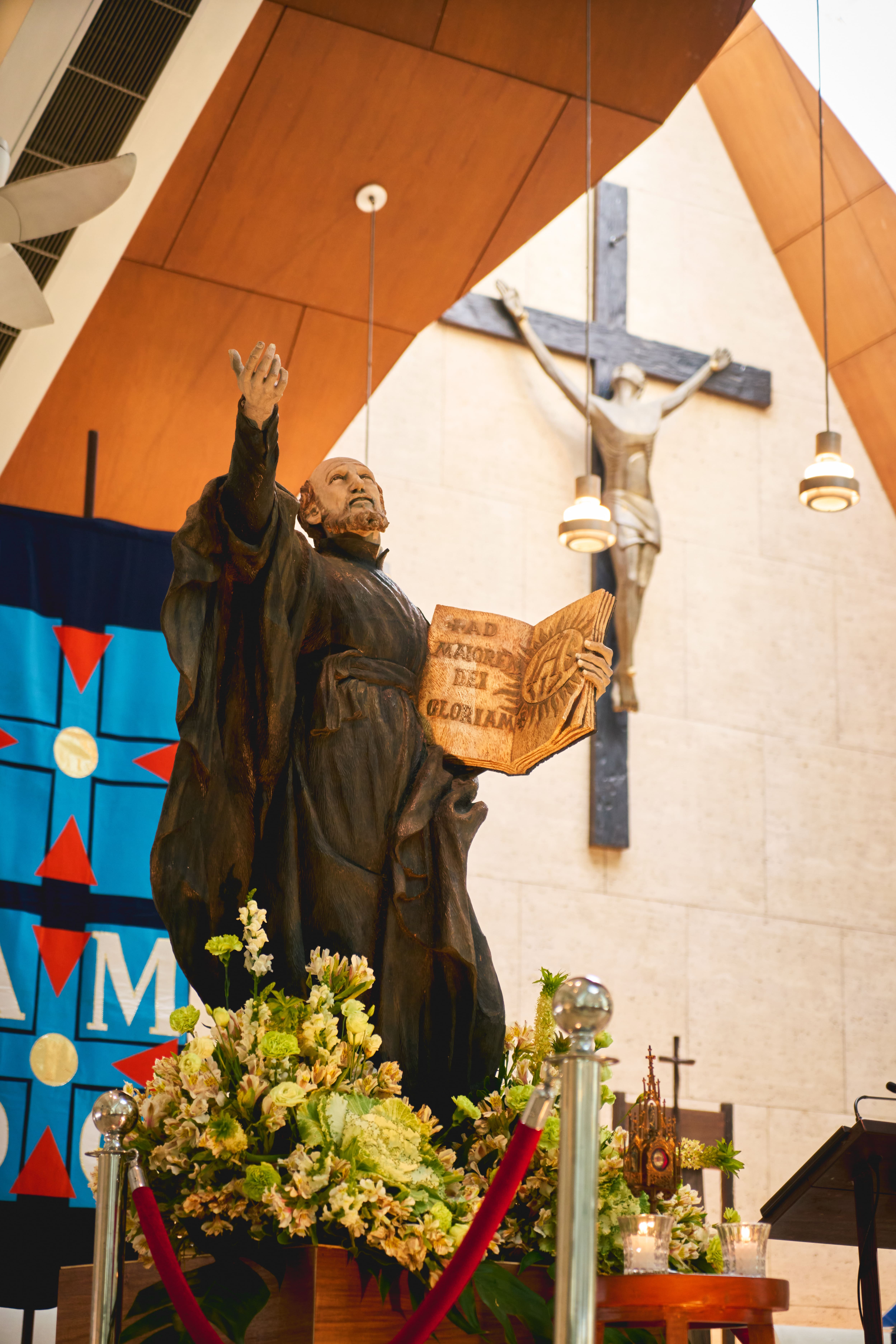
The statue of St Ignatius of Loyola, featuring a relic of a fragment of his pilgrim's shoes, on display for the feast day celebration at the Church of the Gesù. Photo by Whenzy Quijano.
In the years 1522-1523, while living as an ascetic in a cave near the Cardoner River, Ignatius spent hours each day praying at a prominent Gothic church, the Basilica of Santa Maria de la Seu in Manresa, Spain. It was in a Manresa cave where Ignatius suffered deep spiritual turmoil - desolation and consolation. His intense mystical experiences here and his reflections while praying at the Basilica and the nearby Cardoner River - led him to write his Spiritual Exercises.
In September 1523, Ignatius traveled on a grueling, barefoot pilgrimage to the Holy Land with the intent to live there permanently, where Jesus prayed and died. He visited the Church of the Holy Sepulchre to pray and kiss the sacred sites of Christ's crucifixion and burial.
On 15 August 1534, the Feast of the Assumption of Mary, while studying Theology at the University of Paris, Ignatius gathered his companions, including Francis Xavier and Peter Fabre, in a small subterranean chapel on the hill of Montmartre, Paris, France - the Chapel of St Denis. Here, these men took the solemn vows of poverty, chastity, and a promise to go to Jerusalem or place themselves at the disposal of the Pope. This moment is historically recognized as the foundational birth of the Society of Jesus [the Jesuits].
In November 1537, Ignatius and his companions walked to Rome to offer their services to Pope Paul III. He stopped to pray at the wayside chapel in La Storta near Rome, Italy. There he had a profound mystical vision where he saw God the Father place him next to Christ carrying His Cross, and heard God say, "I will be favorable to you in Rome." This vision confirmed that their group should be named the "Company of Jesus."
On Christmas Eve 1538, Ignatius chose the chapel of the Nativity [which houses relics of Christ's manger] inside the Basilica of Santa Maria Maggiore [Rome, Italy] to celebrate his very first Mass as an ordained priest after delaying his first Mass for one year, hoping to celebrate it in Bethlehem.
On 22 April 1541, after Pope Paul III officially approved the Society of Jesus in 1540, Ignatius and his companions gathered before a 13th-century icon of the Blessed Virgin Mary inside the ancient Basilica of Saint Paul outside the Walls [Rome, Italy]. Here the group made their final, solemn perpetual vows as Jesuits, which included a unique 4th vow of direct obedience to the Pope regarding missions. Here also, Ignatius was officially declared the first Superior General of the Order.
It might also be good for us at this time to know a bit of the history of the Church of the Gesù.
It was Fr William F Masterson SJ in 1949 who dreamt of a chapel on Sacred Heart Hill, the highest point of this campus, the Loyola Heights campus - a chapel that was to be the ICON of everything the Ateneo de Manila stands for.
In 1954, a five-year fundraising campaign was launched to raise one million pesos to build the University Church in time for the Centennial celebration of the Ateneo in 1959. Yet the plan was aborted until 1999 (after 50 years), when the plan was pursued again. The goal was to have the Church built by the year 2000 at the turn of the Millennium.
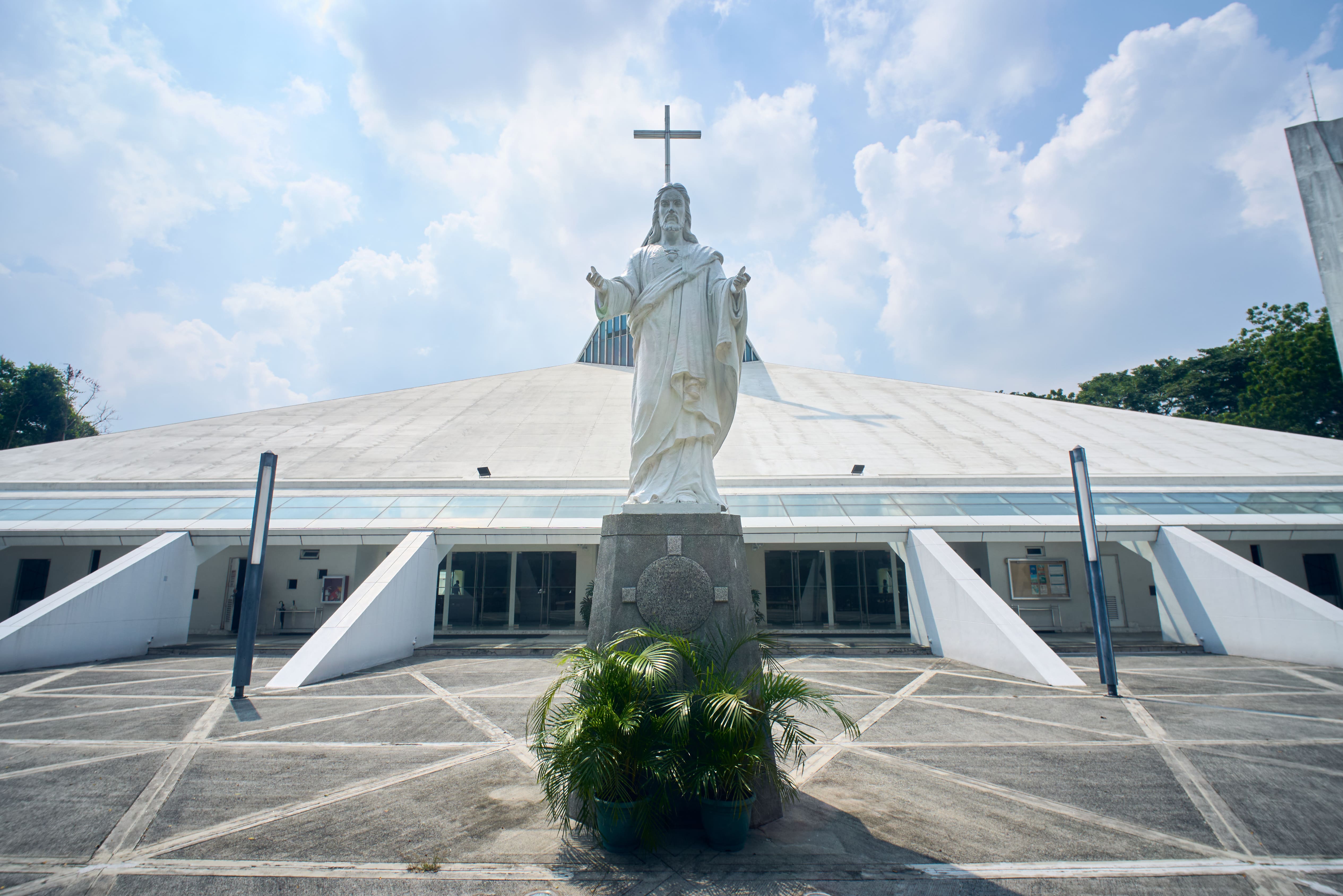
The façade of the Ateneo de Manila Church of the Gesù. Photo by Whenzy Quijano.
Construction began in 2001 at the Sacred Heart Hill with the blessing and the laying of the cornerstone led by Bishop Teodoro Bacani, then auxiliary bishop of the Archdiocese of Manila. At the cornerstone-laying, then University President Fr Ben Nebres SJ buried a time capsule containing the church's construction documents alongside some artifacts symbolizing the Ateneo's identity as a Filipino, Catholic, and Jesuit University.
This Church stands on a 1.2 hectare land and symbolizes the center point of the Grade School, High School, and Higher Education, The Gesù was designed by Ateneo alumnus Architect Jose Pedro Recio and Carmelo T Casas of UST with the design carrying several symbolic images, namely: the Holy Trinity (the Catholic identity of the Ateneo), the Outstretched Arms of the Sacred Heart of Jesus (a special devotion of the Jesuits); and the shape of the Bahay Kubo (the Filipino identity of our school).
The Dedication Liturgy of the Church of the Gesù was held on the feast day of St Ignatius in 2002. The altar and the church walls were dedicated, blessed, and anointed.
In 2005, on the third anniversary of the dedication of the Gesù, another important milestone took place: the Blessing of the 18-Bell Carillon and the Angelus Bell housed in the 25-meter triangular belfry outside the church.
The theme of the 25th Anniversary Celebration Series is:
O HESUS, AMING TANGLAW,
AMING TAHANAN, AMING TIWASAY.
Each word represents a dimension of the Gesù church:
- Tanglaw: where Faith illuminates the path;
- Tahanan: where every Atenean belongs;
- Tiwasay: where hearts find Peace and Wholeness.
These words express belonging, guidance, and inner peace which align well with the vision of a cherished house of worship as the "Home of the Heart."
As we celebrate today the Dedication of the Church of the Gesu, anticipating its 25th year of Dedication next year, we utter this beautiful prayer:
Heavenly Father, Almighty God,
today with hearts full of gratitude and praise,
we stand in awe of Your goodness.
You have guided our hands, provided for our needs,
and brought us to this joyful day.
We gather here to present this house to You - built by hands,
but established for Your glory.
We consecrate and dedicate
this Church of the Gesú to Your holy service.
May this be a sanctuary of peace
for those who are weary, heavy-laden, and seeking rest;
a beacon of truth where Your Word is preached
with power, integrity, and love;
a home of unity where families are strengthened,
broken hearts are healed, and strangers become family;
a launchpad for love that reaches beyond these four walls
to serve, feed, comfort, and restore our community.
Lord, let Your divine presence fill every corner of this building.
Protect everyone who steps through these doors,
and let Your Spirit move freely
in every song sung, every prayer uttered,
and every life transformed.
May this church stand for generations of Ateneans
and their loved ones as a testament to Your faithfulness
and a light in the darkness.
We surrender this space, our work,
and our lives into Your hands.
We ask this through Your Son and our Lord, Jesus Christ,
with the help of our Mother Mary,
St Ignatius, and all the saints in heaven.
Amen.
Recent News
You may also like these articles

Updating of Medical Records Second Semester SY 2026-2027
14 November 2026 TO: Undergraduate and Graduate Students FROM: Higher Education Office of Health Services-College SUBJECT: Updating of Medical Records Second Semester SY 2026-2027 Please

Promotion of Faculty in the Senior High School (Memo U2627-050)
(Memo # U2627-050) I am pleased to announce that upon the recommendation of the Senior High School Committee on Faculty Rank and Permanent Appointment and the endorsement of the Vice President for Basic Education, I am approving the promotion of the following faculty members in the Senior High School:

Demise of Mr Silvestre P Villarin(Memo U2627-049)
(Memo U2627-049) We extend our condolences to Fr Jose Ramon “Jett” T Villarin SJ and his family on the passing of his father, Mr Silvestre Villarin, on 18 November 2026 at the age of 96. Fr Villarin is the former University President, a faculty member of the Department of Physics, and the Executive Director of the Manila Observatory.

[AGS] National Book Week
Open a Book, Stories Unfold, Wonders Flow Let us come together as one AGS community to celebrate the 92nd National Book Week with the theme

Three Ateneo-incubated startups secure DOST-PCIEERD’s startup grant fund
Last 9 November, during the opening day of Philippine Startup Week 2026, Soolok Properties Inc, Pili AdheSeal Inc, and Saltric Power (PDG Engineering Services), three

The courage to commit: PReVEx 2026 brings the question of vocation into the classroom
Young people are often told to keep their options open, yet some of life’s most meaningful choices require the opposite: the courage to commit. What