Revised University Scholarly Publication Awards: Policies and Guidelines (2026)
16 Jun 2026 | Office of the Assistant Vice President for Research, Creative Work, and Innovation

The Office of the Assistant Vice President for Research, Creative Work, and Innovation has released the Revised University Scholarly Publication Awards: Policies and Guidelines, which take effect for scholarly works published beginning in 2026.
The University Scholarly Publication Awards recognize peer-reviewed scholarly work produced by eligible members of the Ateneo de Manila University community. The awards are intended to encourage regular publication, strengthen the quality of Ateneo research output, and support the University’s role as a thought leader across disciplines. Eligibility covers full-time and part-time faculty members, administrators, professionals, research staff, qualified affiliates, adjunct professors, holders of other professorships, and students, provided that the publication properly indicates “Ateneo de Manila University” as the author’s affiliation.
The guidelines classify eligible publications under three award categories: Category A includes peer-reviewed research articles, books, and book chapters indexed in Scopus, Web of Science, or the Norwegian List; Category B includes selected peer-reviewed scholarly books, Scopus-indexed conference proceedings, research notes, review essays, commentaries, and editorial work meeting the stated criteria; Category C covers peer-reviewed works published in other recognized journals, book chapters, special issues, or anthologies approved by the relevant School. Works that are not peer reviewed, not properly affiliated with Ateneo, still in press without a DOI, or published in predatory journals are excluded.
Nominations must be lodged online, with authors providing the required publication information and declarations on affiliation, peer review, and indexing status. Authors must also consent to the deposit of an appropriate version of the work in Archīum, the University’s institutional repository, to widen access to Ateneo scholarly output.
The full PDF may be downloaded through the link below.
You may also like these articles
Updating of Medical Records Second Semester SY 2026-2027
14 November 2026 TO: Undergraduate and Graduate Students FROM: Higher Education Office of Health Services-College SUBJECT: Updating of Medical Records Second Semester SY 2026-2027 Please

Promotion of Faculty in the Senior High School (Memo U2627-050)
(Memo # U2627-050) I am pleased to announce that upon the recommendation of the Senior High School Committee on Faculty Rank and Permanent Appointment and the endorsement of the Vice President for Basic Education, I am approving the promotion of the following faculty members in the Senior High School:

Demise of Mr Silvestre P Villarin(Memo U2627-049)
(Memo U2627-049) We extend our condolences to Fr Jose Ramon “Jett” T Villarin SJ and his family on the passing of his father, Mr Silvestre Villarin, on 18 November 2026 at the age of 96. Fr Villarin is the former University President, a faculty member of the Department of Physics, and the Executive Director of the Manila Observatory.

[AGS] National Book Week
Open a Book, Stories Unfold, Wonders Flow Let us come together as one AGS community to celebrate the 92nd National Book Week with the theme

Three Ateneo-incubated startups secure DOST-PCIEERD’s startup grant fund
Last 9 November, during the opening day of Philippine Startup Week 2026, Soolok Properties Inc, Pili AdheSeal Inc, and Saltric Power (PDG Engineering Services), three
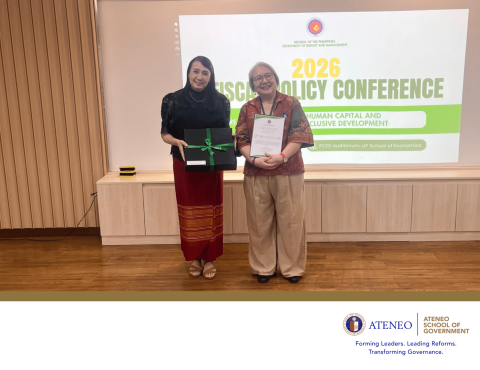
Ateneo Policy Center presents study on local health spending at DBM Fiscal Policy Conference 2026
On 19 October 2026, the Ateneo School of Government, through its research and policy unit, the Ateneo Policy Center (APC), presented findings from a study